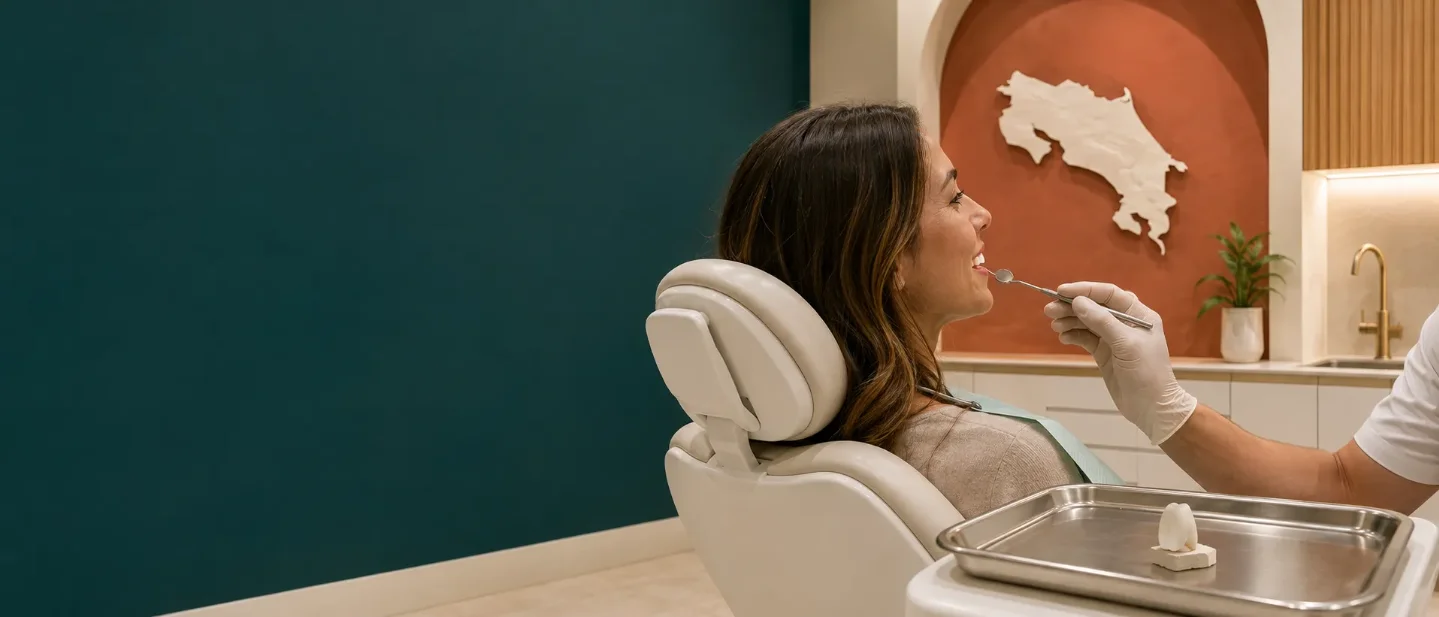
Costa Rica: $400–$720 Porcelain Veneers vs. $900–$2,500 at Home
Costa Rica’s published porcelain-veneer prices can undercut U.S. benchmarks, but the saving depends on matching materials and tooth count, verifying the dentist and facility, and funding insurance and U.S. follow-up.

Costa Rica’s published porcelain-veneer benchmark is $400–$720 per tooth, compared with $900–$2,500 in the United States. Matching the endpoints produces a wide 20%–84% price difference before flights, lodging, diagnostics, temporaries, and follow-up. The Medical Tourism Packages guide was updated April 22, 2026, and its figures are commercial planning benchmarks rather than a binding quote from a clinic.
Porcelain veneers also involve a clinical decision before they become a travel bargain. The same guide describes removing about 0.3–0.5 mm of front-surface enamel for porcelain veneers. Get an independent dental evaluation before you pay a deposit, then ask the Costa Rican clinic to price the same treatment in writing.
The price screen
The table keeps the source’s ranges visible. The savings percentages are arithmetic across the ends of those ranges, so they show a comparison envelope rather than one promised result.
| Service benchmark | U.S. price | Costa Rica price | Approx. saving before travel | Scope and source |
|---|---|---|---|---|
| Porcelain E-Max veneer, per tooth | $900–$2,500 | $400–$720 | 20%–84% | Published price table; confirm whether diagnostics, prep, temporary veneers, lab work, bonding, and aftercare are included. |
| Composite-resin veneer, per tooth | $250–$1,500 | $200–$400 | −60%–87% | Published price table; the destination high end can exceed the U.S. low end. |
| Zirconia veneer, per tooth | $1,500–$3,000 | $400–$500 | 67%–87% | Published price table; confirm material, laboratory, shade, warranty, and replacement terms. |
| Eight porcelain veneers | $7,200–$20,000 | $3,200–$5,760 | 20%–84% | The source’s eight-tooth example; this is treatment only, before travel and home follow-up. |
| Up to 20 veneers or crowns, “Hollywood Smile” makeover | $16,000–$50,000 | $5,000–$7,000 | 56%–90% | Package benchmark; veneers and crowns are different services, so match the tooth count and material before comparing. |
The table’s wide ranges matter. A $720 Costa Rica porcelain veneer beats a $900 U.S. price by only 20% before travel. A $400 destination veneer compared with a $2,500 U.S. price produces an 84% difference. The clinic’s written scope decides where your case sits.
What the quote must say
A price per tooth leaves too much room for two clinics to quote different treatments. Ask for these items in one document:
- Number of teeth and the exact material: E-Max porcelain, composite resin, zirconia, or another product.
- Examination, photographs, X-rays, 3D scans, smile design, and any required gum treatment.
- Enamel preparation, anesthesia, temporary veneers, impressions or digital scans, laboratory fees, try-in, bonding, and final adjustments.
- Whether the quote includes a night guard. The Costa Rica veneer guide lists a night guard as an added cost and says warranty coverage excludes travel costs.
- The clinic’s warranty period, what voids it, and who pays if a veneer chips, debonds, or needs correction after you return home.
- The number of visits, the planned days in Costa Rica, and the fee for an additional visit.
The source describes a core treatment of about six days and four clinic visits, with a 10–14 day stay recommended. Its example itinerary puts consultation and diagnostics on day one, preparation and temporaries on day two, laboratory fabrication on days three and four, final placement on day five, and a check on day six. Treat that schedule as a planning example: your tooth preparation, bite, gum health, lab workflow, and any crown work can change it. The source’s itinerary and treatment details should be checked against the clinic’s written plan.
Verify the dentist and facility
Costa Rica’s physician directory is for medical doctors, so it is the wrong registry for a dentist. Use a dental-specific check instead:
- Request the dentist’s legal name and Costa Rican college code. Ask for a current Certificación de Miembro Activo from the Colegio de Cirujanos Dentistas de Costa Rica, the country’s dental professional college. The college’s FAQ says the certificate is requested by email and that the member must be current on obligations to the college. Ask the dentist to provide the certificate or authorize confirmation directly with the college.
- Confirm the claimed specialty. If the treatment plan names a prosthodontist, implant specialist, or another specialist, ask for the training institution, specialty credential, and the exact role that person will perform. A membership certificate supports current standing; it does not assess your treatment plan or guarantee an outcome.
- Identify the actual treatment site. Get the legal facility name, full address, and the room or hospital where the work will occur. If the clinic claims Joint Commission International accreditation, search the exact organization and city in JCI’s directory. The Medical Tourism Packages’ August 2026 Latin America report says Costa Rica has two JCI-accredited facilities and names Hospital CIMA and Clínica Bíblica; a country-level count still does not prove that a particular dental room or provider is covered by the claim.
- Ask who is accountable. Put the dentist’s name on the treatment plan and ask who examines you, approves tooth preparation, supervises the laboratory, bonds the veneers, handles an urgent problem, and answers after you return to the United States.
A directory entry or accreditation is a screening step. It does not replace an independent examination, a second opinion, or a written plan for correcting a poor fit.
Risks, insurance, and the return home
Veneers can require permanent enamel preparation. Ask the examining dentist what preparation your teeth need, what happens if the final fit or bite is wrong, and which problems require an in-person adjustment after you return.
The CDC’s medical-tourism guidance warns that care abroad can involve infection, antimicrobial-resistant organisms, lower or different credentialing and facility standards, counterfeit or lower-quality products, communication problems, and expensive follow-up in the United States. Before treatment, ask how the clinic sterilizes instruments, which laboratory makes the veneers, how the clinic handles an infection or failed bond, and how it will send your records to a U.S. dentist.
The CDC recommends obtaining copies of medical records and test results before returning home, arranging follow-up care before travel, and discussing the trip with a healthcare or travel-medicine clinician four to six weeks before departure. CDC medical-tourism preparation guidance also advises carrying medication lists, allergies, prescriptions, and relevant records in original or translated form.
Insurance needs its own written check. Many U.S. dental plans classify veneers as cosmetic and exclude them; the Costa Rica pricing guide says the same and notes that corrective work at home can cost $1,000 or more per tooth. That source’s coverage and warranty notes are clinic-market guidance, so read your own plan rather than treating them as a policy rule. Ask your dental and health insurers whether they cover emergency treatment or corrective work after planned care abroad. Ask a travel-health insurer whether elective dental treatment and its complications are excluded.
The CDC travel-insurance guidance, last reviewed May 27, 2026, distinguishes travel health insurance, trip-cancellation insurance, and medical-evacuation coverage. A trip-cancellation policy is not a substitute for overseas medical coverage. Check exclusions, whether the insurer pays a hospital directly, whether pre-existing conditions are excluded, and whether a 24-hour physician support line is available. Costa Rica is relatively accessible from the United States, but a policy can still exclude treatment complications because the treatment was planned abroad.
Review the CDC Costa Rica traveler page again before departure. The current page flags a Level 2 chikungunya notice for northwest Costa Rica dated July 30, 2026, recommends routine vaccines and hepatitis A for unvaccinated travelers, and advises mosquito and food-and-water precautions. Those notices can change. Ask the dentist when you may fly after your specific procedure; CDC’s 10–14-day air-travel warning is framed around major surgery, so a clinic should give you procedure-specific advice rather than a generic number.
The U.S. State Department Costa Rica page was behind a verification shell during this issue’s research. Confirm current passport, entry, safety, and local emergency guidance there before buying a nonrefundable ticket.
Planning checklist
Before paying a deposit
- Get an independent dental evaluation and a second opinion if the plan includes extensive enamel preparation or a full-mouth makeover.
- Request an itemized quote for the same tooth count, material, preparation, laboratory work, bonding, temporaries, night guard, adjustments, and warranty.
- Obtain the dentist’s legal name, college code, specialty claim, and current CCDCR active-member certificate.
- Obtain the exact treatment-site name and address; check any JCI claim in the official directory.
- Ask a U.S. dentist whether the proposed treatment can be followed up at home and what records that dentist will need.
- Get written insurance answers about planned veneers, complications, correction, and evacuation. Add flights, lodging, meals, local transport, and a home-care reserve to the total.
Before departure
- Confirm the clinic’s visit schedule, minimum stay, final flight date, and cancellation terms.
- Carry medication and allergy lists, recent X-rays or scans, and the clinic’s English-language contact details.
- Review the current CDC Costa Rica page and State Department country page.
- Arrange accommodation and transport that make the consultation, lab visits, final placement, and check-up feasible.
At the clinic and after returning
- Confirm that the named dentist, material, tooth count, preparation plan, and treatment site match the quote before preparation begins.
- Leave with photographs, scans or X-rays, the final material and laboratory record, bonding instructions, prescriptions, warranty terms, and payment records.
- Send the records to your U.S. dentist and schedule the follow-up before you leave Costa Rica.
- Keep money and time available for an additional visit or corrective care if the fit, bite, gum response, or veneer surface raises a problem.
Costa Rica’s published veneer prices can leave a substantial gap after treatment costs. The gap becomes a personal saving only after the quote fixes the tooth count and materials, the CCDCR standing check identifies the dentist, the facility claim matches the actual site, and insurance and U.S. follow-up costs are written into the budget.
Este contenido lo produjo un canal automáticamente. Con una sola frase, Neodrop puede seguir produciendo para ti.
Contenido relacionado
More from this channel
- Mexico: $1,499 All-Laser LASIK vs. $2,250–$3,600 at Home
- Costa Rica: A $2,000–$4,500 FUE Session vs. $3,900–$10,600 at Home
- Mexico: A $325 Full-Body MRI vs. $1,500 at Home — Check the Scan First
- Panama: $3,800 for 8 Porcelain Veneers vs. $7,200–$20,000 at Home
- Colombia: A $4,500–$6,500 Gastric Sleeve vs. $15,000–$25,000 in the U.S.