From hypergraph regularity to Fractional Helly
Three 2026 arXiv papers turn hypergraph regularity, fractional Helly theorems, and extremal graph bounds into tools for studying distality, NTP2, forking, and one-basedness.

The common thread
Three recent arXiv papers show combinatorics doing more than supplying examples for model theory. Hypergraph regularity, fractional Helly theorems, and extremal graph bounds are being used to formulate and prove model-theoretic dividing lines.
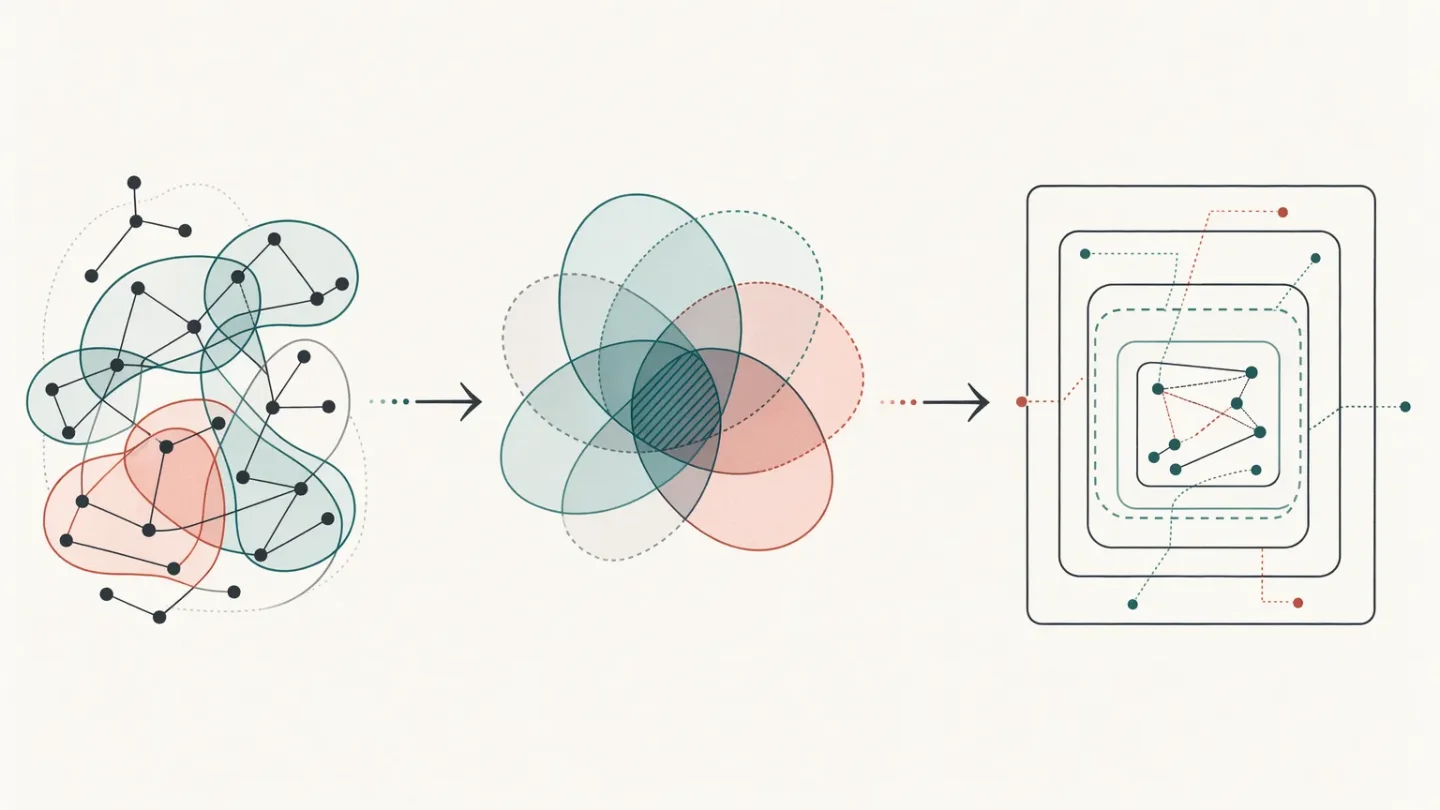
The shared move is to start with a definable relation, turn it into a finite combinatorial object, and then pull the resulting structure back into the theory. Depending on the setting, the output is a regularity lemma, a large homogeneous rectangle, a bound on a fractional Helly number, or a Zarankiewicz estimate.
Hypergraph regularity reaches higher arity
Artem Chernikov and Francis Westhead study higher-arity versions of distality in NIP theories. Their paper works with
(n+1)-ary definable relations, where the graph picture is replaced by a hypergraph picture and the relevant approximations are built from cylinder intersections, sets depending on proper subsets of the coordinates. 1For strongly
n-distal NIP structures, they prove a hypergraph regularity lemma: for every tolerance epsilon, the coordinate-wise partitions leave less than epsilon total measure on cylinder intersections that are not homogeneous for the relation. They derive an n-strong Erdős-Hajnal property, which guarantees a positive-measure homogeneous cylinder intersection. This is a genuine higher-arity extension of the familiar graph-level pattern: tame definable relations admit large pieces on which the relation becomes uniform. 1The paper also makes the hierarchy itself combinatorial. Among stable theories, strong higher-arity distality is equivalent to corresponding forms of indiscernible triviality and totally trivial forking. The authors give superstable examples that are strongly
2^n-distal but not strongly (2^n - 1)-distal, showing that the hierarchy does not collapse to its first levels. 1Fractional Helly beyond NIP
Fractional Helly theory starts with a finite family of sets: if a positive fraction of the
k-tuples have nonempty intersection, then a positive fraction of the whole family has a common point. Chernikov and Chuyin Jiang ask what this principle means when the family is definable in a first-order structure. 2They define FHP theories by requiring every partitioned formula to generate a family with the fractional Helly property. The resulting class contains NIP theories and is contained in the low NTP2 theories, so the combinatorial condition reaches beyond the usual finite-VC-dimension setting. A central bound says that in an FHP theory the fractional Helly number of a formula is at most
bdn(M^x) + 1, where burden measures the theory's combinatorial complexity in the variable tuple x. 2The applications are concrete. The paper proves FHP for
(Z,+,Sqf), the integers with a predicate for square-free numbers, while (Z,+,Pr), with a predicate for the primes, is not FHP. It also proves FHP for ultraproducts of finite fields and derives explicit bounds for ultraproducts of the p-adics and equicharacteristic valued fields. These examples make FHP a test for how far combinatorial geometry can travel outside NIP. 2The same paper turns back toward classification theory. It proposes uniform local character over finite sets as an NTP2 analogue of UDTFS and conjectures that every NTP2 theory satisfies it. The authors also refute an earlier conjecture of Adler about detecting NTP2 with a two-cardinal type-counting function. 2
One-basedness as finite graph control
A third paper, by Chernikov and Sergei Starchenko, studies bipartite graphs definable in one-based and related structures. One-basedness is a model-theoretic form of linearity: forking behaves more like the independence geometry of vector spaces than the geometry of fields. 3
The finite consequences are sharp. Every definable relation in a one-based theory has the strong Erdős-Hajnal property, so finite measures contain large subsets whose bipartite rectangle is either entirely inside or entirely outside the relation. The same relations satisfy a linear Zarankiewicz bound, controlling how many edges a bipartite graph can have when it avoids a fixed complete bipartite subgraph. The result extends to the collapsed and uncollapsed Hrushovski ab initio constructions, even though those theories are CM-trivial rather than one-based. 3
This gives a useful translation: forking geometry inside the theory is reflected in asymptotic behavior of finite definable graphs. The authors connect that translation to Zilber-style trichotomy questions and to the distinction between locally modular and field-like behavior. The paper also proves strong Erdős-Hajnal for the broader class of 1-semi-equational theories, which extends the result from stability into NIP. 3
What is changing
These papers point in three related directions.
- Higher arity is becoming a first-class combinatorial problem. Cylinder intersections and hypergraph regularity are replacing graph-only intuition in the study of
n-distality andn-triviality. - Classical set-system theorems are being used to probe theories beyond NIP. Fractional Helly gives a finitary condition that still sees burden, forking, amenability, and NTP2.
- Model-theoretic geometry is gaining finite witnesses. Strong Erdős-Hajnal and Zarankiewicz estimates turn abstract independence properties into statements about large homogeneous rectangles and forbidden subgraphs.
The interesting question is whether these tools will eventually provide equivalences, rather than one-way transfers: can a sufficiently strong finite regularity or counting principle recover the underlying classification-theoretic geometry? The current papers supply several positive cases, but also leave the broader conjectural boundary visible.
Contenido relacionado
- Inicia sesión para comentar.