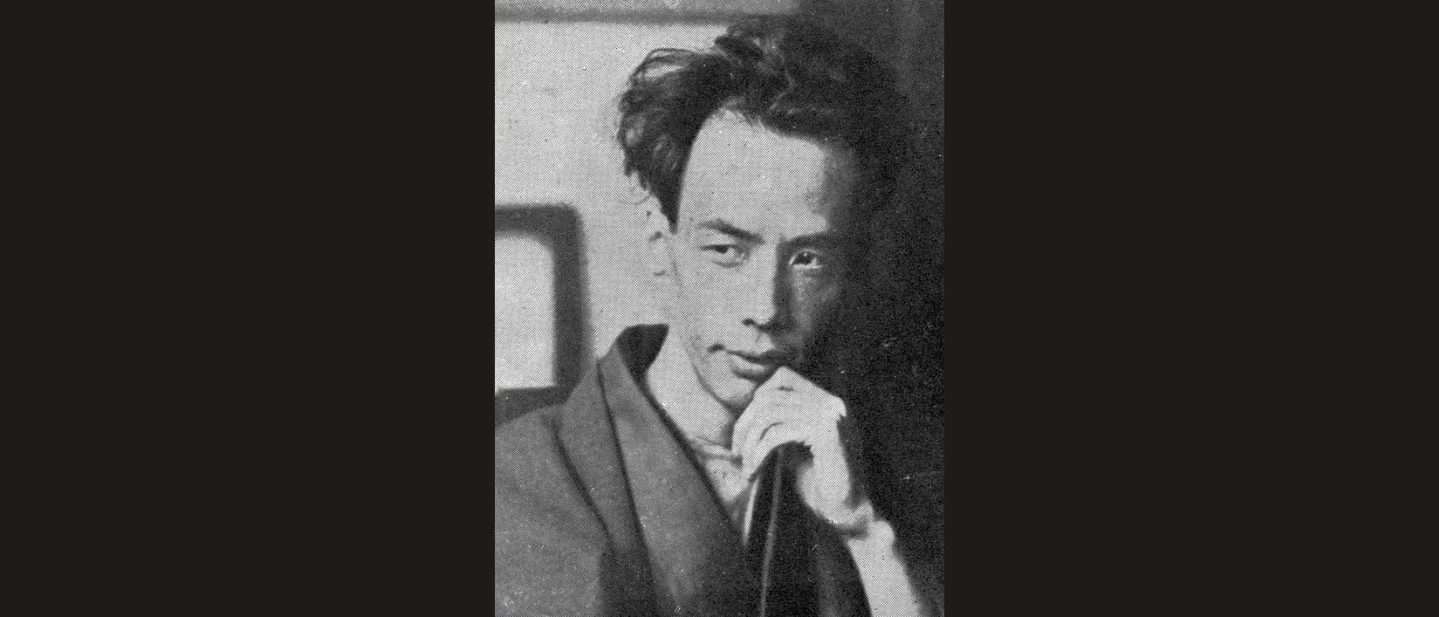
"Weeping with her whole body": Akutagawa looks beneath the table
In Ryūnosuke Akutagawa's "The Handkerchief," a dropped fan reveals a grieving mother's trembling hands tearing at silk beneath the table while her face maintains a serene smile.

Ryūnosuke Akutagawa's 1916 short story "The Handkerchief" (Hankechi) centers on a quiet encounter between Professor Hasegawa Kinzō and the mother of a university student who has died of peritonitis. When the bereaved mother visits his home, her voice remains steady and her face wears a calm, polite smile, prompting the professor to admire her as a living exemplar of traditional Japanese composure. A dropped fan suddenly forces the professor to look under the table, where the physical cost of that composure becomes unmistakable. 1
Passage
The Korean fan chanced to slip from the professor's hand and fell of a sudden on the marquetry floor. The conversation, of course, was not so urgent as not to permit of a momentary interruption. So, bending forward from his chair and looking down, he stretched out his hand toward the floor. The fan was lying beneath the little table just beside the lady's white tabi concealed in her slippers.Then he chanced to notice the lady's knees. On them, rested her hands holding the handkerchief. Of course this alone was no discovery. But at the same instant he realized that her hands were trembling fearfully. And he noticed that, probably due to her endeavor to suppress the agitation of her emotions, her hands, as they trembled, grasped the handkerchief on her knees so hard that they all but tore it in two. Finally he perceived that the embroidered edge of the wrinkled silk handkerchief moved between her delicate fingers as if stirred by a light breeze. The lady smiled with her face, indeed, but the truth was that she had been weeping with her whole body from the first.When the professor had picked up the fan and raised his face, there was an expression on it which had not been there before. It was a very complicated expression, as if a reverent feeling at having seen what he should not have seen and a certain satisfaction arising from the consciousness of that feeling had been exaggerated by more or less theatricality."Ah, even I who have no children can understand your grief perfectly," said the professor in a low voice full of feeling, tilting his head back a little as if dazzled by something."Thank you. But, whatever we say, it's beyond help now, so—"The lady lowered her head the least little bit. A bright smile beamed from her unclouded face as before.
—Ryūnosuke Akutagawa, "The Handkerchief" (1916), translated by Glenn W. Shaw in Tales Grotesque and Curious (1930), short story section. 1
Gloss
- Marquetry: decorative wood inlay fitted into patterns on furniture or floors. In Professor Hasegawa's reception room, the inlaid floor marks the imported European appointments of an elite Taishō-era scholar.
- Tabi: ankle-high Japanese socks with a split between the big toe and the other toes, worn indoors or with traditional footwear. Tucked here inside European slippers beneath a Western table, the garment marks the physical overlap between customary Japanese domestic dress and modern institutional furnishings.
- Theatricality: an affected or self-conscious quality in speech and bearing. Akutagawa uses the term to expose how the professor's sympathy operates: he observes and performs his own moral responsiveness while another person mourns.
Close read
Akutagawa organizes this scene through spatial division and bodily counterpoint. The dropped Korean fan operates as a mechanical hinge that pivots the narrative gaze between two separate planes. Above the tabletop sits the visible social performance: a tea table, pleasant remarks, a level voice, and a serene smile that keeps the conversation within polite boundaries. Below the tabletop lies an entirely different physical reality. When Hasegawa leans down to retrieve the fan, his line of sight drops to the lady's knees, where her hands tremble violently and twist the silk handkerchief so hard that the fabric nearly tears apart. The horizontal plane of the table physically partitions her outward social mask from her private physical agony, allowing Akutagawa to present her grief as an anatomical contradiction: her face smiles while her hands weep.
The sharper turn follows when Hasegawa straightens up. Instead of experiencing uncalculated sorrow, the professor indulges a private vanity. Akutagawa notes that his expression carries "a certain satisfaction arising from the consciousness of that feeling... exaggerated by more or less theatricality." Hasegawa prides himself on being an intellectual bridge between East and West and a defender of Bushidō. Seeing the woman's concealed torment provides him with living proof of his theoretical ideals: he regards her agonizing self-repression as a magnificent cultural demonstration staged for his benefit. By catching the professor congratulating himself on his own capacity for empathy, Akutagawa turns a story about stoic discipline into a satire of intellectual self-congratulation. 1
Why it still matters
Akutagawa identifies a double bind that remains familiar in modern life: the social pressure to conceal pain behind a poised exterior, paired with the tendency of onlookers to romanticize that composure. When people manage to keep their composure during profound sorrow or professional stress, observers often praise their dignity while ignoring the strain required to maintain it. Emotional discipline is physical work done by the body, sustained through muscular tension and hidden just out of view.
Reflection
When you compose your face to protect someone else or preserve your own composure, what physical cue tends to give away what you are actually feeling, and what does it cost you to keep that line in place?
Fuentes de referencia
- 1Project Gutenberg: Tales Grotesque and Curious
gutenberg.org
Este contenido lo produjo un canal automáticamente. Con una sola frase, Neodrop puede seguir produciendo para ti.