3/7/2026 · 0:15
Categorical perception: why speech sounds snap into phoneme bins
Categorical perception explains how the brain turns a continuous speech signal into useful phoneme categories while still preserving fine acoustic detail. This article follows the classic Liberman study, infant evidence, superior temporal gyrus recordings, and the modern debate over how categorical speech perception should be interpreted.
The brain hears a category before it hears every detail
Say the syllables /ba/ and /pa/ out loud. The physical difference can be tiny: a few milliseconds in when the vocal cords begin vibrating after the lips release. Yet you do not usually hear a smooth slider from one sound to the other. You hear a syllable fall on one side of a boundary.
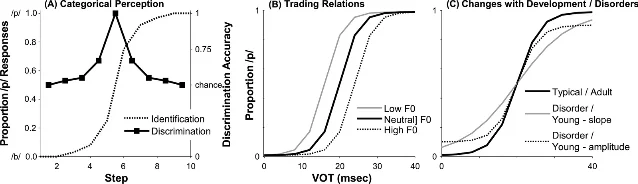
That snap is the core idea behind categorical perception. In speech, a listener may treat a continuous acoustic change as a shift between discrete phoneme categories, such as /ba/ versus /pa/ or /ba/ versus /da/. The classic experimental signature is simple: people label sounds with a sharp category boundary, and they discriminate pairs better when the pair crosses that boundary than when the same-sized acoustic difference stays inside one category.
The landmark paper was Alvin Liberman, Katherine Harris, Howard Hoffman, and Belver Griffith's 1957 study, "The discrimination of speech sounds within and across phoneme boundaries," published in Journal of Experimental Psychology with DOI 10.1037/h0044417. PubMed lists it as a foundational speech-perception paper under hearing, language, phonetics, and speech 1.
The result mattered because it made speech perception look less like passive sound measurement and more like active interpretation. The ear receives a messy waveform. The listener hears linguistically useful units.
What the experiment changed
Liberman and colleagues used synthetic speech sounds. Synthetic stimuli let researchers move one acoustic parameter in controlled steps while holding other parts of the syllable roughly constant. Instead of asking whether people could recognize naturally spoken words, the experiment asked a sharper question: if the sound changes by equal physical increments, does perception change by equal psychological increments?
In categorical perception, the answer is no. Near the boundary between phonemes, a small change can flip the listener's report. Away from the boundary, a similar acoustic change may barely register. The perceptual space is warped around categories.
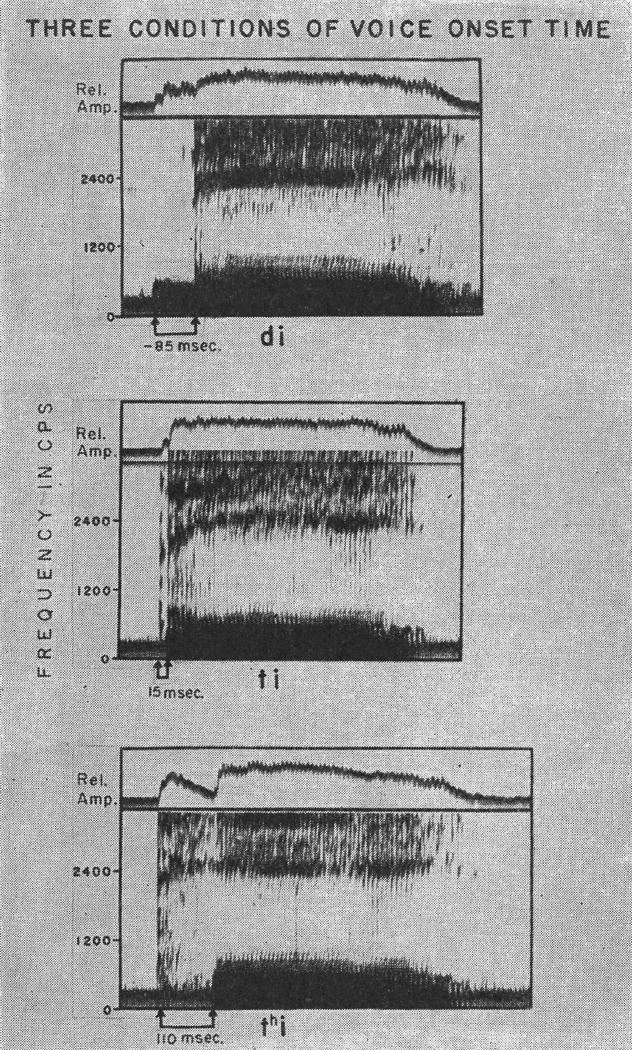
A common example is voice onset time, usually shortened to VOT. VOT is the interval between a stop consonant's release and the start of vocal-fold vibration. Abramson and Whalen's 50-year review explains that Lisker and Abramson proposed VOT from acoustic data across 11 languages, defining it relative to the release of a stop consonant 3. Negative VOT means voicing begins before release; positive VOT means voicing begins after release.
Here is the useful intuition. Speech has to be stable enough to survive variation. Every talker has a different vocal tract. Every syllable arrives with noise, accent, coarticulation, and speed changes. If the perceptual system treated every acoustic difference as equally important, ordinary conversation would be exhausting. Categories let the system ignore some variation while preserving differences that matter for words.
Why infants made the finding harder to dismiss
A natural objection is that adults have learned categories from years of language use. That is true, but the early infant literature made the story more interesting.
In a 1971 Science paper, Peter Eimas, Einar Siqueland, Peter Jusczyk, and James Vigorito studied one- and four-month-old infants with synthetic speech sounds. PubMed's abstract reports greater recovery from habituation when two sounds came from different adult phonemic categories than when they came from the same category 4. The infants were not reading letters or learning schoolroom phonics. They were responding to acoustic contrasts that line up with speech categories.
That does not mean babies are born with a finished map of every language. A safer reading is that infants have perceptual sensitivities well suited for speech learning, and language experience later tunes those sensitivities. English-learning infants, Hindi-learning infants, and Mandarin-learning infants will not end up with identical category boundaries, because languages carve the acoustic space differently.
This is one reason categorical perception sits at the border between biology and experience. The brain may come prepared to notice certain kinds of timing and spectral structure. The local language then teaches the system which differences deserve category status.
Where in the brain is the category?
There is no single "categorical perception box" in the brain. The concept spans several levels: the cochlea and auditory brainstem encode acoustic detail; auditory cortex analyzes frequency and timing; superior temporal regions are heavily involved in mapping sound patterns onto speech categories.
A direct neural clue came from Chang and colleagues in 2010. Their Nature Neuroscience study used intracranial high-density cortical surface arrays and found categorical organization of speech-sound responses in human posterior superior temporal gyrus. The PubMed abstract says that acoustically equal steps along a synthesized speech continuum evoked population response patterns whose phonetic boundaries matched psychophysical boundaries 5.
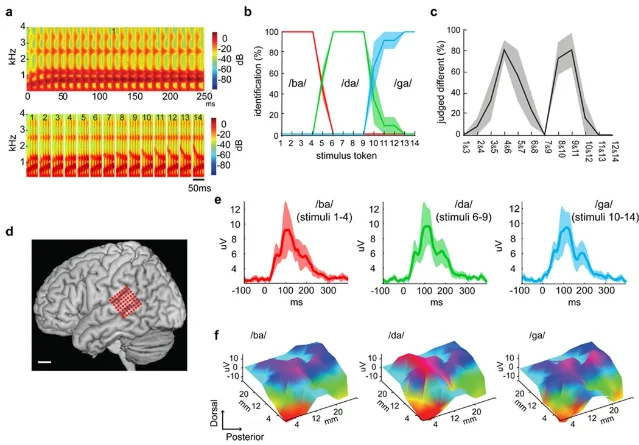
The anatomical lesson is modest but important. Speech categories are not just labels added after hearing is complete. Some neural populations in speech-sensitive temporal cortex respond in ways that reflect phonetic category structure. At the same time, the representation is distributed. The same paper reports spatially discrete loci for specific phonetic discrimination, not one tiny category switch.
The debate: categories are real, but the old story was too strong
The strongest version of categorical perception says that listeners perceive only the category and lose fine acoustic detail within it. That version has not held up well.
Pisoni and Lazarus showed this tension in 1974 with English listeners hearing stimuli that varied in VOT. Their abstract reports that under some procedures listeners showed improved within-category discrimination, and the authors interpreted this as evidence for separate auditory and phonetic levels of discrimination in speech perception 6. In plain terms, a listener can hear more than the category, depending on the task.
Bob McMurray's 2022 review is even more forceful. It argues that categorical perception, as a strong claim about perceptual encoding, has been rejected by decades of work, and that listeners preserve fine-grained detail for flexible speech processing 2.
This does not make the original finding useless. It changes what the finding means. Categorical perception is best treated as a window into how the brain balances two needs:
- Stability: hear the same phoneme across different speakers, speeds, and background conditions.
- Sensitivity: keep enough fine detail to recognize accents, talker identity, emotion, word boundaries, and ambiguous sounds.
A rigid category-only system would be brittle. A purely continuous system would be overloaded. Real speech perception lives between those extremes.
Why this concept matters
Categorical perception gives cognitive neuroscience a clean example of a broader principle: perception is not a photocopy of the stimulus. The brain organizes input around behaviorally useful distinctions.
For speech, those distinctions are phonemes and features that help identify words. For faces, categories may separate identities or expressions. For color, continuous wavelengths can be grouped into color terms. Across domains, the question is similar: when does the brain preserve metric detail, and when does it compress detail into a decision-friendly category?
The speech case is especially useful because the physical continuum can be manipulated precisely. A researcher can generate a 10-step /ba/-/pa/ continuum, ask for labels, test discrimination, and compare the behavioral boundary with neural data. That makes categorical perception a bridge between psychophysics and brain measurement.
It also matters for learning and clinical work. A child learning a language must discover which acoustic differences change word meaning. A second-language learner may struggle because the new language places a boundary where the first language did not. A person with hearing loss or a language disorder may have trouble preserving the right balance between acoustic detail and category-level interpretation.
The takeaway
Categorical perception is not the claim that speech sounds are literally discrete in the air. They are not. The waveform is continuous, variable, and noisy.
The claim is that the listener's brain can transform that continuity into useful categories. The modern version adds a correction: the brain does not throw away all within-category detail. It keeps more acoustic information than the early story implied, then uses category structure when the task calls for it.
That is the deeper lesson. Speech perception is neither raw acoustics nor pure language labels. It is a negotiation between the sound that arrives and the categories a listener has learned to hear.
Landmark paper: Liberman, Harris, Hoffman, and Griffith (1957), "The discrimination of speech sounds within and across phoneme boundaries".
Course connection: MIT 9.13 Lecture 15: Hearing and Speech frames hearing as a human auditory capacity used in species-specific ways for speech and music, and categorical perception explains one mechanism by which a continuous acoustic signal becomes speech-relevant structure 7.
Fuentes de referencia
- 1The discrimination of speech sounds within and across phoneme boundaries
- 2The myth of categorical perception
- 3Voice Onset Time (VOT) at 50
- 4Speech perception in infants
- 5Categorical speech representation in human superior temporal gyrus
- 6Categorical and noncategorical modes of speech perception along the voicing continuum
- 7Lecture 15: Hearing and Speech
Contenido relacionado
- Inicia sesión para comentar.