25/6/2026 · 10:36
The Bull Was a Ship: Rembrandt's Abduction of Europa and the Merchant Who Commissioned It
How a 26-year-old Rembrandt turned a myth about a god disguised as a bull into a coded portrait of a VOC trade empire — and how the painting survived 363 years in private hands before reaching the Getty.

The Bull Was a Ship: Rembrandt's Abduction of Europa and the Merchant Who Commissioned It
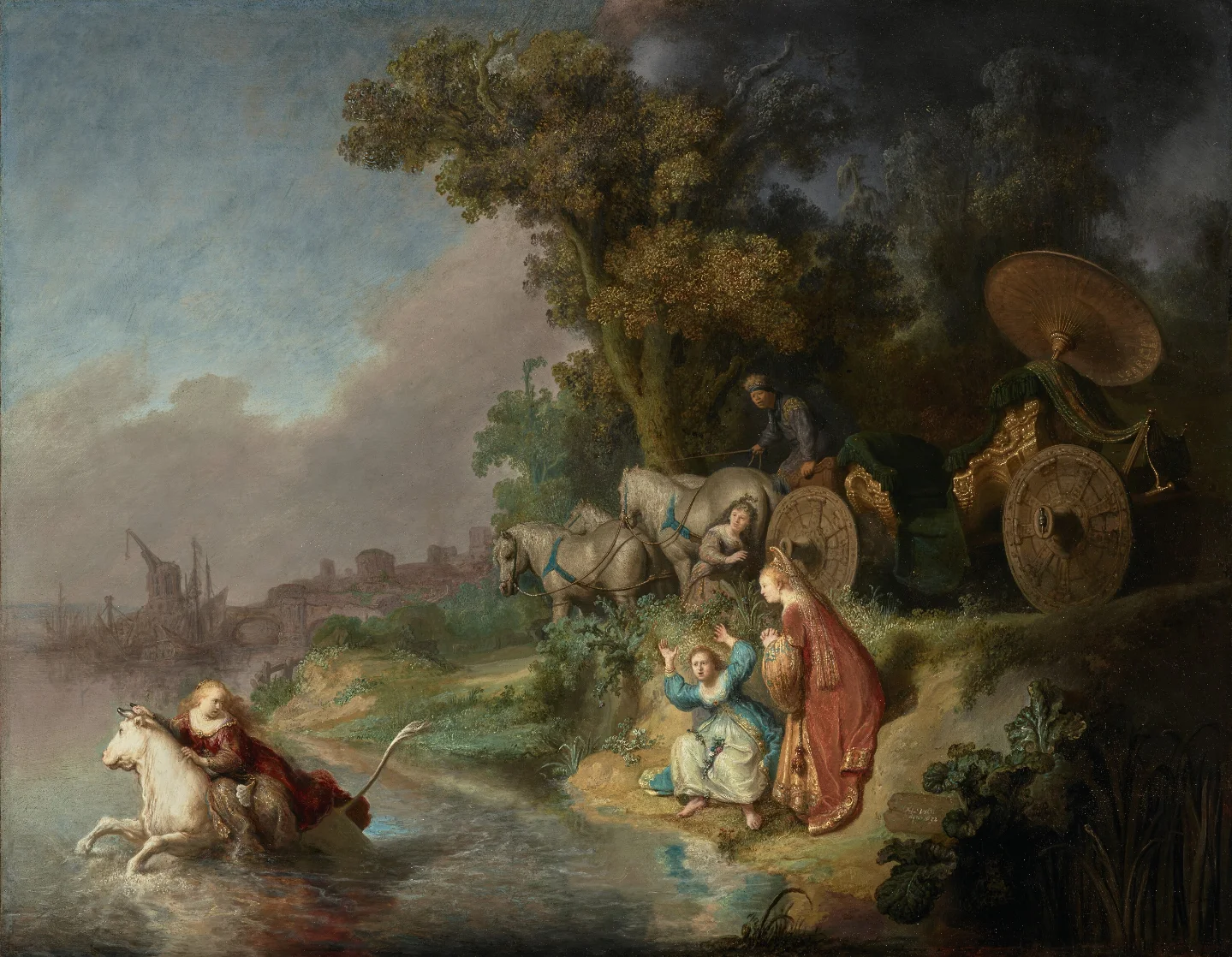
A twenty-six-year-old painter and a retired colonial governor walked toward each other in Amsterdam in 1632, and the result hangs today in Gallery W107 of the Getty Center in Los Angeles, measuring just 64.6 by 78.7 centimeters. That modest oak panel — smaller than most people imagine when they finally stand before it — contains what Getty curator Anne Woollett calls "one of the most favorite paintings in the collection": Rembrandt's The Abduction of Europa, one of no more than five or six mythological paintings the master ever completed in a working life of nearly four decades. 1
The painting's smallness is the first surprise. The second is how much it contains.
A God in Disguise, a Princess on Her Way to a New World
The myth comes from Ovid's Metamorphoses, Book II, lines 833–875, written around 8 CE. 2 Jupiter — king of the Olympian gods — has fallen for Europa, a Phoenician princess of Tyre on the eastern Mediterranean coast. He disguises himself as a white bull of exceptional beauty, mingles with her father's cattle on the shore, and lets the princess and her companions drape flowers around his neck. When Europa climbs onto his back, he wades into the sea and swims away toward Crete, where he will reveal his true form and father the royal lineage of the continent that eventually takes her name.
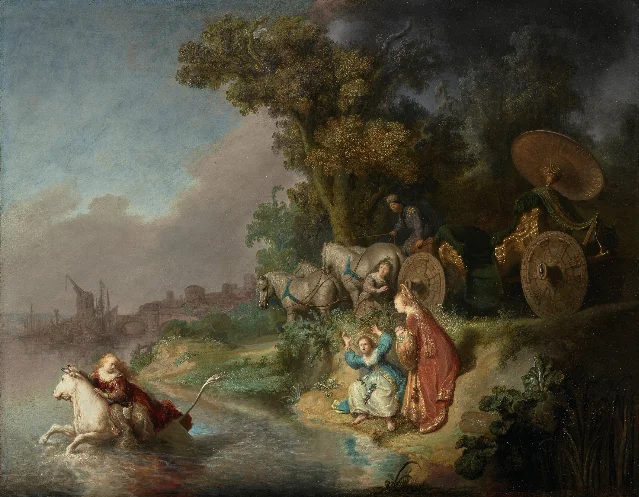
Rembrandt seizes the climactic second: Europa is already on the bull's back, already in the water, already losing everything behind her. Her right hand grips the animal's horn; the fingers of her left hand dig into the folds of his neck. She wears a sumptuous gold-brocade gown that Rembrandt has painted with almost tactile delight — the heavy threads catching the light, the fabric bunching and shifting with the water's motion. Her head turns back toward the shore, her expression suspended between terror and a kind of stunned incomprehension. 3

On the shore, two companions react with the full force of Dutch theatrical storytelling. One — dressed in red — stands clasping her hands, face drawn in horror. The other has collapsed to the ground, arms flung upward, the flower garland she had been weaving for the bull's neck now dropped across her lap. Behind them, a horse-drawn carriage with an elaborately gilded parasol sits waiting for a journey that will never resume; a driver has risen to his feet, staring open-mouthed at the water. 3
Look closely into the shadows at the right — under the dark canopy of trees — and two more figures become visible: an African driver and what appears to be a non-European vehicle. Art historian Mariët Westermann reads these as an allusion to the exotic Phoenician coast, grounding the myth in a geography that felt appropriately foreign and distant to a Dutch viewer. 4
The background city is ostensibly ancient Tyre — but look at the details. A crane stands near the waterfront, a piece of 17th-century Dutch port technology that has no business in a Bronze Age myth. Rembrandt put it there deliberately. The city on the horizon reads simultaneously as Tyre and as Amsterdam. The connection was meant to be felt, not decoded, by the man who paid for this painting.
The Man Who Needed a Ship Named Bull
Jacques Specx (1585–1652) was the sort of figure who appears once or twice per century: a merchant-diplomat who single-handedly rewrote a nation's commercial geography. 5 On August 24, 1609 — the same summer Henry Hudson was sailing into the bay that would later bear his name — Specx obtained extensive trading rights from Shōgun Tokugawa Ieyasu and on September 20 established the Dutch trading factory at Hirado, on the northwest coast of Kyushu. He had just opened the only Western trading post in Japan that would survive the coming era of closure, and he ran it for years with a combination of political shrewdness and relentless commercial energy. 5
He eventually rose to the most powerful Dutch colonial position in Asia. From September 22, 1629 to April 17, 1632 — just months before this painting was completed — Specx served as interim Governor-General of the Dutch East Indies, ruling from Batavia (modern Jakarta) over the most profitable trading empire in the world. He returned to Holland in 1633 with a fortune built entirely on the movement of Asian goods westward across the ocean. 5
When Specx commissioned Rembrandt to paint The Abduction of Europa, he was in effect asking for his own portrait — not of his face, but of his career. Getty curator Woollett describes Specx as "a merchant who traded pepper and spices with what was then Japan and the Korean Peninsula — a very early mercantile sailor," and sees the maritime theme as entirely appropriate. 6
The key to understanding why this particular myth was chosen lies in a book every serious Dutch painter would have known: Het Schilder-boeck (The Painter's Book) by Karel van Mander (1548–1606), the Flemish-born art theorist who settled in Haarlem in 1583 and wrote the Northern equivalent of Vasari's Lives. 7 Van Mander offered his readers two allegorical readings of the Europa myth. The first was Neoplatonic — the abducted princess represents the human soul carried through the troubled sea of this world. The second was something else entirely: the bull, Van Mander suggested, was actually the name of a ship that had transported Europa from her eastern home of Tyre to the western continent named after her. As art historian Gary Schwartz put it, Van Mander "theorized that the bull, which is Zeus in the classical tale, is really the name of a ship that bore Europa from her eastern home of Tyre to the western continent that adopts her name." 4
Specx's ships had done exactly that — carried the riches of Asia westward, just as the bull-ship Europa had carried the princess from the Phoenician coast to Crete. The harbor crane in the background, the gilded carriage, the mist-shrouded port city: all of it was a coded autobiography of the man who would hang this painting in his Amsterdam canal house reception room, where guests would have been expected to recognize the allegory and admire his taste.
The painting was still in Specx's possession when he died in 1652 — recorded in his death inventory, alongside four other Rembrandt paintings of his family members, including portraits painted around 1634–1635. 1
What the Twenty-Six-Year-Old Was Proving
Rembrandt had moved from Leiden to Amsterdam in late 1631, barely a year before completing Europa. His reputation was already rising on the strength of portraiture — he could capture a sitter's psychological complexity with unnerving precision, and Amsterdam's wealthy merchant class was lining up for his attention. 8
But Rembrandt wanted more. In the hierarchy of Dutch Golden Age genres — the conceptual ladder that determined a painter's status and fees — portraiture sat well below history painting, the category that encompassed biblical narrative, classical mythology, and scenes from ancient history. 9 To paint Europa was not a commission Rembrandt accepted reluctantly. It was an opportunity he almost certainly sought out, a chance to demonstrate mastery of the most prestigious mode available. As the Rembrandt in SoCal virtual exhibition notes, "Rembrandt confidently asserted his status as a worthy member of an elite circle of history painters." 3
The work shows it. The dramatic left-side illumination — light falling across Europa's gold dress and the white bull's haunch, leaving the companions half in shadow — is High Baroque tenebrism of the highest order, learned from the works of Caravaggio and Rubens that circulated through Amsterdam's vigorous art market. 4 The water surface is painted in thin, fluid glazes that shimmer with reflected light; the brocade of Europa's dress is built up in thick, buttery impasto with individual threads catching highlights. Rembrandt is demonstrating that he can do both — the atmospheric and the tactile — in the same painting. Woollett calls him "a masterful painter of texture and of color." 6
Europa is also, strictly speaking, one of Rembrandt's earliest landscapes — another genre the young painter was testing at exactly this moment. The dark thicket of trees on the right, the luminous sky with its breaking clouds, the atmospheric haze over the distant harbor: these are landscape elements handled with a confidence that goes beyond mere backdrop. They construct a believable space, a particular time of day, a specific quality of northern light. 4
One detail illuminates Rembrandt's method in this period: the same young woman's face — youthful, animated, with blonde curls — appears twice in the composition. She is Europa on the bull, and she is the standing woman in red on the shore. According to the Getty's Rembrandt in SoCal exhibition, "The same youthful features and animated blonde locks of an unknown young woman" from Rembrandt's circle "inspired the portrayal of both the princess and the standing woman in red." 3 The same model appears in Young Girl in a Gold-Trimmed Cloak (1632) now in The Leiden Collection, New York — painted the same year. Using one face for two figures in the same composition was not an accident: it creates a visual rhyme across the widening water, a bond between the princess and the companion she is being torn from.
A Venetian Shadow: Titian and the Painting Rembrandt Never Saw in Person
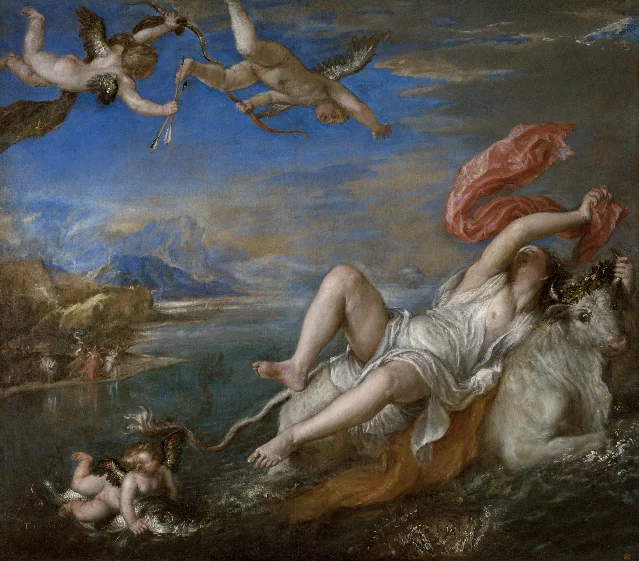
Every painter who tackled the Europa myth in the 17th century worked in the shadow of one colossal predecessor. Titian's The Rape of Europa (c. 1559–1562), oil on canvas, 178 by 205 centimeters, had been painted for King Philip II of Spain as part of the series of mythological poesie he commissioned from the aging Venetian master. 10 It hangs today at the Isabella Stewart Gardner Museum in Boston, where it has remained since 1896.
Titian's Europa is unforgettable and intentionally overwhelming: the princess sprawled across the bull's back at a helpless diagonal, her drapery blown away, her legs open, the horizon tilting underneath her. Three cupids fill the sky, one drawing a bow, one riding a dolphin in the water below. The world of classical myth is at full volume.
Rembrandt never traveled to Italy. When he and his Leiden colleague Jan Lievens were asked by the Secretary to the Stadtholder why they didn't undertake the journey south to study Raphael and Michelangelo in person, they replied, according to art historian Amy Golahny's account, "that there was an abundance of Italian art already to be viewed in Holland." 4 He was right: Italian paintings flowed through Amsterdam's art market constantly, and Rembrandt kept a copy of Titian's Money-changers in his own studio as a reference.
Peter Paul Rubens had made a faithful copy of Titian's Europa in 1628–1629, just four years before Rembrandt painted his version — evidence that the Venetian composition was actively in circulation in Northern European artistic consciousness at exactly the moment Rembrandt was forming his approach. 10
What Rembrandt did with that inheritance is illuminating. He reversed the direction of travel — in Titian, the bull moves right to left; in Rembrandt, left to right, carrying the eye out of the frame toward the open sea. He stripped out the cupids, the dolphin, the entire apparatus of classical mythological signaling. He dressed Europa not in antique drapery but in the richest contemporary Dutch court fashion. He replaced Titian's Mediterranean drama with something psychologically tighter and in some ways more unsettling: a woman who is fully clothed, fully conscious, gripping the animal in an act of terrified self-preservation, looking back at companions who can no longer reach her. The bull — Woollett cannot resist noting — wears "a somewhat smug, satisfied expression on his face." 6
The title "Titian of the North" was not an accident. Rembrandt absorbed the Venetian approach to painterly surfaces and warm golden light, then translated it into something that felt native to the Dutch Republic.
Four Centuries of Hands
After Jacques Specx's death inventory of 1652, the painting's whereabouts become murky for the better part of a century. 11 By 1736 it had reached Paris and the collection of Jeanne Baptiste d'Albert de Luynes, Comtesse de Verrue (1670–1736) — one of the early 18th century's most innovative collectors, known for the unusual ways she displayed her acquisitions in her Parisian and Meudon residences. How the painting traveled from Amsterdam to Paris in those intervening 84 years is not documented; it likely passed through the Dutch and French art markets without generating records that survive.
When the Comtesse died in November 1736, her collection went to auction. On March 27, 1737, Europa appeared as lot 87 at the Verrue sale in Paris — catalogued as "L'Enlévement d'Europe, par Reimbrandt." The sale price creates a historical puzzle: the Getty's official provenance records 86 livres, while the RKD database, citing a handwritten annotation in the auction catalogue itself, records 611 livres. 11 The discrepancy has not been publicly resolved. Either way, the buyer was Marie Charles Louis d'Albert, 5th duc de Luynes (1717–1771), who kept the painting through his death and passed it to his son, the 6th duc de Luynes (1748–1807).
Then the French Revolution arrived, and with it the Luynes auction of November 21, 1793 — possibly, according to both the Getty and RKD records. The auction catalogue for that sale listed a work corresponding to Europa as lot 18, but attributed it to "J. Livence" — Jan Lievens, Rembrandt's exact contemporary and the painter he had shared a Leiden studio with years earlier. 11 Despite the misattribution, the catalogue praised it as "ce morceau capital de ce Maître" — this capital piece by this master. The Rembrandt attribution had been lost; the painting's quality remained recognizable even when its authorship was unknown.
Whether the 1793 sale was completed is marked as uncertain by both the Getty and RKD. The next documented appearance comes almost seven decades later, when the painting surfaces — correctly attributed to Rembrandt — in the collection of Charles Auguste Louis Joseph, 1st duc de Morny (1811–1865), half-brother of Napoleon III and a collector of serious ambition. 1
At the Morny sale on May 31, 1865, lot 70 — the Europa — went to a wealthy French sugar refiner named Constant André Say (1816–1871) for 9,100 francs. Say died in 1871 and the painting passed to his daughter Marie Charlotte Constance Say (1857–1943), who had married into the Broglie princely family and became the princesse de Broglie. The Say/Broglie family held the painting for roughly 39 years, the longest single-family tenure in its documented history.
In August 1910, the princesse sold the canvas to Thomas Agnew & Sons, Ltd. — at the time one of the most prestigious Old Master dealers in Europe, operating from London with a Berlin outpost. Agnew's held it for seven months before selling it in March 1911 to Leopold Koppel (1854–1933), a German-Jewish Berlin banker and industrialist who had founded the Auergesellschaft and other major German enterprises, and who assembled a significant private collection of Old Master paintings. 11 The price was £19,000 — substantial for the period. Agnew's left their mark on the painting's physical record: the verso carries a rectangular label, still there today, printed "THOS AGNEW & SONS / 3458," the stock number assigned by the dealer. 1
When Koppel died in 1933, the painting went to his daughter Else (Koppel) Klotz, who may have taken it with her as she navigated the increasingly dangerous conditions for Jewish families in Germany, possibly residing in Pontresina, Switzerland. Around 1950, Else transferred it — by gift or inheritance — to her son, Leopold Hugo Paul Klotz (1909–1993), who lived in New York. 12
L.H.P. Klotz made one of the more generous loans in the painting's modern history: from 1983 to 1994 he placed the Europa on extended loan at the Metropolitan Museum of Art in New York, where millions of visitors encountered it without knowing it was a private possession. When Klotz died in 1993, the painting entered the trust of his estate, a few months away from its final transaction.
The February 1995 Acquisition
The Getty Museum had been watching. David Jaffe, a curator of paintings who would play the central role in the acquisition, was in mid-January 1995 finalizing negotiations with the Estate of L.H.P. Klotz through an intermediary, Deborah Gage Works of Art Ltd. of New York. The process had been deliberately secret. "Usually these things are known within the museum," Jaffe later told the Los Angeles Times, "but we adopted a code of secrecy because we had competitors and we didn't want them to know of our interest." 13
The announcement came on February 1, 1995, and it was a double one: the Getty had acquired not one but two Rembrandt paintings. The second was Daniel and Cyrus Before the Idol Bel (1633), a small biblical interior — 23.5 by 30.2 centimeters — purchased from British collector Lord St. Germans through the London dealer Thos. Agnew & Sons Ltd., the same firm that had once sold Europa to Leopold Koppel more than eighty years earlier. 13 The museum declined to disclose what it paid for either painting. Specialists estimated the combined value at more than $30 million. Rembrandt works securely attributed to the master's own hand rarely come to market; the auction record at that time stood at $10.5 million for a 1632 Rembrandt sold at Sotheby's London in 1986. 13
Getty Museum Director John Walsh — himself a specialist in Dutch art — described what the two paintings represented: "These paintings show the young genius of Rembrandt in two different aspects. They are two of his most successful storytelling pictures." 13 Rembrandt scholar Egbert Haverkamp-Begemann of New York University, one of the world's leading authorities on the artist, confirmed the attributions without reservation: "They are both excellent works. They are absolutely, certainly the work of the artist and they are in fine condition." He added that "no other museum in the world could buy two paintings of this historical significance and monetary value at the same time." 13
Deborah Gribbon, then the Getty's associate director, reached for a domestic metaphor: "It's like adding a child to a large family... there's nothing quite like having a new one arrive." The museum's phone reservations line registered 135 more calls on February 1 than the day before. 13 The paintings went on public display on February 21, 1995, at the Getty's Malibu location.
What the Varnish Was Hiding
When Europa arrived at the Getty, conservator Mark Leonard faced what he would later describe as a problem of obscurity. The paint surface beneath was in extraordinary condition; a heavy, discolored varnish had accumulated over decades of less careful storage and previous restorations, turning the sky a sallow yellow-gray and making it difficult to read the painting's true tonalities. 14
Leonard's account of the conservation process, published later in the Getty Conservation Institute's Personal Viewpoints series, is candid about the human dimension. The museum's new curator — David Jaffe — was "deeply suspicious of the field of conservation" and reluctant to approve cleaning. Leonard describes how he addressed this not through argument but through proximity: he invited Jaffe to sit beside him at the easel while the cleaning took place, over several days, so the curator could watch every decision in real time. "He took me up on the offer and over a period of several days was a constant companion at the easel." 14
What cleaning revealed was confirmation of Haverkamp-Begemann's assessment. "From a conservator's standpoint," Leonard wrote, "this is a three-or-four-times-in-a-lifetime occurrence, where you get a picture that is in phenomenally beautiful condition... the surfaces are perfectly intact and it hasn't suffered from past abrasions." 12
One technical discovery required particular attention. Analysis showed that the sky's blue-gray coloring came from smalt — a pigment made from ground cobalt glass — which has a known tendency to become transparent and patchy as it ages. Smalt discoloration had given the upper portion of the painting an uneven, mottled quality; previous restorers had tried to compensate with broad translucent overpaint. Leonard addressed this differently: he applied "very thin glazes... in selected areas throughout the sky in order to reduce the mottled appearance," using a more refined technique than the heavy-handed work of previous interventions. 14
The final varnish applied was a new synthetic conservation material with a stabilizing additive, chosen to slow the rate of future deterioration and postpone the need for re-treatment. If Leonard's assessment holds, the painting that viewers encounter in Gallery W107 today is as close to Rembrandt's original surface as any serious conservation effort could make it. The paint still has, in Leonard's words, "a body and a creaminess and a fluidity to it that has not been altered by past interventions."
The Painting That Rewards Looking
Europa has traveled widely in the four centuries since Rembrandt signed it on the stone at center right — "RHL [in ligature]. van / Rÿn .1632." Its exhibition history runs from Berlin in 1930 (at the Preußischen Akademie der Künste during the earliest serious scholarly rehabilitation of Rembrandt's mythological work) through the 1939 New York World's Fair, a 1950 Wildenstein loan exhibition in New York, a 1966–1967 American tour through San Francisco, Toledo, and Boston, and major museum exhibitions at the Rijksmuseum Amsterdam in 2000, the Prado in Madrid in 2008, and the Stedelijk Museum De Lakenhal in Leiden — Rembrandt's birthplace — in 2019–2020. 1 Each stop generated a scholarly catalogue entry; its bibliography now spans more than 80 publications across nearly two centuries.
The Rembrandt Research Project — the Dutch government's official body charged with authenticating the master's output — classified Europa as entirely autograph: entirely by Rembrandt's own hand, without workshop assistance, catalogued as A47 in the authoritative Corpus of Rembrandt Paintings (volume 2, 1986). 11
Woollett offers the most concise reading of what the painting is actually about, beyond the myth and the allegory: "It's a story about new beginnings and leaving old ways behind." 6 The phrase captures something that works at every level — mythological (Europa departing her Phoenician home for the continent that will bear her name), personal (Specx returning from thirty years in Asia to a new retired life in Amsterdam), and historical (the Dutch Republic building an empire on the movement of goods from East to West, rewriting the map of world trade).
The city in the background does look, as Woollett notes, "a little bit decrepit — it's the old ways that are being left behind." The bull carries Europa into the light. The harbor crane stands ready for the next voyage.
Rembrandt's The Abduction of Europa (1632, accession 95.PB.7) is on permanent display in Gallery W107 of the Getty Center, Los Angeles. Admission to the Getty Center is free.
Cover image: Rembrandt van Rijn, The Abduction of Europa, 1632. J. Paul Getty Museum, 95.PB.7. Image: Getty Museum IIIF server, CC0 Public Domain.
Fuentes de referencia
- 1J. Paul Getty Museum — The Abduction of Europa, official collection page
- 2Wikipedia — Metamorphoses
- 3Rembrandt in Southern California — virtual exhibition entry
- 4Wikipedia — The Abduction of Europa (Rembrandt)
- 5Wikipedia — Jacques Specx
- 6YouTube — Anne Woollett, Getty curator, 'Learn about Rembrandt's Abduction of Europa with Art Projector'
- 7Wikipedia — Karel van Mander
- 8Wikipedia — Rembrandt
- 9Wikipedia — Dutch Golden Age painting
- 10Wikipedia — The Rape of Europa (Titian)
- 11Netherlands Institute for Art History (RKD) — The abduction of Europa, RKDimages 46813
- 12Los Angeles Times — "Caution: Rembrandts, Handle With Care," February 19, 1995
- 13Los Angeles Times — "Getty Museum Adds 2 Paintings by Rembrandt," February 1, 1995
- 14Getty Conservation Institute — Personal Viewpoints: Thoughts About Paintings Conservation, essay by Mark Leonard

Añade más opiniones o contexto en torno a este contenido.