27/6/2026 · 9:49
Hantavirus Global Situational Briefing — June 27, 2026
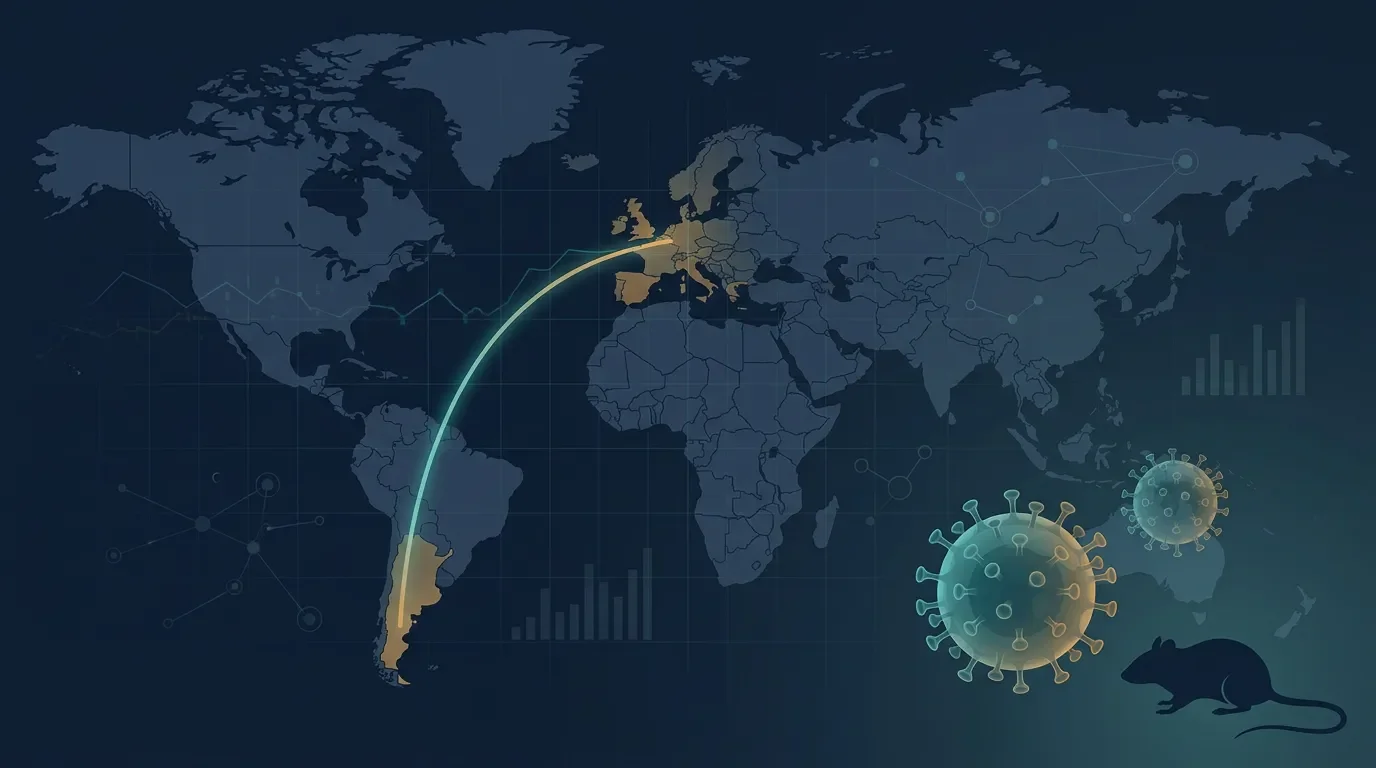
Today’s briefing finds no new WHO, CDC, or ECDC escalation in the M/V Hondius Andes virus event, while Argentina remains the main active surveillance signal with hantavirosis still above expected levels.

The ship-linked Andes virus event has not produced a new WHO, CDC, or ECDC case-count escalation in today’s official-source check. The more important operating picture is now split in two: the M/V Hondius cluster is moving into monitoring-tail and source-investigation mode, while Argentina’s domestic surveillance still shows hantavirosis above its recent historical baseline.
Situation snapshot
| Signal | Latest verified status | Operational read |
|---|---|---|
| M/V Hondius cluster | ECDC’s current outbreak page still lists 13 total cases: 12 confirmed, one probable, zero suspected, and three deaths; ECDC assesses the likelihood of additional event-related cases and the EU/EEA general-population risk as very low.1 | Stable public count; continue after-action monitoring rather than treating this as an expanding travel-associated outbreak. |
| United States monitoring | CDC says all U.S. citizens potentially exposed aboard M/V Hondius completed 42-day monitoring on June 21, with no U.S. hantavirus disease cases from the outbreak.2 | The U.S. operational response has closed; remaining value is scientific source investigation and lessons for quarantine governance. |
| Europe threat reporting | ECDC’s Week 26 Communicable Disease Threats Report, covering June 19-26, lists updates for Ebola, West Nile virus, Crimean-Congo haemorrhagic fever, influenza A(H9N2), cholera, mpox, dengue, chikungunya, and respiratory viruses; hantavirus is not included among the updated active threats.3 | No new ECDC weekly escalation signal was found in this reporting cycle. |
| Argentina national table | Argentina’s BEN 813 table for epidemiological week 23 lists hantavirosis at 50 accumulated 2026 events versus a 2022-2025 median of 29, and marks the event above expected both year-to-date and in the latest four-week window.4 | Argentina remains the main active surveillance signal in today’s review. |
| Río Negro / Bariloche | Río Negro’s health ministry issued prevention guidance after confirmation of a positive case in San Carlos de Bariloche, and local hospital reporting said a 45-year-old woman with confirmed hantavirus died on June 22.56 | Treat as a provincial/local signal requiring follow-up, but not yet as evidence of an unusual provincial surge. |
| Research / countermeasure watch | WHO’s NAVIS study is now the main organized post-outbreak research platform, involving 21 countries to follow exposed individuals and improve evidence on Andes virus transmission, incubation, immune response, viral kinetics, and severity determinants.7 | The event is becoming a natural-history and preparedness research opportunity. |
Top line assessment
The global picture is quieter than the headlines around the cruise-ship cluster suggest. WHO’s May 28 Disease Outbreak News recorded 13 M/V Hondius-linked cases and three deaths as of May 27, assessed global risk as low, and noted an effective reproduction number below 1 as of May 22.8 ECDC’s later outbreak page keeps the public count at 13 cases and three deaths, and CDC has now closed U.S. monitoring without a U.S. case.12
That does not make the event trivial. It changes the question. The immediate response question was whether exposed travelers would generate additional cases. The current question is what the response can teach about Andes virus transmission, quarantine duration, clinical follow-up, and environmental source investigation.
CDC’s June 24 briefing is the clearest U.S. status update. CDC said its response had concluded after all potentially exposed U.S. citizens completed 42-day monitoring, and none developed hantavirus disease. CDC also said its scientists had returned from Argentina after working with Argentine partners to trap and test rodents in areas connected to the outbreak; preliminary trapped-rodent testing was negative, and the likely source remains under investigation.9
For today’s briefing, that means the ship cluster should be carried as a monitoring-tail and science story, not as a spreading outbreak signal unless a new official count, new death, new risk assessment, or source-investigation result appears.
Argentina: the active surveillance signal is domestic, not ship-linked
Argentina’s current national signal has two different statistical frames, and they should not be merged.
First, the BEN 813 selected-event table is a calendar-year early-warning table. Through epidemiological week 23, it lists hantavirosis at 50 accumulated 2026 events, compared with a 2022-2025 median of 29. The same row marks the event above expected in the year-to-date comparison and in the latest four-week window.4 This is the cleanest current national signal for daily monitoring.
Second, BEN 812 is the more detailed seasonal analysis. It uses a July-to-June season to capture the southern summer pattern. Through epidemiological week 22 of the 2025-2026 season, Argentina reported 108 confirmed hantavirosis cases, a national incidence of 0.23 per 100,000, and 36 deaths, for a 33.3% case-fatality proportion.10 BEN 812 also says the season’s confirmed cases were concentrated mainly in Buenos Aires, Salta, Santa Fe, Jujuy, Río Negro, Entre Ríos, and Chubut, with Salta accounting for most cases in the northwest region.10
The practical interpretation: Argentina’s national hantavirosis burden is elevated enough to remain the main daily watch item, but the calendar-year count and the seasonal confirmed-case count are different surveillance lenses. The 50-event BEN 813 row should not be added to, or treated as a replacement for, the 108 seasonal confirmed cases in BEN 812.
Bariloche / Río Negro: a local fatal case, but no provincial surge signal yet
Río Negro’s June 22 health notice confirms a positive hantavirus case in San Carlos de Bariloche and repeats prevention guidance focused on rodent exposure, ventilation of closed spaces, bleach disinfection, N95 or N99 masks, eye protection, and keeping food waste and shelter away from rodents.5
Local hospital reporting gives the clinical context: a 45-year-old female patient with confirmed hantavirus died at Hospital Zonal Bariloche on June 22 after rapid deterioration. The same report quotes the hospital epidemiology area as saying there had been four cases in the province so far this year: three in Bariloche and one in El Bolsón.6
A later local report quotes Río Negro health minister Demetrio Thalasselis as saying provincial activity remains within expected parameters, with roughly four to six cases per year and no atypical provincial pattern detected.11 That does not erase the seriousness of the fatal case. It does set the confidence level: the case is a real local signal, while the claim of a broader provincial surge is not yet supported by the official or semi-official sources reviewed today.
The follow-up questions for the next brief are narrow: whether the case is classified in national surveillance, whether any linked contacts become symptomatic, and whether Río Negro or Argentina’s national bulletin updates the regional denominator.
What public-health teams should watch now
The highest-value watchpoints have shifted from headline counts to operational evidence.
1. Source investigation. CDC’s preliminary rodent testing from the Argentina field investigation was negative, and the likely exposure source remains under investigation.9 A confirmed environmental or genomic source would matter more than another general explainer about hantavirus.
2. Quarantine and discharge criteria. WHO’s EPI-WIN infection-prevention webinar frames the unresolved operational questions: when to discontinue transmission-based precautions, how to approach safe discharge, and how to implement quarantine and contact management in home or facility settings. WHO also says available evidence supports low onward transmission probability, while the exact contributions of contact, contaminated surfaces, direct respiratory-particle deposition, and airborne transmission remain under study for the M/V Hondius event.12
3. Argentina’s next BEN update. The next meaningful domestic signal is whether the BEN 813 calendar-year table’s 50 accumulated events remains stable, rises materially, or is reconciled with the seasonal confirmed-case analysis in the next detailed hantavirosis chapter.410
4. Immune correlates and countermeasures. A June PubMed-indexed study on Andes orthohantavirus reports that moderate acute HCPS cases had stronger Fc-mediated antibody effector functions than severe cases, and that survivors retained polyfunctional non-neutralizing IgG activities for years after infection.13 This is not a treatment recommendation. It is a countermeasure-development signal that fits WHO’s NAVIS emphasis on generating comparable immune-response and severity data during outbreak follow-up.7
Bottom line
Today’s briefing does not support a new global escalation. The M/V Hondius public count remains stable in the latest ECDC outbreak page, U.S. monitoring has closed without disease among monitored U.S. contacts, and ECDC’s Week 26 threat report does not add hantavirus to its updated active-threat list.123
The active daily risk picture is more local and more technical: Argentina’s national table still flags hantavirosis above expected levels, Río Negro has a confirmed Bariloche case and a recent fatality to follow into national classification, and the international response is now producing the research and IPC evidence that will determine how future Andes virus clusters are managed.457
Fuentes de referencia
- 1Andes hantavirus outbreak in cruise ship
- 2Andes Virus Outbreak on a Cruise Ship: Current Situation
- 3Communicable disease threats report, 19 - 26 June 2026, Week 26
- 4Boletín Epidemiológico Nacional N°813, SE 23
- 5Salud solicita tomar precaución para prevenir el Hantavirus
- 6Desde el Hospital Zonal dieron detalles sobre el fallecimiento de la paciente con hantavirus
- 7Twenty-one countries launch coordinated Andes virus research initiative following hantavirus outbreak
- 8Hantavirus outbreak linked to cruise ship travel, Multi-locations
- 9Transcript - Update on CDC’s Hantavirus Response – 6/24/26
- 10Boletín Epidemiológico Nacional N°812, SE 22
- 11Hantavirus: Thalasselis afirmó que se mantienen los promedios históricos
- 12WHO Health Emergencies EPI-WIN webinar: Hantavirus in focus IV
- 13Polyfunctional antibody signature defines protection in Andes orthohantavirus cardiopulmonary syndrome
Añade más opiniones o contexto en torno a este contenido.