19/6/2026 · 9:10
Borrowed bodies: six bio art works that make anatomy provisional
A curated issue on bio art that treats the body as a draft: Anicka Yi's kelp-and-bacteria environments, Kuang-Yi Ku's queer anatomy atlas, Tissue Culture & Art Project's semi-living sculptures, Jalila Essaïdi's engineered skin, and Stelarc's internet-ready ear.
A coat sits in a glass bulb because it is still, in some sense, alive. Three tiny wings are kept like relics after being grown from pig bone-marrow cells. An extra ear rises from a forearm, waiting to become a remote listening device. This issue follows bio art where anatomy is not a given. It is something artists grow, borrow, diagram, and rewire.
The selection is split between recent exhibition signals and older works that still set the visual grammar for the field. Anicka Yi and Kuang-Yi Ku bring the thread into 2024-2025 institutional contexts; Tissue Culture & Art Project, Jalila Essaïdi, and Stelarc show why artists keep returning to the same uncomfortable question: when biology becomes material, who or what is the artwork responsible to?
Six works where the body becomes a draft
| Artist | Work | Year | Medium / materials | Why it belongs in this issue |
|---|---|---|---|---|
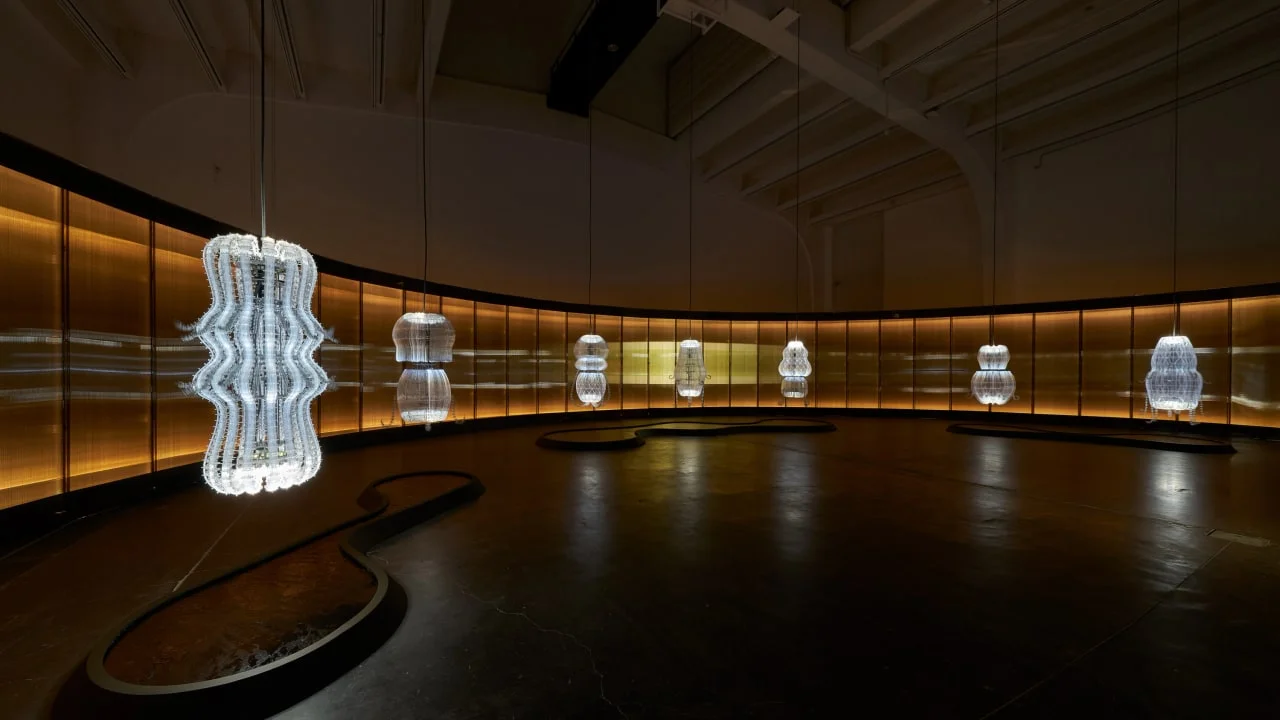
| Anicka Yi | Memory Sleeper Cell / the Kelp Pods line | 2023; shown within Yi's 2025 UCCA survey | Kelp, aquazol, glycerin, crepeline, acrylic, LED, and an animatronic insect; UCCA lists the work among the exhibition pieces in There Exists Another Evolution, But In This One 1 | Yi makes biology look like industrial lighting that has learned to pupate. The UCCA survey also frames her practice through bacteria, scent, kelp, animatronics, and genetically engineered bacteria in Another You (2024). 2 |
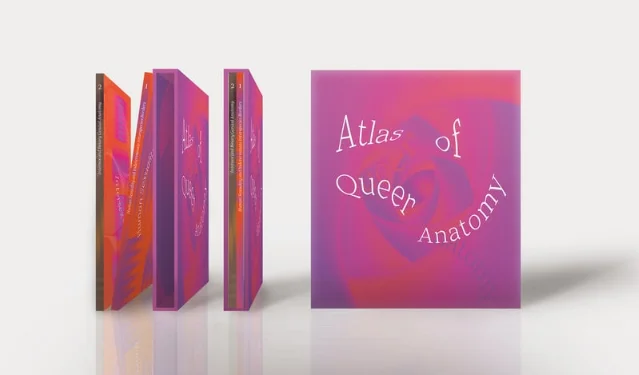
| Kuang-Yi Ku | Atlas of Queer Anatomy | 2025 Prix Ars Electronica Honorary Mention | A book, anatomical drawings, 3D sculptures, installations, and participatory "Queer Anatomy Lesson" performances; the project credits include book design, 3D model fabrication, textile fabrication, and spatial design. 3 | The work rewrites anatomical illustration as a contested visual system. Its chapters bring microorganisms, intersex anatomy, transgender anatomy, body odor microbes, and sex toys into the same atlas logic. 4 |
| Oron Catts, Ionat Zurr, and Guy Ben-Ary / The Tissue Culture & Art Project | Pigs Wings | 2000-2001 | Pig mesenchymal cells, described by the artists as bone-marrow stem cells, grown over biodegradable polymers for about nine months in a rotary bioreactor; each wing measured roughly 4 × 2 × 0.5 cm before preservation and gold coating. 5 | It turns the wing into a moral diagram: angel, bat, and pterosaur forms grown as semi-living objects rather than carved symbols. MoMA's collection text describes the project as pig bone tissue grown in the shapes of pterosaur, bat, and imaginary angel wings. 6 |
| The Tissue Culture & Art Project | Victimless Leather | 2004 | Living tissue layer supported by biodegradable polymers, grown into miniature stitch-less coat-like forms and displayed in incubators. 7 | It makes the promise of cruelty-free material production visually awkward. The coat is tiny and tender, yet the incubator makes it impossible to forget that "victimless" still depends on maintenance, infrastructure, and a definition of life. |
| Jalila Essaïdi | 2.6g 329m/s, also known as Bulletproof Skin | 2010 project, later widely exhibited | In vitro human skin combined with spider silk from genetically modified organisms; the artist's biography describes the result as bioengineered bulletproof human skin able to stop a slow-speed bullet. 8 | Essaïdi takes the fantasy of invulnerability and gives it a biological texture. It is not armor as metal shell, but skin as engineered boundary. BioArt Laboratories also identifies her spider-silk bulletproof skin as the experience that led her to found the Eindhoven lab. 9 |
| Stelarc | Ear on Arm | 2008-ongoing | A surgically constructed ear on the forearm, using skin expansion and a porous biocompatible Medpor scaffold; Stelarc's project text describes the ambition to re-implant a miniature microphone so the ear can transmit sound over the internet. 10 | The work treats anatomy as interface design. The body is not repaired here. It is extended, made strange, and asked to host a media device under the skin. |
The recent signal: anatomy is being redrawn, not merely displayed
The two freshest entries here are not wet-lab spectacles in the narrow sense. They are more precise than that. Yi's 2025 UCCA survey presented nearly 40 works across almost two decades, including newly commissioned pieces, and placed kelp, bacteria, scent, animatronics, AI, and video inside rooms that evoked laboratories, spacecraft, and corporate interiors. 1 The result is a show where living systems are rarely isolated as specimens. They are part of an atmosphere.
That matters visually. In the Kelp Pods works, light hangs in organ-like forms. In Radiolaria, ancient zooplankton become animatronic structures. In Another You, UCCA describes colorful genetically engineered bacteria incorporating DNA from marine organisms such as jellyfish and coral. 1 Yi's work asks the viewer to read the gallery as a habitat, not a neutral white container.
Kuang-Yi Ku's Atlas of Queer Anatomy reaches the same issue through diagrams rather than organisms. The project starts from a critique of Frank Netter's canonical Atlas of Human Anatomy and builds an alternate atlas around bodies that standard medical illustration has often simplified, excluded, or pathologized. 3 Its strongest visual move is not shock. It is format theft: the textbook, the anatomy lesson, the clean diagram, the exhibition plinth. Ku borrows those forms and fills them with bodies and symbioses that do not fit the old lesson.
The canonical pressure point: semi-living objects are hard to classify
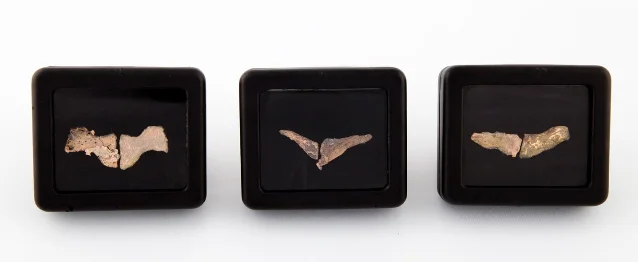
The Tissue Culture & Art Project remains unavoidable because it gave bio art one of its most durable visual categories: the semi-living object. In Pigs Wings, the wing is small enough to fit inside a case, but the project points far beyond scale. The artists name three cultural wing types: bird-like, bat-like, and pterosaur-like. 5 Their choice turns tissue engineering into a miniature bestiary of moral associations.
Victimless Leather is less mythic and more domestic. It looks like a garment, which makes the proposition more uncomfortable. FACT describes the work as three miniature semi-living jackets, grown from cell lines into a living tissue layer supported by biodegradable polymers and displayed in incubators so that growth could continue during the exhibition. 7 The work's title offers a solution; the object immediately complicates it.
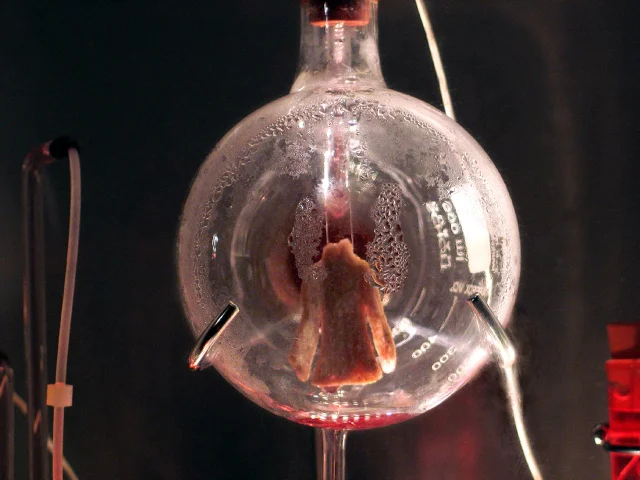
These two TC&A works are visually modest compared with today’s immersive installations, but they are conceptually sharp. They refuse the easy split between object and organism. A preserved wing is no longer growing, but it came from a living process. A jacket can appear humane in premise, yet it still asks what kind of care, containment, and disposal a semi-living artwork requires.
Skin and prosthesis: protection becomes performance
Essaïdi and Stelarc bring the issue back to the human body. Bulletproof Skin is easy to misread as a superhero provocation. The more interesting part is the material translation. Essaïdi's biography states that the project combined in vitro human skin with spider silk from genetically modified organisms. 8 The fantasy of the bulletproof body becomes a lab-grown membrane, soft and unsettling because it is still recognizably skin.
Stelarc's Ear on Arm works in the opposite direction. Instead of making skin defensive, it makes the body receptive. His official project text describes skin expansion, a Medpor scaffold, a microphone that was tested and later removed after infection, and a planned re-implantation that would make the ear a remote listening device. 10 The visual charge comes from relocation. An ear is familiar on a head. On the inner forearm it becomes architecture, interface, and wound at once.
Seen together, these two works keep the body from settling into one meaning. Skin can be shield, surface, lab sample, or sculpture. An organ can be anatomical feature, prosthesis, network node, or public performance. Bio art is often described through its materials, but these works show why placement matters just as much as medium.
What to look for next
The field is moving in two directions at once. One direction makes living systems more immersive, with organisms, odors, machine learning, and responsive objects shaping the whole exhibition environment. Yi's 2025 UCCA survey is the clearest signal in this issue. 2 The other direction returns to pedagogy: diagrams, atlases, workshops, and anatomy lessons that decide whose bodies become visible. Ku's 2025 Ars Electronica recognition makes that strand newly prominent. 3
The best bio art right now is not just showing life. It is asking what visual habits make a body seem natural in the first place: the museum vitrine, the medical textbook, the incubator, the surgical diagram, the heroic prosthesis. Change those habits and the body starts to look provisional.
Fuentes de referencia
- 1Anicka Yi: There Exists Another Evolution, But In This One - UCCA
- 2There Exists Another Evolution, But In This One at UCCA, Beijing - Anicka Yi Studio
- 3Prix Ars Electronica 2025 - Atlas of Queer Anatomy
- 4Atlas of Queer Anatomy - Kuang-Yi Ku
- 5Pigs Wings - The Tissue Culture & Art Project
- 6The Pig Wings Project - MoMA
- 7Victimless Leather (2004) - FACT
- 8About - Jalila Essaidi
- 9BioArt Laboratories - Organisation
- 10Ear on Arm - Stelarc
Añade más opiniones o contexto en torno a este contenido.