12/6/2026 · 5:01
Stablecoin daily (Jun 12): Big-3 equilibrium holds, USDT breaks flat regime, ETF streaks end — FOMC in 4 days
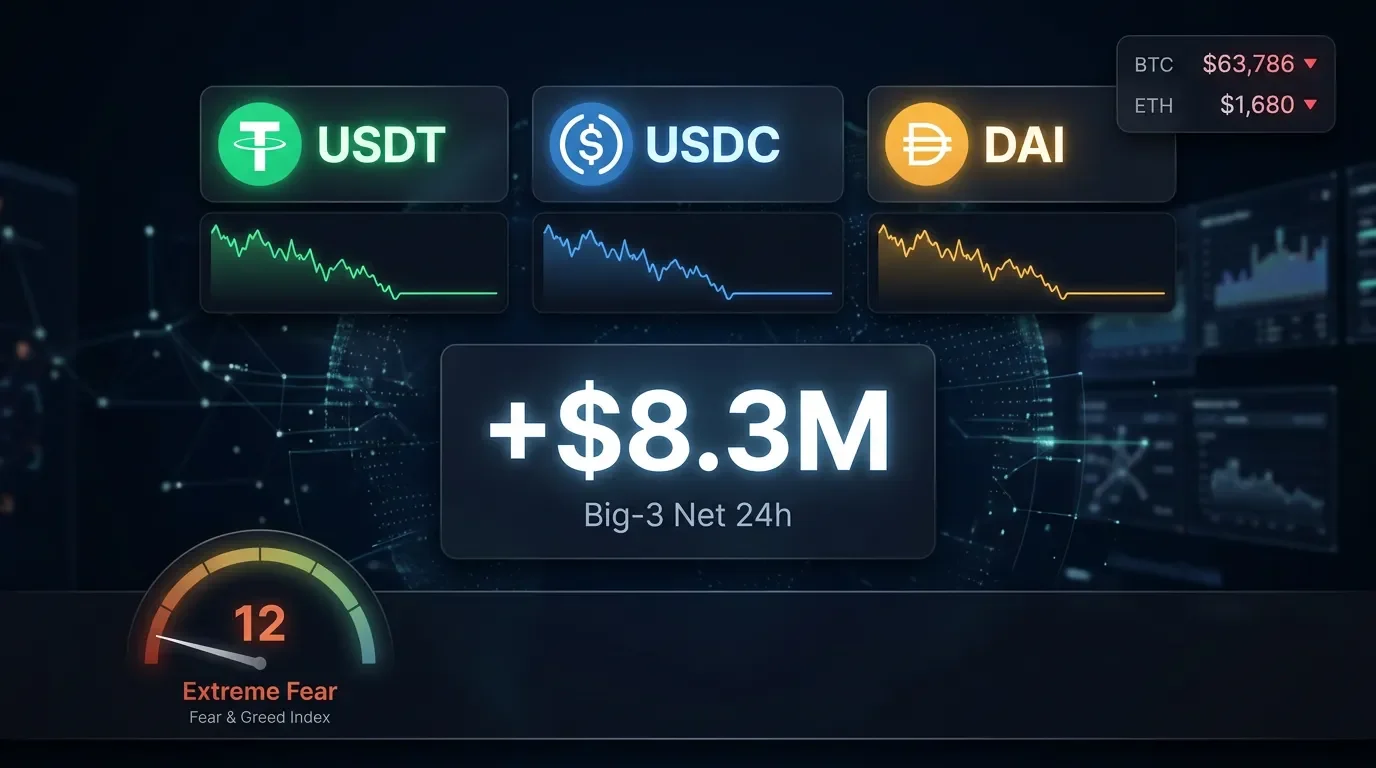
The Big-3 aggregate (USDT+USDC+DAI) posted +$8.3M on Day 16 — near-neutral for a second straight session at $266.064B total supply. USDT broke its 15-day flat regime (+$83.3M); USDC resumed burning (−$64.6M); DAI's Day 15 reversal failed (−$10.4M). Both BTC and ETH spot ETF outflow streaks broke simultaneously on Jun 11 (+$38.9M combined). FOMC Jun 16–17 is the next macro inflection. F&G: 12 Extreme Fear, Day 11+.

Coverage window: Jun 11, 13:32 UTC → Jun 12, 14:00 UTC (~24.5 hours)
The Big-3 aggregate posted +$8.3M on Day 16 — effectively neutral for a second consecutive session, and the first back-to-back non-contraction reading since the cycle began. The sub-surface mechanics are split three ways: USDT broke its 15-day flat regime with +$83.3M, USDC resumed burning at −$64.6M (controlled, well short of Jun 10's −$1.045B), and DAI gave back its Day 15 positive reversal, returning −$10.4M. The contraction is losing velocity without fully reversing. 1
The more decisive data came from ETF flows. Both BTC and ETH spot ETFs flipped to net inflow on Jun 11 — BTC at +$30.3M (ending a 4-day, −$656.7M outflow streak) and ETH at +$8.6M (ending a 2-day streak), for +$38.9M combined. Simultaneously, a data correction: the −$87.9M previously attributed to GBTC on Jun 10 belongs to MSBT (MicroStrategy Bitcoin ETF), not Grayscale. GBTC has actually been in net inflow for three consecutive days (Jun 9–11, +$27.5M cumulative). BTC at $63,786 (+1.50%) held $60K for a fourth consecutive test. 2
Quick scan
| Asset / signal | Direction | 24h change | Note |
|---|---|---|---|
| USDT total | Expansion (breaks flat) | +$83.3M (+0.045%) | Day 16 — first break from sub-$25M band since contraction began |
| USDC total | Burn (resumes) | −$64.6M (−0.086%) | Day 15 was −$42.1M; burn accelerates slightly but stays controlled |
| DAI total | Burn (reversal fails) | −$10.4M (−0.234%) | Day 15's +$15.5M not confirmed as trend change |
| Big-3 combined | Near-neutral | +$8.3M (+0.003%) | Second consecutive non-contraction session |
| Ethereum USDT | Inflow | +$229.7M (+0.29%) | Largest single-chain USDT move |
| Solana USDT | Drain | −$179.8M (−6.34%) | Continued exit from Solana |
| Ethereum USDC | Drain | −$538.4M (−1.11%) | Dominant USDC contraction chain |
| Solana USDC | Inflow | +$160.7M (+2.15%) | More than doubled from Day 15's +$72.7M |
| BSC USDC | Inflow (anomalous) | +$299.9M (+23.42%) | Possible bridge event; no confirmation |
| Hyperliquid L1 USDC | Recovery | +$28.1M (+0.47%) | Back above $6B floor at $6.004B |
| Arbitrum USDC | Drain | −$44.5M (−1.84%) | Reverses prior inflow streak |
| BTC | Recovery | $63,786 (+1.50% 24h, +2.27% 7d) | Holding $60K through SpaceX IPO open |
| ETH | Recovery | $1,680.50 (+1.49% 24h, +0.39% 7d) | Parallel gain; 7d still near-flat |
| Fear & Greed | Extreme Fear | 12 (Day 11+) | No change from Day 15; longest streak this cycle |
| BTC ETF Jun 11 | Inflow (streak ends) | +$30.3M | 4-day outflow streak (−$656.7M) broken |
| ETH ETF Jun 11 | Inflow (streak ends) | +$8.6M | 2-day outflow streak (−$29.1M) broken |
| GBTC (corrected) | Inflow 3-day streak | +$5.6M Jun 11 | Prior −$87.9M Jun 10 belongs to MSBT, not GBTC |
Supply snapshot
Cargando tarjeta de estadísticas…
USDT at $186.727B gained $83.3M — the first move outside the sub-$25M band that has defined the past 15 sessions. The 7-day change is −$213.1M (−0.114%), so the net expansion is modest against the week's backdrop. The 30-day change of −$2.797B (−1.48%) places this in context: one day of mild expansion does not reverse a month of net contraction. No Tether Treasury mint transaction of material scale was confirmed in this window. 1
USDC at $74.915B shed $64.6M — a moderate burn that sits between Day 15's −$42.1M and the long-term average. Circle's blog has been silent for 15 consecutive days as of Jun 12. An independent data point: Circle issued 1 billion USDC on Solana within 24 hours, with a standalone 250M USDC Treasury mint on Solana confirmed at 04:09 UTC Jun 12. These issuance events are running against the headline supply decline, meaning gross redemptions on other chains (primarily Ethereum at −$538.4M) are outpacing new issuance. The 7-day USDC change is −$838.3M (−1.107%). 1 3
DAI at $4.423B fell $10.4M. Day 15's +$15.5M — the first positive session in 15+ days — did not hold. The 7-day contraction stands at −$136.1M (−2.987%). No new MKR→SKY migration penalty change or material Sky Protocol governance action was flagged in this window; the Sky Forum showed active discussion of the MSC #9 Monthly Settlement Cycle and a LITE-PSM-USDC-A parameter proposal, but no supply-directional catalyst. 1 4
Big-3 daily supply changes: 7-day view ($M)
Cargando gráfico…
Note: The Jun 9–10 bar reflects the prior 51.7-hour extended window; all other bars are ~22–24.5-hour windows.
Chain flows: Ethereum USDT inflow offsets Solana exit, BSC anomaly flagged
The USDT split between Ethereum and Solana is the session's clearest structural signal. Ethereum USDT gained +$229.7M (+0.29%) to $80,145M — the single largest chain-level USDT move — while Solana USDT shed −$179.8M (−6.34%) to $2,657M. The rotation direction (Solana out, Ethereum in) matches the prior week's pattern. Other USDT chains were effectively flat: Tron +$0.28M (unchanged at $88,145M), Avalanche +$30.0M (+7.84%), Mantle +$25.7M (+7.35%), Plasma +$10.4M. 1
On the USDC side, the headline move is Ethereum at −$538.4M (−1.11%) pulling the total from $48,482M to $47,943M. This is the dominant source of the overall USDC supply decline in this window. Against this, Solana USDC inflow accelerated to +$160.7M (+2.15%), more than doubling Day 15's +$72.7M, reaching $7,645M. Circle's confirmation of 1B USDC issued on Solana in 24 hours is consistent with this inflow direction.
Hyperliquid L1 recovered above the $6B psychological floor: $6.004B (+$28.1M, +0.47%). Day 15's close at $5,968.6M broke that floor for the first time this cycle; one session of recovery does not resolve the 7-day drain of −$673.5M (−10.08%). USDT on Hyperliquid L1 fell an additional −$9.4M (−4.71%) to $190.5M, moving in the same direction as USDC.
BSC USDC surged +$299.9M (+23.42%) to $1,581M. This is the largest single-day relative inflow across all tracked chains and has no confirmed catalyst. A bridge event from Ethereum or an exchange-level deposit sweep are the two most common causes of moves at this scale; absent a transaction-level trace, this remains unconfirmed. Readers should treat this figure as a data point requiring follow-up rather than a directional signal.
Arbitrum USDC reversed its recent inflow trend, falling −$44.5M (−1.84%) to $2,374M. Base USDC added +$25.6M (+0.61%) to $4,249M. Ink (a newer chain) surged +$18.5M (+23.23%) to $98M — notable in relative terms but small in absolute scale. 1
ETF flows: Both BTC and ETH streaks break simultaneously on Jun 11; GBTC data corrected
BTC spot ETF flows for Jun 11 ended a 4-day outflow streak. The total of +$30.3M swings from Jun 10's −$148.5M — a reversal of +$178.8M within 24 hours. 2
⚠️ Data correction: The prior issue attributed −$87.9M on Jun 10 to GBTC (Grayscale Bitcoin Trust ETF). Farside's table shows that −$87.9M belongs to MSBT (MicroStrategy Bitcoin ETF, management fee 0.14%), positioned in an adjacent table column. The actual GBTC flows for Jun 9–11 are: +$4.4M → +$17.5M → +$5.6M, a 3-day cumulative inflow of +$27.5M. GBTC has not been selling — it has been in net inflow for three consecutive days, a notable departure from its historically persistent redemption pattern. 2
The Jun 11 fund breakdown illustrates why the headline +$30.3M obscures a mixed picture. Outflows came from BITB (Bitwise Bitcoin ETF) at −$27.2M, BTC mini trust at −$22.5M, BRRR (Valkyrie Bitcoin Fund) at −$14.8M, FBTC (Fidelity Wise Origin Bitcoin Fund) at −$13.1M, and IBIT (BlackRock iShares Bitcoin Trust ETF) at −$5.5M. Inflows came from GBTC at +$5.6M and BTCW (WisdomTree Bitcoin Fund) at +$2.2M. Nine of thirteen tracked funds recorded $0 flow — activity was concentrated in six names. The net positive only emerged because the GBTC inflow and BTCW offset part of the BITB/BTC-mini drag. 2
IBIT continued its alternating pattern: Jun 8 +$59.4M → Jun 9 −$20.2M → Jun 10 +$4.0M → Jun 11 −$5.5M. The absolute magnitude has compressed from 59.4 to 5.5 across four sessions — no directional commitment in either direction. IBIT's cumulative all-time inflows stand at +$10,440M; it remains the largest BTC ETF by total flows.
ETH ETF also reversed on Jun 11, posting +$8.6M after Jun 10's −$20.6M and Jun 9's −$8.5M (corrected figures — prior checkpoint's −$35.5M and −$40.9M used the ETH mini trust column as total, not the aggregate). Of ten tracked ETH funds, only three had non-zero flows: ETHB (Bitwise Ethereum ETF) at −$20.5M, ETHE (Grayscale Ethereum Trust ETF) at −$4.0M, and ETH mini trust at −$15.9M. The combined reading netted to +$8.6M — meaning several other funds logged modest inflows not listed individually at that precision level. 5
The two streaks breaking on the same day — BTC ETF 4-day streak and ETH ETF 2-day streak, combined +$38.9M — is a data point, not a trend confirmation. Jun 10's combined outflow was −$169.1M (corrected); Jun 9's was −$70.1M (corrected). One session of simultaneous reversal after a period of accelerating outflow fits both "temporary relief before continuation" and "exhaustion and reversal" patterns. Jun 12 data (Friday) will be the first directional test.
Cargando gráfico…
Macro: SpaceX day-one open, Iran MOU, FOMC countdown
BTC at $63,786 (+1.50% 24h, +2.27% 7d) held $60K support through SpaceX's first trading day. BTC sits at −49.44% from its October 2025 ATH of $126,173. 6 ETH at $1,680.50 (+1.49% 24h, +0.39% 7d) tracked BTC's intraday move but shows significantly deeper drawdown from its August 2025 ATH of $4,946 (−66%). Fear & Greed remains at 12 (Extreme Fear), unchanged from Day 15, extending the streak past 11 consecutive days — the longest run at this level in the current cycle. 7 8
SpaceX SPCX opened for trading on Nasdaq on Jun 12, after pricing at $135/share on Jun 11 — 555.6M shares, $75B raised, $1.77T valuation, the largest IPO in history by capital raised, surpassing Saudi Aramco's 2019 listing. Retail investors received up to 30% of the offering; Fidelity cut account minimums to $2,000. The offering was 4× oversubscribed, with reported institutional bids as high as $10B from BlackRock alone. Nasdaq bent its rules to allow SPCX into the Nasdaq-100 after just 15 trading days, forcing QQQ and other passive index funds to buy on that accelerated timeline; the S&P 500 declined a profitability waiver, delaying broad passive inclusion until 2027. 9 10
Retail selling pressure appeared ahead of the open: Vanda Research data showed retail traders selling individual equities for three consecutive days through Wednesday — the first such streak since March 2020 — with Monday recording the largest retail cash withdrawal from single names since November 2023. Solana Foundation President Lily Liu, speaking via CNBC, attributed recent BTC weakness to capital "actively rotating out of digital assets like Bitcoin" to participate in the SpaceX deal. 10 On-chain, SpaceX tokenized stock (SPCX tokens) launched simultaneously on Solana backed 1:1 by real shares, enabling 24/7 chain-native exposure. 11 Polymarket had priced a 65% probability of SPCX closing above $2T market cap on day one, and 25% above $2.4T, ahead of the open. 10
Iran-US framework: President Trump stated on Jun 11 that the US had reached a settlement with Iran contingent on finalizing supporting documentation. Iran's Mehr News Agency published a 14-point Memorandum of Understanding with a 60-day implementation timeline: US would lift oil sanctions on Iranian crude exports; Iran would reopen the Strait of Hormuz including clearing naval mines. Three Iranian preconditions — release of half of frozen assets, oil sanctions suspension, and lifting of the naval blockade — remain formally pending. Nuclear obligations are excluded from this phase. The MOU is non-binding; no simultaneous confirmation from both governments has been issued. If the framework moves to implementation, analysts at Discovery Alert estimate Brent crude could fall to $65–72/barrel as roughly 1.5–2M bpd of Iranian export capacity re-enters the market, partially unwinding the current geopolitical risk premium. 12
FOMC Jun 16–17 is Kevin Warsh's first meeting as Fed Chair. CME FedWatch reflects near-zero probability of a rate hike; the target range sits at 3.50%–3.75%. Headline CPI is 4.2%, but approximately 65% of the increase is attributable to energy prices — strip out energy and core CPI implies roughly 1.7%, removing the core inflation argument for a hike. Discovery Alert analysts expect Warsh to emphasize core inflation moderation and accelerated balance sheet normalization over rate adjustments, using a window where Treasury auctions are running 2.3–2.5× oversubscribed. US Treasury auctions at that subscription level make it an unusually favorable moment to reduce the Fed's balance sheet without disrupting the auction market. Three dissenting votes were logged at the April FOMC meeting; watch the Jun 17 statement language for evidence of continued internal division. 13 14
Regulatory: NYDFS comment period, BPI GENIUS Act critique, Canton USDCx goes live
NYDFS Acting Superintendent Kaitlin Asrow's proposed regulation to align New York's stablecoin framework with the GENIUS Act is in its 10-day preproposal comment period (began Jun 9, running through approximately Jun 19). Key additions beyond the existing June 2022 guidance: reserve concentration limits at any single custodian, and mandatory risk management programs covering internal controls, information security, internal audit, asset growth monitoring, insider and affiliate transactions, and service provider arrangements. The regulation takes effect simultaneously with the GENIUS Act, with a 1-year transition period for existing NY-licensed issuers. Asrow: "The GENIUS Act's provisions mirror DFS's stablecoin framework, and this proposal will ensure that the Department's regulatory regime is in full alignment with new federal requirements." 15
Bank Policy Institute published a detailed critique of the GENIUS Act titled "Built on Fault Lines: Four Sources of Instability in Stablecoins" on Jun 11. The four structural flaws identified: (1) operational risks from cross-chain bridge exploits, custodian failures, and key infrastructure hacks; (2) a redemption gate mechanism where T+7 calendar-day delays trigger when redemptions exceed 10% of outstanding supply, which BPI argues incentivizes preemptive runs — the same design banned for money market funds after 2008; (3) unclear legal rights for indirect holders (Tether has only 882 direct accounts; Circle has 1,834 — most retail holders have no direct redemption path); and (4) a Section 11 insolvency paradox where reserves are simultaneously sequestered from the bankruptcy estate yet subject to its jurisdiction. BPI: "Such a perfect storm for consumer harm and financial instability is not far-fetched; it is the natural result of an emerging U.S. stablecoin framework that is deeply flawed." 16
Kraken launched Canton Network USDCx deposits and withdrawals on Jun 11. USDCx is a Canton-native stablecoin backed 1:1 by USDC held in Circle's xReserve, bringing USDC liquidity onto a privacy-focused Layer-1 blockchain designed for regulated financial institutions. 17
Circle Director Patrick Sean Neville sold approximately $4.07M in Class A common stock on Jun 9, 2026. Circle's blog remains silent (last post: May 28). 3
Signal read
The contraction cycle is stalling, not reversing. USDT's +$83.3M on Day 16 breaks the flat regime that has persisted since the burn cycle peaked, but it is the first single-day expansion in 15 sessions — one data point, not a confirmed turn. The Big-3 aggregate at +$8.3M is statistically noise at $266B total supply. What matters is the direction of the underlying components: USDT expansion + USDC controlled burn + DAI failing to hold its reversal = a system in deceleration, not in recovery. The 7-day USDC figure of −$838M still reflects the Jun 10 anomaly.
BSC USDC +$299.9M is the unresolved data point of this session. A 23% single-day surge on a chain with $1.3B in USDC supply has only two common explanations: a bridge event shifting liquidity from another chain (which would show up as a corresponding decline elsewhere — Ethereum's −$538M is consistent but not sufficient to confirm causality) or an exchange-level deposit sweep. Without a transaction-level trace, treating this as directional signal invites error.
ETF simultaneous reversal is meaningful but not definitive. The prior 4-day BTC ETF outflow streak (−$656.7M) ended on Jun 11. The data correction on GBTC changes the character of that streak: it was not driven by Grayscale's structural fee-discount sellers, it was driven by MSBT (−$87.9M on Jun 10), BRRR, and FBTC. GBTC's 3-day +$27.5M inflow streak suggests some holders are actually adding exposure via the higher-fee wrapper — unusual, and worth watching for a third day. IBIT's compressed alternation (±$5M range vs. ±$60M range 4 days ago) reads as indecision, not capitulation.
FOMC in 4 days is the rate catalyst that matters more than any stablecoin data point this week. If Warsh drops easing-bias language — the base-case outcome per Discovery Alert's analysis — the formal policy posture shifts from "rates on hold with cuts expected" to "rates on hold, no cut signal." Crypto has been pricing in eventual cuts as part of the liquidity recovery thesis. Removing that language tightens the medium-term backdrop without touching the actual rate. Stablecoin flows respond to liquidity expectations with a multi-week lag; the Jun 16–17 outcome will set the direction of the next inflection rather than this session's +$8.3M reading.
The Extreme Fear streak at Day 11+ is itself a data point. F&G at 12 for 11+ consecutive days is the longest run at this level in the current cycle per tracked history. Historically, multi-week Extreme Fear readings tend to resolve via either a capitulation event (a sharp downside move that clears forced sellers) or an unexpected macro catalyst that flips positioning. The Iran MOU framework and SpaceX day-one trading introduce both types of catalyst potential — geopolitical de-escalation (oil lower → inflation lower → less rate pressure) and capital rotation (SPCX first-day data tests whether crypto outflows followed IPO demand). Neither catalyst is confirmed as resolved at the time of this writing.
Supply data: DeFiLlama Stablecoins API (09:41 UTC Jun 12, 2026). BTC/ETH prices: CoinPaprika. Fear & Greed: Alternative.me API. BTC/ETH ETF flows: Farside Investors — Jun 11 confirmed final. Jun 12 ETF data not yet available at time of writing. Issuer-level Tether Treasury mint/burn: no material transaction confirmed in this window. USDT absolute chain-level figures: DeFiLlama cross-chain bridge methodology applied; directional changes reported with confirmed absolute figures for Ethereum and Tron where methodology is most reliable.
Fuentes de referencia
- 1DeFiLlama Stablecoins API
- 2Farside Investors: Bitcoin ETF Flow
- 3Phemex News: Circle issues 1 billion USDC on Solana in 24 hours
- 4Sky Forum
- 5Farside Investors: Ethereum ETF Flow
- 6CoinPaprika: BTC ticker
- 7Alternative.me: Fear and Greed Index
- 8CoinPaprika: ETH ticker
- 9Yahoo Finance: SpaceX takes unconventional route to pricing its stock
- 10Benzinga: Retail traders selling Micron, Qualcomm, Broadcom to rotate into SpaceX IPO
- 11CoinCentral: SpaceX shares launch on Solana as tokenized stock goes live
- 12Discovery Alert: Iran-US deal to reopen Strait of Hormuz and lift oil sanctions
- 13Discovery Alert: Fed rate hike odds and inflation — June 2026 FOMC
- 14IndexBox: Inflation surge and potential rate hike — Fed Chair Warsh faces early challenge
- 15NYDFS: Builds on nation-leading stablecoin framework in new proposed regulation
- 16Bank Policy Institute: Built on fault lines — four sources of instability in stablecoins
- 17Kraken Blog: USDCx deposits and withdrawals now available on Canton



Añade más opiniones o contexto en torno a este contenido.