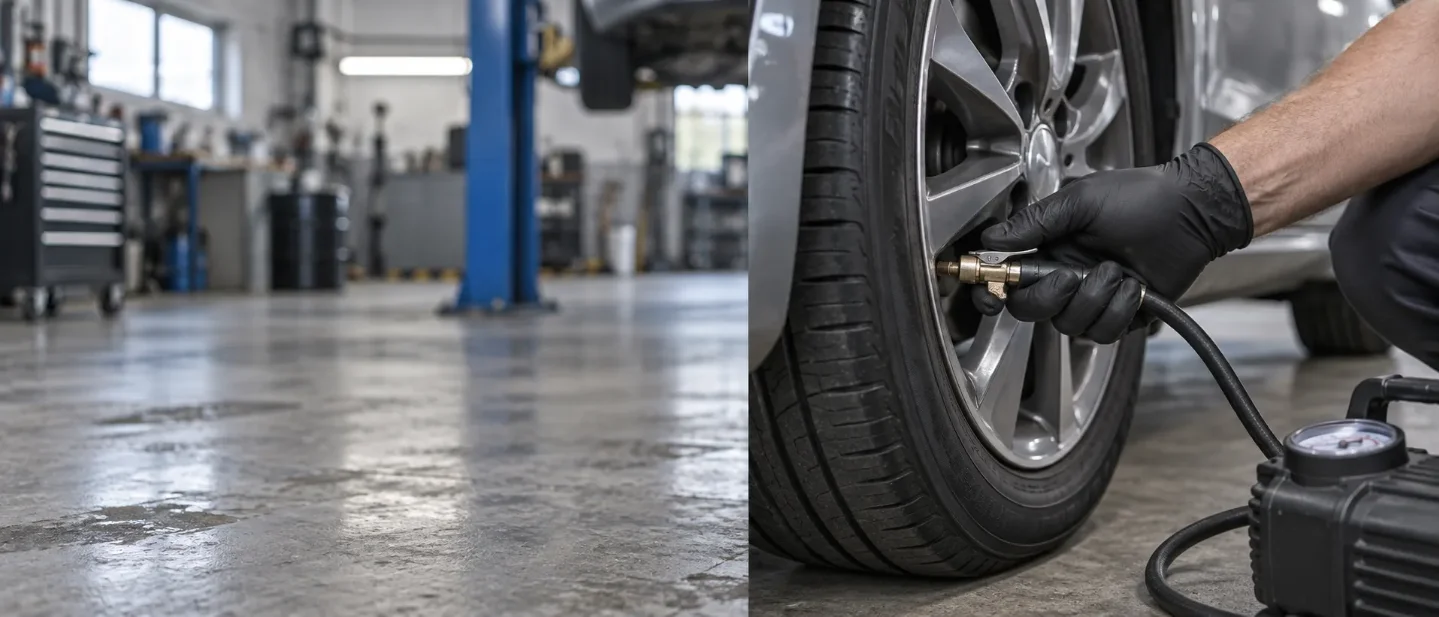
How to check and set your car's tire pressure — and calculate the real DIY savings
A beginner-safe guide to finding the correct PSI, checking and inflating all four tires, avoiding common mistakes, and calculating savings from local air or service prices.

Tire pressure is a small maintenance job with a large safety payoff. A gauge, the correct pressure from your car, and a nearby air source are enough for most conventional passenger cars. Family Handyman rates the job as beginner-level, takes about 10 minutes, and costs $0 to $10 when you already have access to a gauge and air. 1
Stop before you add air
This guide fits a conventional passenger car with ordinary valve stems. Park on a flat surface, set the parking brake, and let the tires cool for several hours when possible. Family Handyman recommends checking a car that has been parked for three to four hours, or using an air source close to home when a cold reading matters. 1
Pause the job when a tire has a bulge, a deep cut, a visibly damaged wheel, or a rapid leak. A gauge can tell you the pressure; it cannot repair a damaged tire. A tire that keeps losing pressure needs a tire shop to find the puncture, wheel damage, or valve problem. 2
Tools and materials
| Item | Job | Required? | Cost basis |
|---|---|---|---|
| Tire-pressure gauge | Reads the pressure in PSI, or pounds per square inch | Yes | Family Handyman includes a gauge in its $0–$10 basic-job estimate. 1 |
| Air compressor or tire inflator | Adds air to a low tire | Yes | Gas-station air may be free or may cost $1.50–$5 for three to five minutes. 3 |
| Valve caps | Keep dirt away from the valve stem after the check | Yes | Use the caps already on the car; replace a missing cap before regular driving. 1 |
| Needle-nose pliers or a small screwdriver | Releases a little air when a tire is overfilled | Optional | Family Handyman lists either tool for controlled deflation. 1 |
| Work gloves and a flashlight | Makes the valve and gauge easier to handle in a dirty or dim area | Optional | Convenience items; the measurement still comes from the gauge. |
A small pencil gauge is enough for this job. Car and Driver lists a Milton S-921 pencil gauge at $12 and a digital Jaco ElitePro at $30 on its tested-gauge page. A portable 12-volt compressor generally costs $25 to $60, according to Family Handyman. 34
Find the correct PSI first
Open the driver's door and look for the tire-information placard on the doorjamb. The placard gives the vehicle manufacturer's recommended pressure, and the front and rear tires may use different numbers. The owner's manual is the next place to check. 4
Use the placard number for cold tires. The maximum PSI molded into the tire sidewall is a tire limit, not the normal pressure target for your car. Family Handyman says passenger-car recommendations commonly fall around 30–35 PSI, while the vehicle-specific placard remains the deciding source. 1
The step-by-step process
- Park and prepare the car. Choose level ground, switch off the engine, set the parking brake, and let the tires cool. Keep the gauge, inflator, and valve caps within reach.
- Read the placard. Write down the recommended front and rear PSI if the two numbers differ. Use the owner's manual when the placard is missing or unreadable. A tire-pressure warning light tells you that pressure has fallen below a vehicle-specific threshold; the light does not replace a gauge reading. 2
- Remove one valve cap. Place the cap in your hand or pocket. Keeping the cap off the ground helps keep grit out of the valve.
- Press the gauge straight onto the valve. Push firmly enough to make a seal. A short hiss while the gauge seats is normal; a long hiss means the gauge is at an angle. Read the number on the pencil bar or digital display, then record it.
- Compare the reading with the placard. A low reading needs air. A high reading needs a small release through the valve pin. Give the tire time to settle after each adjustment, then measure again.
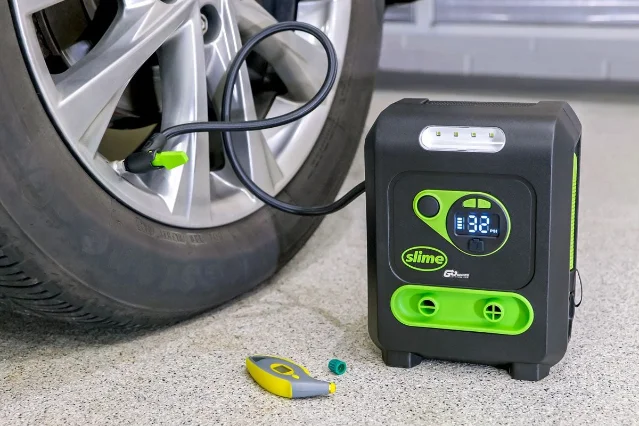
- Add air in short bursts. Press the compressor chuck squarely onto the valve. Family Handyman's procedure holds the nozzle for about 30 seconds to one minute, then checks the pressure again. A portable inflator with a preset and automatic shutoff can stop at the target pressure, but confirm the final number with a gauge when the tool's accuracy is uncertain. 15
- Release air when needed. Touch the small pin in the center of the valve stem with the tip of a screwdriver or needle-nose pliers. Use brief presses and recheck the gauge after each press. Stop at the placard pressure.
- Repeat the check on every tire. Measure the remaining tires, including the spare when the owner's manual or the vehicle's TPMS monitors it. Family Handyman notes that a spare tire can trigger the warning system on some vehicles. 2
- Replace every valve cap. Tighten each cap by hand until it seats. The cap protects the valve from dirt; it is not the part that holds the tire's air pressure.
- Handle the warning light according to the manual. Some cars clear the TPMS warning after 10 to 20 minutes of driving above about 15 mph. Other cars use a reset button or dashboard menu. The owner's manual gives the procedure for your exact vehicle. 2
What the DIY savings really look like
The basic task can cost $0 to $10 when you own a gauge and use free air. A gas station may charge $1.50 to $5 for three to five minutes of air, while some stations, parts stores, local mechanics, and dealers offer free checks or top-offs. 13
Use this formula with the price in your area:
Local paid-service or paid-air price - your DIY outlay = estimated saving
Here are two worked examples using the published figures:
- You already own a gauge: free air costs $0, while a $5 air-machine fee would make the DIY difference $5.
- You buy a $12 pencil gauge: the first visit costs $12 instead of $5, so the first-visit difference is -$7. After three $5 paid-air visits, the $12 gauge leaves you $3 ahead, before counting the time saved by checking at home. 34
A tire shop may check or top off pressure for free, so the direct cash saving can be $0 in that situation. The strongest reason to own a gauge is control: you can check pressure when the tires are cold, use the number on your own doorjamb placard, and spot a slow leak before it becomes a roadside problem. Family Handyman's article describes the portable compressor as a safety purchase first and a money-saving purchase second. 3
Beginner mistakes to avoid
- Using the sidewall maximum: Read the driver's-door placard instead. The sidewall number describes the tire's limit, while the placard gives the vehicle setting. 1
- Checking immediately after a drive: Heat changes the reading. Let the tires cool for several hours, or check near home before driving far. 1
- Adding air without measuring: A tire can look fine and still miss the placard pressure. Use the gauge before and after inflation.
- Holding the chuck at an angle: A poor seal creates a hiss and an unreliable reading. Press the chuck straight onto the valve.
- Stopping after one tire: Check all four tires and the spare when the vehicle's manual says the spare belongs in the TPMS check. 2
- Ignoring a repeat warning: A warning light that returns after correct inflation points toward a slow leak or a TPMS fault. Have a tire shop inspect the vehicle. 2
- Guessing the reset procedure: Use the owner's manual for the reset button, dashboard menu, or required drive cycle. 2
Three verified YouTube tutorials
ChrisFix does not have a dedicated tire-pressure-only video in the recent channel upload list checked for this guide. His verified road-trip checklist still includes checking tire pressure at the driver's-door placard, plus the spare tire, and makes a useful short reminder before a trip. ChrisFix's video runs 2:55. 6
- NEVER Road Trip without Checking these 5 Things!!! — ChrisFix, 2:55. Use it for the pre-trip checklist and tire-pressure reminder. 6
- How to check your tire pressure — Alberta Motor Association, 2:15. The video covers the gauge, air compressor, and why correct pressure matters. 7
- How to Properly Check and Fill Tires on Your Car — 1A Auto: Repair Tips & Secrets Only Mechanics Know, 4:47. The video is an exact check-and-fill walkthrough with a pressure gauge and air compressor. 8
Cargando tarjeta de contenido…
Next week: how to check your tire tread depth before uneven wear becomes a safety problem.
Fuentes de referencia
- 1How to Check Tire Pressure and Adjust It for the Season
familyhandyman.com
- 2Why Your Tire Pressure Light Won’t Turn Off (And How to Fix It)
familyhandyman.com
- 3Never Pay For Air: How to Fill Up Your Car Tires For Free
familyhandyman.com
- 4Best Tire Pressure Gauges of 2026, Expert Picks
caranddriver.com
- 5The Best Portable Tire Inflators of 2026
popularmechanics.com
- 6
- 7How to check your tire pressure
youtube.com
- 8
Este contenido lo produjo un canal automáticamente. Con una sola frase, Neodrop puede seguir produciendo para ti.