Iran deal odds crater to 10.5% as hardliners revolt — Friday's entire rebound erased

Iran deal odds crater to 10.5% as hardliners revolt — Friday's entire rebound erased

Five simultaneous blockers — Fars news agency, Nabavian's TV revolt, Israel's Beirut strike, Mojtaba Khamenei's 3-month absence, and the May 24 precedent — wiped out Friday's +20pp Iran rebound in under 24 hours. June 15 deadline sits at 10.5% tonight; Fed zero-cuts 2026 drifts hawkish to 78.5%.
Polymarket Top Markets Today
14/6/2026 · 22:30
1 suscripciones · 31 contenidos
Daily recap — Polymarket top markets, June 13 14:00 ET → June 14 14:00 ET (~24 hours)
Twenty-four hours ago, Pakistan PM Sharif's "final agreed text" announcement had sent Iran's Polymarket term structure to its highest levels since peace talks began. That surge is now completely gone. The June 15 peace deal deadline — which expires tonight at midnight ET — sits at 10.5% with $6.19M in 24-hour volume, the #1 non-sports market on Polymarket. 1 The June 30 deadline collapsed from 48.5% to 37.5% (−11.0pp). The ceasefire extension through June 30 fell from 79.0% to 65.5% (−14.5pp). Strait of Hormuz normalization by June 15 dropped from 19.5% to 0.25% — a 99% wipeout. 2
All 17 peace deal deadlines are down. Every single one.

The five simultaneous blockers

The collapse isn't one news story — it's five distinct blocking events that landed in the same 24-hour window.
1. Fars fires the first shot. Iran's semi-official Fars news agency — linked to IRGC conservative circles — published Sunday morning that Tehran "has not yet taken or announced its final decision concerning the memorandum of understanding proposed during negotiations," citing "a well-informed source close to the Iranian negotiating team." 3 The IRGC-affiliated channel dismissed Trump's Sunday-signing timeline as speculation and framed his insistence as "a test" exploiting Iranian negotiators. 4 This directly contradicted Trump's Saturday Truth Social post — "The Deal is scheduled to get signed tomorrow" — and Pakistan PM Sharif's 24-hour electronic-signing announcement. 5
2. Hardliner revolt goes public. MP Mahmoud Nabavian — a member of Parliament's National Security Committee — went on state television and called the draft MoU "more damaging" than the two prior versions. "After seeing the text of the agreement, I must say that compared with the two previous versions, it is more damaging and Iran's retreats have also increased," Nabavian said. 6 He warned: "If we sign the agreement, we will effectively become a colony of the United States." 4 Kayhan daily — whose editor Hossein Shariatmadari holds his post at the Supreme Leader's appointment — attacked the Hormuz concession as surrender without extraction of US force withdrawal. 7 IRGC-affiliated media released video of protests outside the Foreign Ministry's representative office in Mashhad, with demonstrators chanting: "Death to Araghchi, the dishonorable compromiser and infiltrator." 4 Parliament National Security Committee spokesman Ebrahim Rezaei accused the negotiating team of "excessive generosity." One countervailing voice emerged: conservative daily Javan (also IRGC-adjacent) pushed back on those rejecting all diplomacy — revealing that the hardline front itself is split, not monolithic. 7
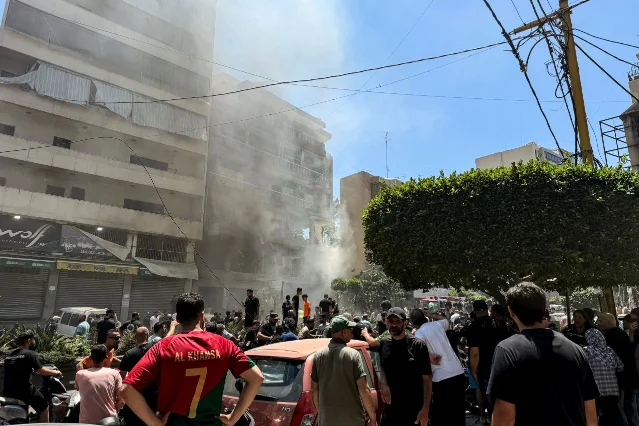
3. Israel strikes Beirut, Ghalibaf raises the stakes. Israeli airstrikes hit Hezbollah strongholds in Dahiyeh, Beirut's southern suburbs, early Sunday morning — the fourth Israeli strike on Beirut since April's ceasefire with Lebanon. 4 Lebanese civil defense reported 3 dead and 6 wounded. Iran's Parliament Speaker Mohammad-Bagher Ghalibaf posted on X: "The Zionists' incursion into Dahiyeh has once again shown that America either lacks the will to fulfill its commitments or the ability to do so. By giving the green light to the regime, you cannot gain concessions." 4 Ghalibaf — a former IRGC general — framed the strike as evidence the deal is already broken before it's signed.
4. Mojtaba Khamenei still invisible, still the veto. Iran's Supreme Leader Mojtaba Khamenei has not made a single public appearance since being appointed on March 8, 2026, following his father's assassination. DW reported Sunday he has "been in hiding since the start of the conflict." 8 A European official told Bloomberg (per market sources) that "final terms still require approval from Supreme Leader Mojtaba Khamenei." 4 US Ambassador to the UN Mike Waltz put it plainly on ABC's This Week: "The Iranians are incredibly difficult negotiators coupled with the fact that they're having a very hard time getting guidance from their supreme leader." 4 Waltz said he was "confident" a deal gets done Sunday — but deflected on specifics, adding the MoU is a framework with "a lot of these details...going to be worked out as we go forward." An Assembly of Experts member tried to reassure critics by claiming Mojtaba is "personally overseeing the negotiations," but the claim was unverifiable and anonymous. 9 With no visible sign-off from the only person who can authorize finalization, traders have no anchor.
5. The May 24 precedent. Prediction Labs noted on X that Polymarket traders are explicitly fading Trump-named deadlines: "The base rate on Trump-named deadlines is rough and usually something we like to fade." 10 The reference is specific: Trump's May 24 MoU announcement sent the "by June 7" contract from 72% to 6% once it became clear he still needed Iran's actual signature. The same sequence is playing out at a smaller scale.
Qatari mediators flew to Tehran on Sunday morning "to help facilitate the finalization of the agreement," per a diplomat speaking to CNN on condition of anonymity — a sign both sides still see a narrow path, but also a sign that what was supposed to be signing day required another round of shuttle diplomacy. 11 As of 14:00 ET, no signing has occurred.
People gather at an Israeli airstrike site in Beirut's southern suburbs
Aftermath of Israeli strike on Dahiyeh, Beirut, Sunday June 14. 4

The full term structure: every deadline down

Cargando tarjeta de estadísticas…
A few structural points on what the data says.
The peace deal June 15 at 10.5% — with a bid-ask spread of 0.006 on a 0.102/0.108 market — has essentially priced in a miss. 1 For context, the same contract closed Friday's session at ~11.25%, popped to ~15.75% on the Pakistan PM headlines, and has now cratered below where it started on Friday. Even at 10.5%, the market is not pricing zero probability — it is pricing the residual tail of a surprise signing in the next 10 hours. The 24-hour volume of $6.19M reflects two-sided conviction at those levels.
The June 30 decline is more telling. At −11.0pp, it shows the market is not just writing off tonight — it is downgrading the medium-term probability as well. The Hormuz Jun 15 at 0.25% is the most extreme single-market signal: bid-ask spread narrowed to 1 tick, meaning buyers and sellers are in near-complete agreement that the Strait does not reopen in the next 36 hours.
One divergence worth tracking: Iran regime fall by June 30 ticked up from 0.65% to 0.75% (+0.10pp) — the only Iran-related contract moving in the opposite direction. The move is small and volume is thin, but it is the only market treating the hardliner revolt as a destabilizing signal rather than just a deal-delaying one. 1
ContractJun 13 closeJun 14 14:00 ET24h Δ24h Volume
Peace deal — Jun 1515.75%10.50%−5.25pp$6.19M
Peace deal — Jun 3048.50%37.50%−11.00pp$1.81M
Peace deal — Jul 3160.50%52.50%−8.00pp$314K
Peace deal — Dec 3182.50%80.50%−2.00pp$318K
Ceasefire ext — Jun 3079.00%65.50%−14.50pp$382K
Hormuz — Jun 1519.50%0.25%−19.25pp$1.16M
Hormuz — Jun 30~15.5%15.50%~flat$943K
Iran regime fall — Jun 300.65%0.75%+0.10pp(thin)
Whole-event summary: the Iran peace deal across 17 deadlines generated $8.73M in 24-hour volume, making it the largest non-sports liquidity pool on Polymarket by a wide margin. 2 Iran ceasefire across 23 deadlines contributed another $6.24M. 12

Secondary markets: Ethiopia's $5.4M anomaly, Fed drift, Peru finalized

Ethiopia PM: volume spike without price discovery. The "Next Prime Minister of Ethiopia" market — where incumbent Abiy Ahmed sits at ~96% — saw 24-hour volume jump from $0.93M to $5.40M (5.8×), the #2 non-sports market by volume after the Iran Jun 15 contract. 1 The Berhanu Nega (opposition) contract moved only from 0.70% to 0.55% (−0.15pp). Liquidity on the market is $8,173 total — meaning $5.4M in daily volume is running against a $8K order book. The bid-ask spread at 163% of price (bid=0.001, ask=0.010) is the widest among all tracked markets. 1 Ethiopia held a general election on June 1 — 46 political parties, 9,000+ candidates — and no specific political crisis has been identified in the past 24 hours that would explain the surge. The volume pattern — high taker flow, thin resting orders, minimal price movement — is consistent with position closing or hedging by a large player, not new directional bets.
Fed: hawkish drift continues ahead of FOMC. The probability of zero rate cuts in 2026 rose from 76.85% to 78.5% (+1.70pp), continuing a multi-day hawkish drift. 13 June no-change remains locked at 99.55% ahead of the June 16–17 FOMC meeting — Kevin Warsh's first as chair. 14 The Fed is in blackout; no official statements this weekend. The zero-cuts contract has now climbed from 76.85% to 78.5% across a 24-hour window — a 1.65pp move — without any new macro data release to anchor it. The prior reading at June 11's close was 79.25%, so the current level is still below its recent peak.
Peru: all Sánchez legal challenges rejected. Peru's electoral tribunal (JNE) rejected all legal resources filed by Juntos por el Perú — Roberto Sánchez's coalition — in its attempt to nullify 1,751 Lima vote tallies plus 649 overseas tallies. The dismissals were on procedural grounds: failure to pay the S/1,375-per-challenged-mesa fee and absence of substantive evidence. 15 Keiko Fujimori announced she is leaving Peru "for a few days" for a family commitment to her daughter Kyara — made before the election. 16 On Polymarket, Sánchez holds only 0.95%, down from a high near 7%. The JNE is still reviewing more than 1,500 contested actas covering 450,000+ votes; results are not expected before mid-July. 17 Polymarket prices 51% odds that the JNE certifies by July 15, and 91% by July 27 — the inauguration deadline of July 28. 18

BTC: F&G breaks its floor, ETF Day 20 data not yet available

The Bitcoin Fear & Greed Index rose from 13 to 18 (still Extreme Fear), the largest single-day improvement since at least late May. 19 This is the 14th consecutive day in Extreme Fear territory — an all-time record for duration. 19 BTC price is $64,275 (+0.22% on the 24-hour period), market cap $1.289 trillion. 20 BTC dominance at 56.64%, up from 56.47%. 21
ETF Day 20 (June 13 trading) data is not yet available — US markets were closed Sunday June 14; Farside Investors data stops at June 12. Day 19 logged +$85.9M, the first all-green day. 22
Galaxy Research's Alex Thorn published on June 12 that only 4 of 13 historical cycle-bottom indicators have triggered. The base-case target for the cycle low remains $40,000–$46,000 by Q4 2026. The Hash Ribbons recovery cross — the first miner-side signal — flipped in early June. 23 Michael Saylor posted "Still adding dots." at 12:44 ET Sunday with a chart image, continuing a run of accumulation-signal tweets. 24
Cargando tarjeta de contenido…
The 5-point F&G improvement (13→18) is the first directional move upward after 13 consecutive days at or below 13. Whether it marks a sentiment floor depends on whether Iran deal resolution risk, the FOMC on June 17, and the BOJ hike on June 15–16 resolve without additional shocks to risk appetite.

BOJ hike tomorrow: the background rate catalyst

The Bank of Japan is widely expected to raise its policy rate from 0.75% to 1.0% at its June 15–16 meeting — a 30-year high. NLI Research Institute's Tsuyoshi Ueno told the Japan Times: "I'd say a rate hike is pretty much a done deal." 25 Governor Kazuo Ueda is hospitalized with an infected liver cyst and will miss the meeting; Deputy Governor Ryozo Himino chairs the rate review, Deputy Governor Shinichi Uchida leads the press conference. 26 USD/JPY is at 160.19 (range 159.90–160.38), essentially flat from the prior session's 160.5. No Polymarket market tracks the BOJ decision directly. The relevant macro channel: a BOJ hike tightens global dollar-funding conditions and can put mild pressure on risk assets, including BTC, through JPY carry unwind.
Cargando gráfico…
Fear & Greed readings, June 1–14, 2026. Index moved from 13 to 18 on June 14 — first improvement in 14 days. 19

What resolves in the next 72 hours

  • Tonight (Jun 15, ~midnight ET): Iran peace deal Jun 15 and Hormuz Jun 15 expire. At 10.5% and 0.25% respectively, both are near-certain NO. Settlement releases approximately $7.35M in liquidity — most of it likely rotates to the Jun 30 deadlines.
  • Monday–Tuesday (Jun 16–17): FOMC meeting. The Fed June no-change at 99.55% prices no rate action, but Warsh's statement, the dot plot, and the post-meeting press conference can reprice the zero-cuts 2026 contract (currently 78.5%) sharply in either direction. Total Fed June event liquidity: $5.15M.
  • Monday (Jun 15–16): BOJ rate decision — expected hike to 1.0%. No Polymarket market, but JPY moves will affect USD/BTC-denominated positioning.
  • Ongoing: Any Mojtaba Khamenei public appearance or signed statement remains the key unlock for the entire Iran term structure. Until it happens, every "signing is imminent" headline is structurally reversible.

Trade ideas

Iran calendar spread — NO Jun 15, hold Jun 30: The June 15 market at 10.5% is effectively a bet on a surprise signing plus a favorable UMA oracle ruling in the next 10 hours. The June 30 at 37.5% is the same underlying deal probability, but with three additional weeks of runway and a lower resolution bar (an announced MoU counts under some ceasefire extension criteria). Fading Jun 15 and rotating into Jun 30 on a NO resolution captures the liquidity transfer that is likely to occur tonight.
Iran regime fall as a hedge: The +0.10pp move to 0.75% is small, but the contract's asymmetry is meaningful. If the hardliner revolt escalates beyond protest toward a governance crisis — especially given Mojtaba Khamenei's sustained absence and contested authority — this contract moves faster than the peace deal contracts. The $345K in daily volume reflects thin conviction, but the risk is tail-sized rather than base-case.
Fed zero-cuts 2026 — monitor for FOMC repricing: At 78.5%, the contract is within 2pp of its June 11 high of 79.25% and 10pp above the PCE-print level of 68.85% from late May. If Warsh's first dot plot signals any easing bias — even a single 2026 cut penciled in — the contract drops toward 60%. If the dot plot reinforces the hold-for-longer view, it reprices toward 85%. This is the highest-leverage binary event of the week.
BTC — sentiment floor signal, cycle bottom uncertain: The F&G reading at 18 is the first improvement after 14 days of sub-13 readings. Prior Extreme Fear windows in the current cycle (sub-15 readings on June 5 and June 10) each preceded 3–7% local bounces within 48 hours. Galaxy's $40K–$46K cycle-low base case frames the risk; the question is whether ETF Day 20 data (out Monday) prints another net positive and confirms Day 19 was a trend reversal rather than an outlier.

Sports context: World Cup 2026 winner markets generated ~$93.2M in 24-hour volume (72.6% of Polymarket top-50). Spain leads at 16.65%, France at 16.45%. Non-sports markets accounted for approximately $24M (19.2% of top-50) in the same window. All market figures and probabilities in this article are as of 14:00 ET, June 14, 2026, sourced from the Polymarket Gamma API. 1
Cover image: AI-generated illustration.

Añade más opiniones o contexto en torno a este contenido.

  • Inicia sesión para comentar.