26/6/2026 · 20:12
The glasshouse under black rain
An original no-character atmospheric horror piece set inside an abandoned glasshouse where rain, rot, glass, and still water turn the empty structure into the source of dread.
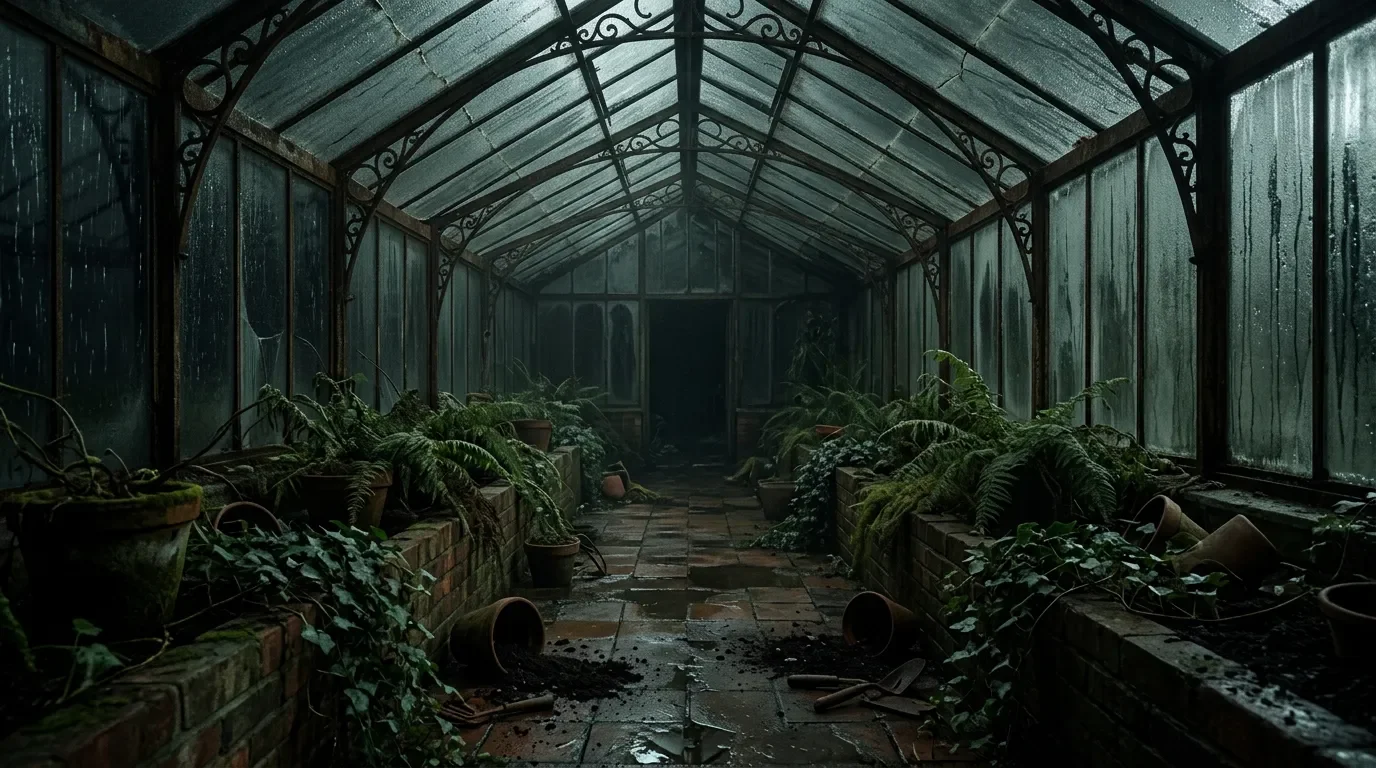
The rain has taken the glasshouse without force. It slides down every pane in black ropes and gathers at the lower edges, where old putty has swollen into soft grey ridges. The roof holds the night in broken rectangles. Each one trembles under water, then releases a thin runnel into the iron ribs, and the ribs conduct it inward with a patient metallic tick.
Nothing grows upright here anymore. Ferns hang in collapsed fans over the benches. The leaves have gone stiff at the tips and wet in the middle, as if the damp has chosen where to keep them alive. Empty pots crowd the floor in rings of clay. Some have split cleanly from rim to base. Others are packed with soil that has sunk below its own surface, making small dark bowls where the rainwater stands.
The central aisle is tiled in a green that no longer belongs to daylight. Puddles occupy the hollows between the slabs. They do not ripple when the roof drips into them. They take each drop and close again, flat and sealed, reflecting the glass above with a deeper blackness than the sky itself can provide.
At the far end, the door to the boiler room remains ajar. Its hinges have rusted into a granular bloom. Beyond the gap, the brickwork is furred with mineral white, and the floor slopes down into a darkness too low for the rain to reach. The old pipes pass through that darkness and return along the wall, jointed and thick, their paint lifted in scales. Water beads along their undersides. It gathers, swells, and falls with a sound softer than the rain, almost deliberate.
The air has no single temperature. Near the panes it is cold enough to tighten the smell of metal. Under the benches it is warm with rot. Between the two, the damp hovers in layers. It clings to the hanging fronds, to the labels gone blank in their trays, to the white mold at the base of a wooden staging board. Every surface has accepted a different kind of moisture, and none of them dry at the same speed.
The glass does not admit the outside so much as press it thin. Beyond the walls there are only dark vertical suggestions: the trunks of trees, the posts of a fence, the leaning ribs of another structure already taken by ivy. Rain erases their edges. The panes keep a weak copy of them inside, where the reflections overlap the real ironwork until the glasshouse appears to contain more supports than it was ever built to bear.
In the western corner, a stack of seed trays has softened into a single black block. Their cells are full of water. A pale skin floats on several of them, intact, unwrinkled, waiting for no germination. The shelving above has bowed under damp sacks of compost. The sacks have burst along their seams. Soil has poured out in heavy fans and stopped halfway down the boards, held there by its own wet weight.
The rain strengthens. It does not become louder all at once. It thickens by degrees, filling the spaces between the separate drips until the glasshouse loses the intervals that made it sound empty. The roof answers in a continuous shiver. Water finds the cracked panes and writes crooked lines across the interior. It threads through old repair wire. It slips down the inside of the glass and gathers behind the iron brackets, where brown stains radiate outward like dried leaves trapped in the metal.
Still, the place keeps its shape. The aisle remains clear. The benches hold their ranks. The high shelves trace their narrowing perspective toward the boiler-room door. Order survives here, but only as a form for decay to occupy. Each straight line guides the damp farther in. Each shelf gives the rot a level on which to settle. Each pane, even broken, divides the dark into manageable pieces.
A smell rises from the floor after the rain has soaked through the cracked tiles: soil opened too many times, cold ash, old fertilizer, and the faint sweetness of stems collapsed into themselves. It does not spread evenly. It waits in pockets. It thickens near the empty water tanks and thins beneath the roof vent, where a strip of night air pushes down and turns the hanging drops silver for a moment before they fall.
The vent is jammed half open. Its handle points toward the floor with the useless certainty of a stopped clock. Around it, the roof glass is filmed with algae so dark it seems to have grown from the night rather than the rain. The panes nearest the vent are clouded from inside. Their mist gathers into slow vertical tears. One joins another. A third divides and trails sideways along a hairline crack, searching for a lower seam.
Below, a coil of hose lies across the aisle. It has hardened into the shape of water no longer moving. The brass nozzle rests beneath a bench, green at the threads, its mouth filled with a plug of silt. Around it, roots have escaped from a broken trough and crossed the tile in pale cords. They enter the grout, vanish, reappear beside another pot, then disappear under the door to the boiler room, where the floor goes down.
The darkness under that door is not empty in the same way as the rest of the glasshouse. The benches are empty because their pots have failed. The shelves are empty because their plants have thinned to wire. The aisle is empty because the rain has polished it clean. The boiler-room dark is empty because it holds back the sound of the rain. No drip reaches it distinctly. No reflection comes out of it. The roots go in and lose their whiteness at the threshold.
By now the panes have stopped showing the garden. They show only water, iron, and the pale undersides of leaves pressed against the interior. The glasshouse has become a closed weather system, raining on itself. The same water falls, gathers, rises as chill vapor, and returns to the roof. Nothing leaves except heat. Nothing enters except more dark.
Near the center of the aisle, one puddle begins to cloud from below. The change is slow enough to seem like a fault in the tile. A milky stain spreads through the reflection of the roof, covering the black rectangles pane by pane. It reaches the reflected vent and holds there. The surface remains smooth. The rain falls into it without breaking it.
Along the benches, the collapsed ferns do not move. The pots do not settle. The boiler-room door does not open farther. Yet the glasshouse tightens around its own wetness. The iron ribs seem lower than before, the shelves closer, the rows of clay narrowing toward the dark gap at the end. The rain keeps measuring the same distances and finding them shorter.
At last the roof gives a single, dull knock. Not a crack, not a fall: only the sound of old glass accepting a weight already there. After it, the rain resumes with the same steady patience. Water descends through the panes, the roots continue into the dark, and the aisle holds its sealed puddles under a ceiling that has begun, almost imperceptibly, to bow.
Añade más opiniones o contexto en torno a este contenido.