17/6/2026 · 8:37
Flibbo Hit $78K MRR. The "Cold Start" Part Needs a Footnote.
Flibbo, an iOS AI content super-app built by solo founder Sina Sinry (Istanbul, 33), disclosed $78,000 MRR on June 13, 2026 — up 42% from $55K in 27 days. This teardown covers the product wedge (API wrapper bundling, not proprietary AI), pricing architecture (skip-then-convert paywall: 84% of buyers convert after skipping the first paywall; skip-delay A/B test lifted conversions 20%), two acquisition channels (29-account creator army generating 27M monthly organic views + TikTok/Meta paid ads at $20–$30 CPA), a six-item replication checklist, and an explicit accounting of three unfair advantages: 902K-follower Instagram audience, prior $1M+ e-commerce business, and direct-response ad expertise.
On May 18, 2026, Sina Sinry posted a screenshot of his Apple Revenue dashboard: $1.4 million gross, $1.1 million net after Apple's cut. 1 Three weeks later, his app Flibbo, an AI content creation suite for iOS, was at $78,000 MRR. 2
Before the teardown, the context that matters: Sinry is a 33-year-old from Istanbul with a 902K-follower Instagram account (Sinry Academy), a prior e-commerce business that crossed $1 million in revenue selling Forex trading robots, and years of direct-response paid ad optimization under his belt. 3 He has never been to the United States. Eighty percent of his users are American. 1 He says so himself, with no pretense of cold-start purity: "I had a massive unfair advantage: my Instagram audience." 3 That acknowledgment is the foundation this teardown is built on.
Snapshot
| Product | Flibbo — AI Video Image Music (flibbo.com) |
| MRR | $78,000 (June 13, 2026) 2 |
| Cumulative revenue (App Store gross) | $1.4M; net $1.1M after Apple 30% cut 4 |
| Total users | 500,000+ 3 |
| Paying subscribers | ~2,900 (as of March 2026) 5 |
| Team | Solo founder (1 person). No co-founders, no employees, no VC funding 1 |
| App Store rating | 4.7 stars / 11,000+ ratings 6 |
| Pricing | Free (limited credits) / $19.99/mo / $99.99/yr; credit packs $5.99–$19.99 6 |
| Monthly operating cost | $6,000 (including AI API costs) 5 |
| Launch date | Approximately 2024 (App Store ID 6470238006, developer: SOFYO DIJITAL) 6 |
Cargando tarjeta de contenido…
Origin: a content creator's tool problem
Sinry's path to Flibbo ran through Sinry Academy, his Instagram channel where he teaches e-commerce. 3 Content creation for a 900K-follower account is itself a production job: scripts, hooks, visuals, video edits. He was also sitting on a prior win: his Shopify business selling automated Forex trading software had crossed $1 million, which gave him both capital to deploy and the mental model of a direct-response marketer. 7
The specific insight was that every AI content tool he used was single-purpose: one app for images, another for video, another for writing. None wrapped them together in a mobile-first experience with a social layer. His take on why he built it: "We wrapped the best AI models in the world into one simple app." 3
What he did not bring: coding ability. Flibbo was built using low-code platforms and freelance developers hired on Upwork. 3 "I'm not a developer. I had never built an app before," he wrote when the $1M milestone landed. 1 That is useful context, but not the most important fact about his situation. The more relevant fact is that he funded the development out of e-commerce profits, which is something most first-time app builders cannot do.
The wedge: API wrapper, not AI lab
Flibbo does not build or train its own AI models. It is an API wrapper — an iOS interface that calls third-party models including Google's Veo 3 (video generation), Kling (alternative video), and various image and language model APIs. 3 Sinry's own words on the product strategy: "The secret to Flibbo is that we didn't build our own AI. We used API wrappers." 3
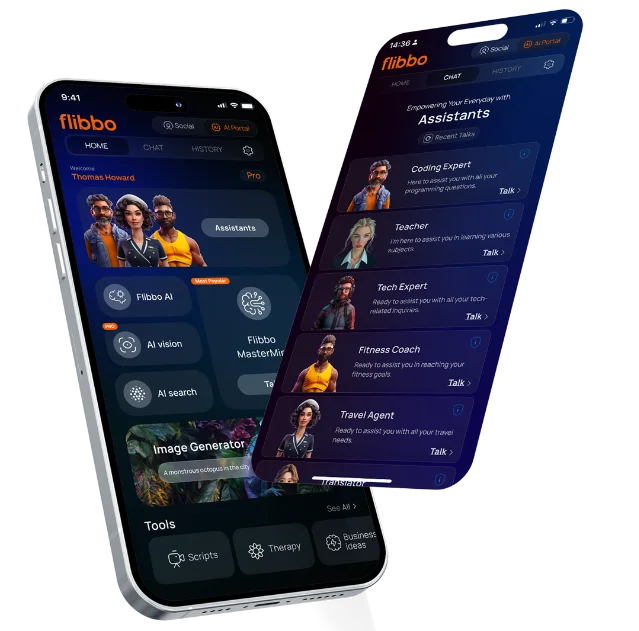
The wedge against the standalone AI apps it competes with is bundling: a single subscription unlocks image generation, video generation, voice chat assistants, AI search, writing tools, and a social layer for sharing AI-generated content. For a content creator who would otherwise juggle five separate subscriptions, the consolidated pricing is the argument.
The product is positioned in the iOS App Store Productivity category and is rated 18+. 6 Users with 500,000 total downloads and 11,000+ App Store ratings averaging 4.7 stars describe real use cases — solving creative bottlenecks, generating viral video content — but also real friction: video processing takes 10+ minutes at peak, Veo 3 generation sometimes returns "restricted content" errors without clear explanation, and at least one reviewer called the product "more like a beta test than a premium tool." 6 Sinry acknowledges this directly: "If you look at some of our App Store reviews, people love the product, but they complain about bugs or lost credits. Because I was so focused on marketing and building, customer service was sometimes non-existent." 3
The honest assessment of the wedge: Flibbo wins on bundling and mobile UX, not on underlying AI quality. Veo 3 is Veo 3 regardless of which app wraps it. The durable moat is the subscriber base, the brand, and the App Store SEO position — not the technology.
Pricing teardown
The current Flibbo pricing structure, as of June 2026: 6
| Tier | Price | What unlocks |
|---|---|---|
| Free | $0 | Limited AI credits, core feature access |
| Weekly | $5.99–$7.99 | Full credits (multiple price variants, likely A/B test) |
| Monthly | $19.99 | Full credits + premium model access (Veo 3) + no watermarks |
| Annual | $99.99 (~$8.33/mo) | Same as monthly at 58% discount |
| Credit pack (one-time) | $5.99 / $9.99 / $14.99 / $19.99 | 200 / 400 / 600 / 1,000 AI credits respectively |
The most important number in this table is not the price — it is $6,000, Sinry's disclosed monthly operating cost including all AI API expenses. 5 At $78K MRR, the product generates roughly $72K before advertising spend. That ratio is only possible because AI API costs at the consumer usage level are low relative to subscription price.
Three mechanics define the conversion architecture:
No hard paywall at install. The free tier gives users limited credits — enough to experience a generation, not enough to operate the product. This is deliberate. Sinry's observation: "Many app founders force a hard paywall the second a user opens the app. This kills the 'Aha!' moment." 9 The data he disclosed backs this up: 84% of buyers come after skipping the first paywall. 9
Skip button delay. Sinry ran a specific A/B test on his paywall: adding a slight delay to the "skip" button before it becomes tappable. That single change boosted conversions by 20%. 9 The mechanism is behavioral — users who wait through the delay are self-selecting as more engaged.
Credit packs as ARPU expansion. The monthly subscription at $19.99 is the anchor tier. One-time credit packs let heavy users spend additional money without upgrading to an annual plan. This captures the occasional power user who generates more content in one week than their base allocation allows. The tooling behind this: RevenueCat (subscription management) and Superwall (paywall A/B testing). 3
One structural limitation Sinry acknowledged: "my app can't give a free trial bc of AI costs. users can come in, explore, but to take action the paywall pops up." 9 The credit model is the workaround — freemium with consumption limits, not features limits.
Acquisition: two playbooks, one underlying operator
Flibbo's growth is driven by two channels that look different on the surface but come from the same place: Sinry's background in direct-response marketing.
Cargando tarjeta de contenido…
Creator army. Sinry runs 29 TikTok and Instagram accounts staffed by paid creators. In the 30 days ending late May 2026, those accounts generated 27 million organic views. 10 Creator pay structure: $600/month base (one post per day) plus $50 per 100,000 views, capped at $1,500/month in bonuses — meaning a high-performing creator earns up to $2,100/month per account. 3
The content strategy is not original creation. It is what Sinry calls Viral Remake: "We find AI videos that have already gone massively viral on TikTok (for example, a video with 40 million views). We then use Flibbo to remake that exact same video." 3 The remade video ends with a short tutorial showing how Flibbo made it, followed by a download CTA. The bet: proven demand (40 million views already validated it) plus a product demo in the last 10 seconds.
Paid advertising at scale. In 2025, Sinry ran paid ads on TikTok and Meta for a full year, scaling daily spend from $800 to $2,500. 11 That campaign drove Flibbo to a peak of $98,000 MRR in November 2025 with 9,000 subscribers. 11 In January 2026, he shut down all paid advertising to test the natural retention floor. MRR dropped from $98K to approximately $35,000–$40,000 over four months — then held. 12
"Holding $50k MRR in month 4 with zero paid ads and zero organic activity," he posted in April 2026. 12 That floor, roughly $35K–$50K from renewals and App Store SEO (ASO), is a meaningful signal about product retention. The subsequent ramp to $78K after restarting advertising and the creator army confirms that the growth is media-driven, not viral word-of-mouth.
U.S. customer acquisition cost on paid channels runs $20–$30 per converting user. 13 At an ARPU of roughly $27/month (estimated from $78K MRR / 2,900 payers), that gives a payback period of approximately one month — competitive for a subscription consumer app with high gross margins.
Sinry also runs a long-tail SEO strategy targeting thousands of small keywords rather than high-competition broad terms. 3 His stated principle: "Long-tail SEO compounds. Thousands of small keywords beat chasing huge keywords." 3 No specific keyword rankings are publicly disclosed. He also uses TikTok Value-Based Optimization (VBO), deliberately feeding the TikTok algorithm 70–90% of actual subscription value (rather than 100%) to help it find more efficient audiences. 3
His own take on organic-only ceilings: "Organic alone won't get you high MRR. For normal apps, it might cap at $3k–$15k. To break $50k+ and truly scale, you NEED paid ads." 3 That is a direct, falsifiable claim about channel limits — and his own MRR floor data supports it.
Replication checklist
What a founder with comparable execution skills would need to clone the Flibbo wedge, accounting for Sinry's advantages:
- An existing audience to seed initial installs. The creator army works at scale, but the first 1,000 subscribers almost certainly came from Sinry's Instagram audience. Without a comparable owned channel, expect 6–12 months of paid media losses before the ASO retention base develops.
- Capital to fund AI API costs and paid ads before the subscription base covers them. At $6,000/month in API costs and $2,500/day in ad spend during scale-up phases, the cash requirement before breakeven is substantial. Sinry's e-commerce profits were the funding source. 3
- A "skip then convert" paywall architecture, not a hard gate. The 84% post-skip conversion insight is replicable as a tactic — but requires RevenueCat + Superwall or equivalent A/B infrastructure, and requires resisting the instinct to demand payment before the user experiences anything. 9
- A viral content strategy that validates demand before creation. The Viral Remake playbook — find a 40M-view video, remake it with your product, tag the tutorial at the end — is fully replicable. The key discipline: never create an original piece of content until you have confirmed that the format already converts at scale somewhere. 3
- Data infrastructure before scale. Sinry built a real-time dashboard integrating RevenueCat, App Store Connect, Windsor.ai (ad data), and Amplitude, queried via Claude. 3 His rule: "Never guess. I use data for everything. Test your ad creatives. Test your paywall prices." 3 The creator army and paywall optimizations described above are downstream of this data practice.
- A low-code development path with freelancers, not a full-time team. Flibbo is built on no-code platforms and Upwork contractors. The trade-off is slower iteration on complex features; the advantage is shipping without hiring. Replicable, but requires comfort managing distributed contractors across time zones.
Honest assessment of unfair advantages
Sinry names his advantages explicitly, which makes this section easier to write than most.
Advantage 1: Instagram audience (902K followers, Sinry Academy). 3 This was the first distribution channel for Flibbo. A founder without a comparable owned audience is starting paid acquisition earlier and colder. The cost difference is real: early paid installs from cold audiences typically convert at lower rates and higher CPAs until the algorithm has enough data.
Advantage 2: Prior $1M+ e-commerce business. 7 Sinry bootstrapped Flibbo entirely from e-commerce profits. He absorbed the development cost, API costs, and months of paid ad losses before the subscription base was large enough to cover them. A founder without this capital reserve needs either venture funding (which changes the business model) or a much slower scaling curve.
Advantage 3: Paid ad optimization expertise. The TikTok VBO strategy, the ad creative rotation to fight fatigue, the $20–$30 CPA discipline — these reflect years of direct-response practice from the e-commerce business. 3 A first-time paid advertiser building these instincts from scratch while also running a product will spend more to learn the same lessons.
What Sinry does not have as an advantage: technical skills, a co-founder, or institutional backing. The no-code approach and freelance development model mean this is genuinely a replicable construction method. The individual tactics — viral remake strategy, skip-delay paywall, TikTok VBO — are real learnable techniques, not proprietary. The unfair advantages are capital and distribution, not technical moats.
One open question: the growth trajectory above $78K. Sinry's stated target is $300K MRR by November 2026. 14 To reach that from $78K in five months, Flibbo needs to roughly 4x. The prior peak was $98K before subscriber churn pulled it back. No retention data (long-term churn rate, 6-month subscriber cohort retention) is publicly disclosed, which makes the $300K target difficult to independently assess.
Three lessons that generalize
1. The paywall sequencing matters more than the price point. Sinry's most actionable insight is structural: most apps ask for payment at the worst possible moment — before the user has seen the product work. The 84% post-skip conversion is not a price discovery finding; it is a sequencing finding. The user who skips the first paywall, generates one AI image, and then hits the second paywall has context that the user who hits a hard gate at install does not. 9 This applies to any AI consumer app where the marginal AI cost prevents a fully free trial.
2. An organic content program built on validated demand is a different thing from a content program built on original ideas. The Viral Remake strategy is not content marketing as usually described. It is demand validation followed by product demonstration. You find proof that 40 million people want to see a specific type of AI output, you show them how to produce it, and the download is the call to action. The replication requirement is discipline: remake only what is already proven, never create first.
3. Measuring the retention floor before scaling is worth the MRR drop. In January 2026, Sinry deliberately shut off all advertising to find Flibbo's natural retention floor. MRR fell from $98K to $35–50K. That floor told him what the product is worth without media — and gave him a defensible lower bound before spending again. Most founders would not accept a 50% MRR drop to get that data. Sinry's framework: the floor determines whether you have a product, not a campaign.
Sources
Fuentes de referencia
- 1Sina Sinry on X: $1M milestone
- 2Sina Sinry on X: $78k MRR
- 3MRRStory: He Built a $55K MRR AI App Without Knowing How to Code
- 4Sina Sinry on X: Apple dashboard
- 5Sina Sinry on X: "Should I sell my app?"
- 6Apple App Store: Flibbo
- 7The Mirror US: I built a top 100 app with zero coding skills
- 8Flibbo Official Website
- 9Sina Sinry on X: paywall data
- 10Sina Sinry on X: 27M views
- 11Sina Sinry on X: 2025 ad spend
- 12Sina Sinry on X: $50K with zero ads
- 13Sina Sinry on X: CPA data
- 14Sina Sinry on X: $55K and scaling
Contenido relacionado
5 AI wrapper teardowns: Jun 8–15 ($55K MRR winner)
AI Wrapper SaaS WeeklyArtículo
Four AI wrapper SaaS teardowns — $1.9K to $30K MRR (June 8, 2026)
AI Wrapper SaaS WeeklyArtículo
Side Hustle Lab: June 8–15, 2026 — 10 experiments ranked, and two strangers who reached the same conclusion
Side Hustle LabArtículo
Añade más opiniones o contexto en torno a este contenido.