29/6/2026 · 0:25
Covert Spatial Attention: Seeing Without Moving Your Eyes
Covert spatial attention explains how the brain can prioritize one part of the visual field before the eyes move. This article follows the idea from Posner's cueing task to biased competition in visual cortex and the frontoparietal systems that prepare and redirect attention.

The useful trick in visual attention is that you can look at one place and prepare for something somewhere else. Your eyes stay fixed, but part of the visual field becomes easier to process. That is covert spatial attention: selection without an eye movement.
The idea matters because it turns attention from a vague mental effort into a measurable operation. If a cue tells you that a target is likely to appear on the left, you usually detect a left target faster and a right target slower. Michael Posner's 1980 orienting paper made that logic explicit: ask people to commit attention to a location away from fixation, then trace the cost and benefit in detection efficiency 1.
The core idea: attention is selection before recognition
Vision gives the brain more information than it can use at once. Covert spatial attention is one way to solve that bottleneck. It does not move the image on the retina. Instead, it changes which part of the existing retinal image receives priority.
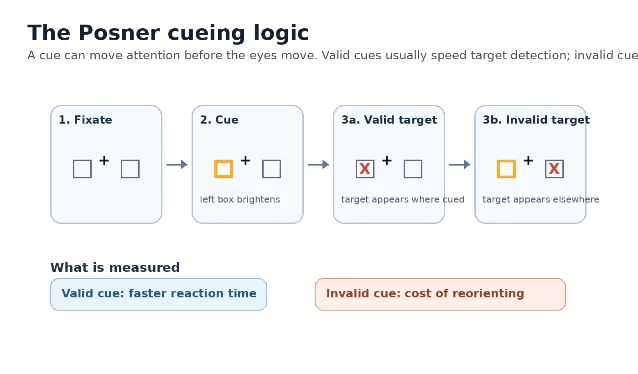
That priority can show up behaviorally before it shows up as a conscious story. In a cueing task, a participant fixates the center, sees a cue, and then responds when a target appears. If the cue correctly predicts the target's location, responses are faster; if the cue misleads, responses are slower. Later reviews of the Posner cueing paradigm describe it as a compact way to measure how attention is allocated in space 2.
The word "spotlight" is useful, but only if you keep it modest. It captures the fact that one location can be enhanced relative to others. It should not make you imagine a literal beam sweeping across the brain. Attention can be narrow or broad, tied to objects as well as locations, and guided by goals, habits, rewards, and sudden events.
The landmark experiment: moving attention without moving the eyes
Posner's crucial move was experimental, not poetic. Earlier psychologists could say that people "paid attention" to something. Posner gave researchers a task in which attention could be cued, delayed, misdirected, and measured in milliseconds.
In the basic version, the participant keeps looking at a central fixation point. A cue indicates a likely target location. The target then appears either at the cued location or elsewhere. The difference between valid and invalid trials is the signature: attention had been prepared at one place, so the system processed that place more efficiently and had to reorient when the cue was wrong.
The task also separated attention from eye movement. Posner described a covert mechanism that can be oriented to a position in visual space other than fixation, and he compared evidence from normal humans, brain-injured humans, and alert monkeys 1. That separation is why the paradigm became a bridge between cognitive psychology and neuroscience.
What changes in the visual cortex?
Behavioral cueing tells us that selection happened. It does not by itself tell us where selection happens in the brain.
A key neural result came from Moran and Desimone's 1985 recordings in monkeys. They recorded single cells while animals attended to one stimulus location and ignored another. When both stimuli fell inside the receptive field of a neuron in prestriate area V4 or inferior temporal cortex, the response to the unattended stimulus was strongly reduced; cells in primary visual cortex were not affected in the same way in that study 3.
That finding changed the metaphor. Attention was not just a late decision after vision had finished its work. It could gate visual processing inside the cortical hierarchy. Desimone and Duncan later framed this as biased competition: multiple stimuli compete for neural representation, and attention biases the contest toward the currently relevant one 4.
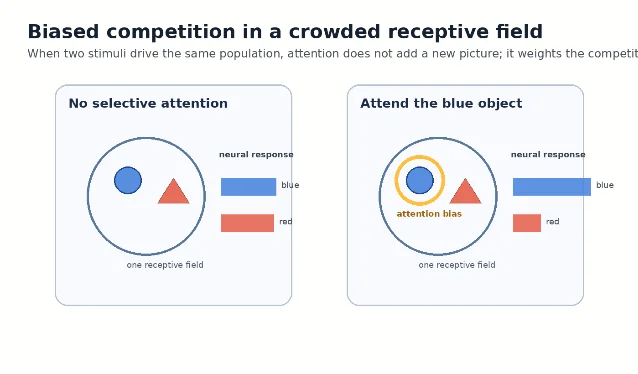
This is a better model for everyday seeing. A mug, a hand, a keyboard, a notification, and a face can all be in view at once. Attention does not need to erase the others completely. It needs to make one stream of information more likely to win the next stage of processing.
Top-down bias: the brain can prepare a place before anything appears
One of the strongest signs that attention is an active control signal is that it can change visual cortex before the stimulus arrives.
Kastner and colleagues used human brain imaging to show increased activity in extrastriate visual cortex when participants covertly attended to a peripheral location while waiting for visual stimuli. Frontal and parietal areas showed stronger increases during this expectation period, consistent with a top-down bias coming from a frontoparietal network 5.
That is an important shift. Attention is not merely a reaction to a target. It can be a preparatory state: the brain sets the gain of a region of visual space in advance, so the incoming signal has a better chance of being selected.
The control networks: goals and interruptions
Modern accounts usually distinguish two interacting control systems, not one all-purpose spotlight. Corbetta and Shulman reviewed evidence for a dorsal frontoparietal system, including intraparietal and superior frontal regions, involved in preparing and applying goal-directed selection. They also described a more right-lateralized ventral system, including temporoparietal and inferior frontal cortex, that detects behaviorally relevant stimuli, especially salient or unexpected ones 6.
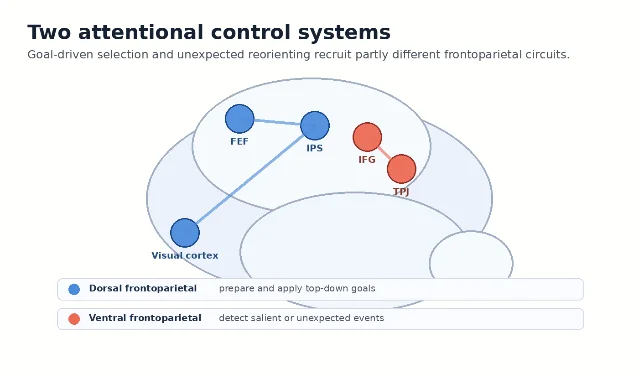
A simple example: you search your desk for a red pen. That goal recruits a top-down bias toward red objects and likely desk locations. But if your phone flashes suddenly, the ventral system can interrupt the search and reorient you. Normal attention is the negotiation between those two pressures: what you meant to select and what the world forces you to consider.
What is still debated?
Three questions remain lively.
First, researchers still argue about the best description of the attentional effect. Sometimes attention looks like gain: a stronger response to the attended signal. Sometimes it looks like noise reduction, sharpening, normalization, or a change in which neurons are pooled for a decision. The right answer depends on the task, stimulus, brain area, and measurement method.
Second, attention is not the same thing as awareness. MIT 9.13's attention and awareness lecture explicitly frames the topic around differences between perceptual information we are aware of and information we are not 7. Attention often helps information reach awareness, but the two can come apart: one can attend without full reportable awareness, and salient events can shape processing before they become a clear conscious percept.
Third, the spotlight image hides the diversity of attention. Spatial attention is only one form. Feature attention can favor a color or motion direction across the field. Object-based attention can spread through the parts of a selected object. Social attention can follow gaze. The Posner task remains central because it gives us a clean entry point, not because all attention reduces to a dot on the left or right.
Why this concept matters
Covert spatial attention shows that perception is not a passive camera feed. Even before recognition, the brain is already asking: which part of this scene is worth spending computation on?
That makes attention a core concept for cognitive neuroscience. It links reaction time to cortical physiology, single-neuron competition to fMRI network control, and everyday focus to clinical problems such as spatial neglect. It also gives a more realistic picture of seeing. The brain does not simply receive the world. It samples, weights, prepares, and reorients.
Landmark paper
Michael I. Posner's 1980 paper, "Orienting of Attention," is the landmark starting point for this concept. Its enduring contribution was to make covert attention experimentally tractable: attention could be directed away from fixation and measured through the costs and benefits of target detection 1.
Course connection
Fuentes de referencia
- 1Orienting of Attention
- 2Measuring attention using the Posner cuing paradigm
- 3Selective attention gates visual processing in the extrastriate cortex
- 4Neural mechanisms of selective visual attention
- 5Increased activity in human visual cortex during directed attention in the absence of visual stimulation
- 6Control of goal-directed and stimulus-driven attention in the brain
- 7Lecture 24: Attention and Awareness
- 8The Human Brain
Añade más opiniones o contexto en torno a este contenido.