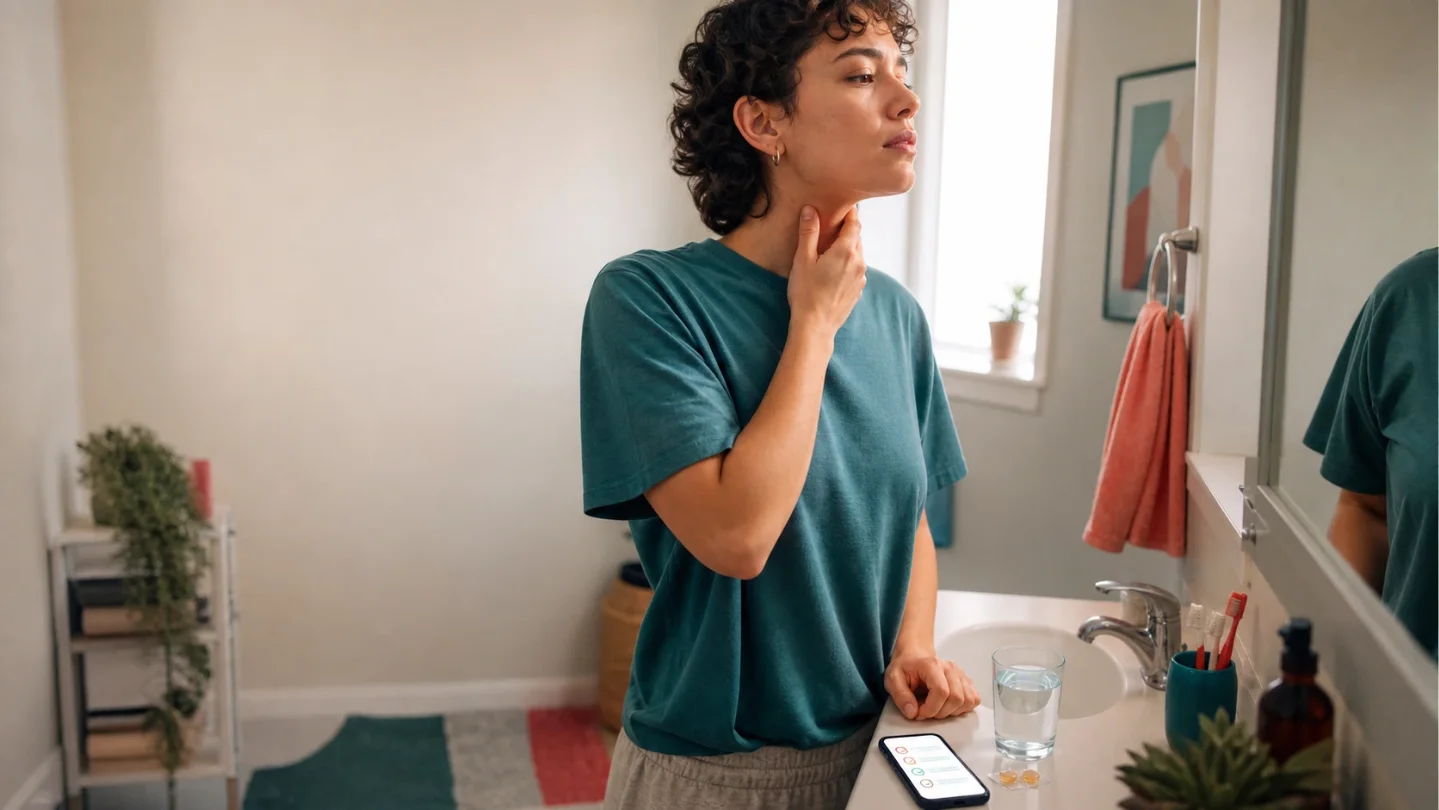
Your sore throat is not automatically strep. Here's the throat-check plan.
A practical guide to sorting a sore throat into home-care, test-worthy, and urgent-help buckets, including how strep, mono, COVID, and regular viral sore throats tend to look different.
A sore throat is annoying because it gives you just enough information to spiral. Maybe it is a cold. Maybe it is strep. Maybe it is COVID. Maybe you opened your mouth to check it in bad bathroom lighting and immediately made everything worse.
The move is not to diagnose yourself from vibes. It is to sort the throat into a few buckets: normal home-care sore throat, test-worthy sore throat, and do-not-wait sore throat.
Most sore throats are not strep
Viruses cause most sore throats. CDC says only around 1 in 10 adults with a sore throat have strep throat. 1
That matters because antibiotics do not help a regular viral sore throat. They also are not something to take "just in case." If strep is on the table, the useful move is a test, not guessing from how gross your tonsils look.
A sore throat is more likely to be viral when it comes with cough, runny nose, hoarseness, or pink eye. CDC lists those as symptoms that point away from strep and toward a virus. 1
Strep is more suspicious when the sore throat hits fast and comes with fever, pain when swallowing, red swollen tonsils, swollen lymph nodes in the front of the neck, tiny red spots on the roof of the mouth, or white patches on the tonsils. 1
Do the 60-second throat check
Do not scrape your tonsils, poke anything, or take a flash photo 19 times. Just check the pattern.
| What is happening | What it points toward | What to do next |
|---|---|---|
| Sore throat plus cough, runny nose, hoarse voice, or pink eye | More likely a virus than strep 1 | Treat symptoms, avoid spreading it, and watch whether it improves. |
| Sudden sore throat plus fever, painful swallowing, swollen front-neck glands, or white patches | Strep is more plausible 1 | Ask about a rapid strep test instead of self-starting antibiotics. |
| Sore throat plus extreme fatigue, fever, swollen neck or armpit glands, body aches, or a longer draggy illness | Mono is possible, especially for teens and young adults; CDC says mono is common in this group. 2 | Rest, hydrate, avoid sharing drinks, and get checked if symptoms are intense or lingering. |
| Sore throat plus fever, cough, congestion, fatigue, body aches, headache, stomach symptoms, or loss of taste or smell | COVID or another respiratory virus can look like this. 3 | Stay home while sick, consider testing, and protect people around you. |
This table is not a diagnosis. It is a filter. It tells you whether tonight is a tea-and-rest night or a "message a clinic/pharmacy" situation.
What you can do at home tonight
Most sore throats get better by themselves within about a week. NHS advice is basic but useful: drink water, rest, eat cool or soft foods, avoid smoke, and use simple pain relief if it is safe for you. 4
A warm salt-water gargle can help some people. NHS suggests dissolving half a teaspoon of salt in a glass of warm water, gargling, and spitting it out. 4 Do not swallow the salt water like it is a wellness shot.
Lozenges, cool drinks, ice pops, and soft food can make swallowing less miserable. If you use acetaminophen, ibuprofen, sprays, or medicated lozenges, read the label first, especially if you are pregnant, have stomach/kidney issues, take blood thinners, or already took a combo cold medicine. NHS specifically notes that some medicines are not safe for everyone. 4
Also, do the boring spread-control stuff. CDC says to stay home and away from others when you have respiratory virus symptoms that are not better explained by another cause. You can return to normal activities when symptoms are improving overall and you have been fever-free for at least 24 hours without fever-reducing medicine, then use extra precautions for the next 5 days. 5
When a strep test makes sense
If the pattern looks strep-ish, testing matters. CDC says providers generally ask about symptoms, examine you, and may use a rapid strep test first. A throat culture can catch some infections that a rapid test misses. 6
If the test is positive, antibiotics usually enter the plan. CDC says antibiotics can shorten illness, reduce symptoms, reduce spread, and help prevent serious complications such as rheumatic fever. 6
If the test is negative, antibiotics usually are not needed because group A strep is not causing the sore throat. For adults, CDC says a throat culture after a negative rapid test is usually not necessary. 6
Two practical points:
- If you start antibiotics for confirmed strep and still are not feeling better after 48 hours, CDC says to call a healthcare provider. 6
- If mono is possible, do not treat leftover antibiotics like a shortcut. CDC says people with mono should not take penicillin antibiotics such as ampicillin or amoxicillin. 2
When it is not a wait-it-out throat
Most sore throats are not dramatic. Some are.
Get urgent help now if you have trouble breathing, cannot swallow, are drooling because swallowing is hard, make a high-pitched sound when breathing, or your symptoms are severe and getting worse quickly. NHS lists those as emergency signs for a sore throat. 4
Ask for care soon, not someday, if your sore throat does not improve after a week, keeps coming back, comes with a lump in your mouth or neck, or comes with a mouth ulcer lasting more than 3 weeks. NHS also flags very high temperature, dehydration signs like peeing less than usual or very dark pee, and a weakened immune system as reasons to get urgent advice. 4
For COVID-like illness, emergency warning signs include trouble breathing, persistent chest pain or pressure, new confusion, inability to wake or stay awake, or pale, gray, or blue lips, nail beds, or skin depending on skin tone. CDC says to call emergency services if those show up. 3
And if mono is likely, skip contact sports until you have fully recovered. CDC says mono can enlarge the spleen, and contact sports can risk spleen rupture. 2 That is not a "push through it" situation.
The lazy version
If your throat hurts and you do not want to think this hard, use this:
- If you have cough, runny nose, hoarseness, or pink eye, treat it like a likely viral sore throat unless something feels seriously off.
- If it hit fast with fever, painful swallowing, swollen front-neck glands, or white patches, ask about a strep test.
- If you are wiped out for days with swollen glands and a sore throat, think mono and avoid sharing drinks or doing contact sports.
- If you have COVID-like symptoms, stay home while sick and test if it will change what you do around other people.
- If breathing, swallowing, dehydration, chest pain, confusion, or fast-worsening symptoms enter the chat, stop self-managing and get help.
A sore throat usually does not need panic. It does need pattern recognition. The win is knowing when tea and rest are enough, and when your throat is trying to tell you the group chat cannot solve this one.
Contenido relacionado
- Inicia sesión para comentar.
More from this channel
- Your nosebleed is not a head-tilt moment. Here's the stop-the-bleed plan.
- Your allergy pill can still make you sleepy. Here's the antihistamine plan.
- Your Q-tip is not an ear-cleaning tool. Here's the earwax plan.
- Your back-seat nausea is not random. Here's the motion-sickness plan.
- Your chair is not neutral. Here's the movement-snack plan.
- Your period app is not the backup plan. Here's what to do after a condom break.
- Your nicotine pouch is not a harmless mint. Here's the ZYN-label reality check.
- Your burning pee is not a cranberry-juice problem. Here's the UTI plan.