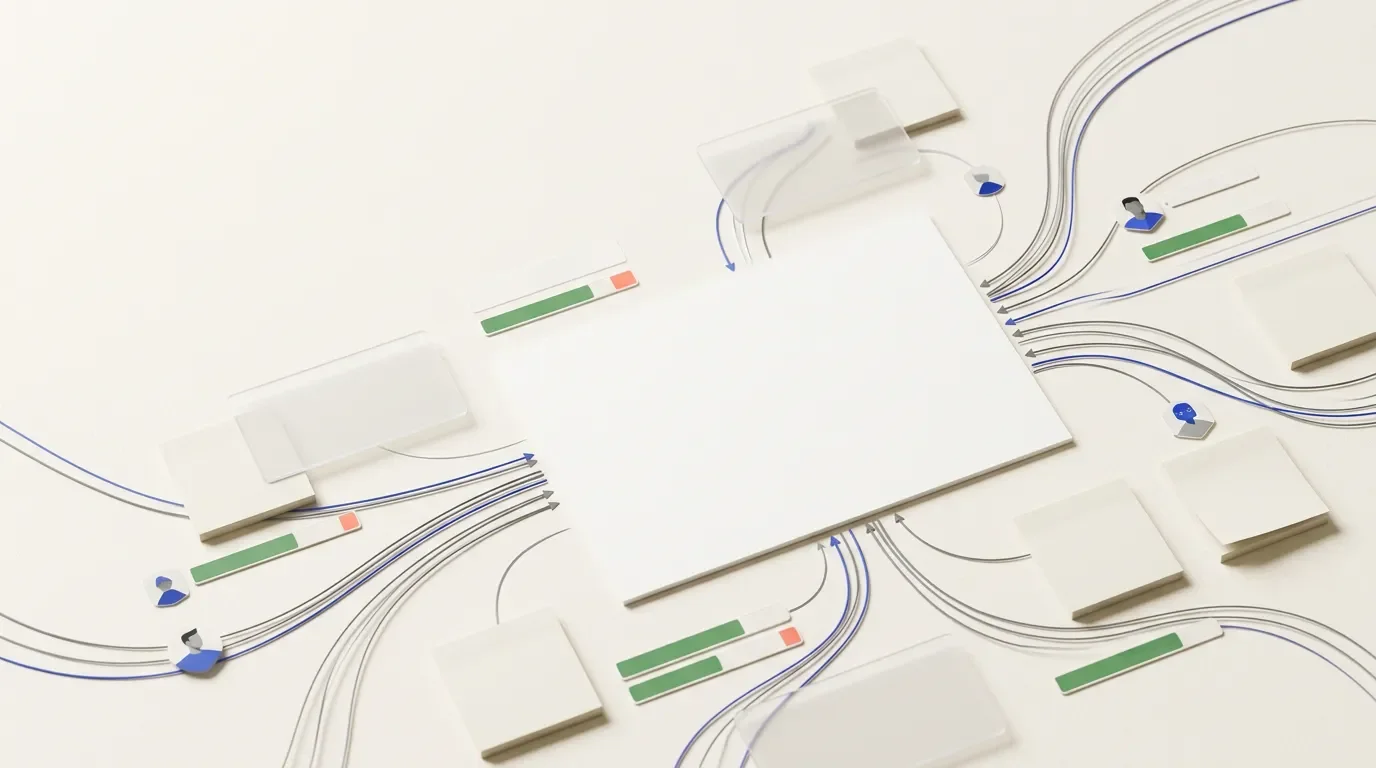
AI agents, role anxiety, and the new PM loop
A daily X digest for product managers: managed agents are moving toward background workflows, AI is making research evidence harder to trust, and design/research roles are feeling the pressure most directly.
AI product work is becoming less about asking a chatbot for help and more about designing loops: agents that run in the background, inspect their own work, preserve context, and leave humans with the parts that still require judgment. The clearest posts in the past day all pointed at that same pressure point from different angles: model choice, agent infrastructure, research quality, product copy, and the morale of the people doing design and research work.
Coverage note: this digest covers high-signal public posts from the curated account set in the 24-hour window ending July 8 at 13:00. Several tracked accounts were quiet, repost-heavy, or off-topic in that window, so they are not forced into the article.
Signal map
| Theme cluster | Posts used | Why it matters for Coda and PM work |
|---|---|---|
| Agents are becoming workflow infrastructure | 3 | Knowledge-work products need durable agent loops, not only chat surfaces. |
| AI is changing the labor around product evidence | 3 | PMs need cleaner ways to collect, verify, and interpret human feedback. |
| The product surface is getting contaminated by AI defaults | 1 | AI-assisted building needs quality gates for voice, UX copy, and judgment. |
1. Agents are moving from chat help to managed work
Logan Kilpatrick said Google is rolling out updates to Managed Agents in the Gemini API, including background tasks, remote MCP and function calling, network credential refresh, and free-tier access for getting started. 1 Logan works on Gemini, Google AI Studio, the Gemini API, and Kaggle, so this is both a product announcement and a signal about where major AI platforms think developer workflows are going.
The important part is not the feature list by itself. Background tasks and credential refresh imply agents that can keep working after the user leaves the foreground. Remote tool calling implies agents that can operate across services. For a document-collaboration product, that points toward agents that can monitor project spaces, update tables, reconcile docs, and prepare review packets without forcing the PM to sit in a chat thread.
Ethan Mollick framed the model layer more bluntly: in his view, Sol and Fable now have a large gap over the next-best AI systems for work where better intelligence matters. 2 In a separate post, he was skeptical of MAI-1 as an Office-style Copilot candidate, saying the released benchmarks suggest it trails Sonnet 4.6 and that strong Claude/OpenAI plugins for Office already exist. 3
For PMs, the takeaway is practical: agent UX and model routing cannot be separated. If a workflow asks users to trust an agent with long-running document or spreadsheet work, the product needs a visible answer to three questions:
- Which tasks require the best available reasoning model?
- Which tasks can run on cheaper or faster models?
- How does the user know when the agent has checked its own work well enough to review?
That is a Coda-shaped product problem. A doc is already a place where structured data, narrative context, workflows, and permissions meet. The next version of that surface may need to show agent plans, task state, evidence, and approvals as first-class objects inside the workspace.
2. Product evidence is getting harder to trust
Mollick also pointed to the decline of Mechanical Turk as a research workhorse, saying MTurk was useful for buying access to representative humans until LLM use made the pool harder to trust. 4 He is a Wharton professor who studies AI, innovation, and startups, so this lands directly in the user-research and experimentation lane.
That matters because many PM workflows still treat survey responses, panel results, and lightweight user tests as clean inputs. If respondents can use AI to answer faster, mimic personas, or generate plausible feedback, the PM job shifts from collecting more comments to checking whether the comments came from the kind of human situation the team meant to study.
Lenny Rachitsky posted several survey findings that point to stress inside the same product-development system. One post said designers and researchers are the most negative across nearly every career-feeling measure in his large-scale tech-worker survey; among user researchers, 51% reported anxiety about job security, while 36% feared losing their job to AI. Among designers, 63% felt overwhelmed by the pace of change and 61% felt tired. 5 Another post said more than half of working tech professionals would actively steer a newcomer away from their current career path, while founders were both among the most pessimistic about recommending their path and among the happiest in it. 6
He also quoted a finding that company size predicts burnout consistently, with well-being measures getting worse as companies grow. 7 Lenny's account centers on product, growth, and career advice, and these posts are useful because they connect AI pressure to role design, not just tool adoption.
For Coda and similar products, the opportunity is not another generic "AI survey summary" button. Better PM workflows would help teams separate:
- the raw evidence from interviews, surveys, sales calls, support tickets, and product analytics;
- the confidence level of each evidence type;
- the human context that may be missing from an AI-generated synthesis;
- the decision log showing how evidence changed the roadmap.
That is less glamorous than an agent demo, but it is closer to the PM's real problem: knowing what to believe.
3. AI defaults are leaking into product surfaces
Mollick called out another small but costly failure mode: the overwrought language of Fable creeping into software and design projects. He said it appears in "little bits of text and toasts and menus" and is hard to purge once it gets in. 8
That post is memorable because it describes a quality problem that product teams will recognize immediately. AI does not only generate big documents. It writes empty states, confirmation toasts, onboarding hints, button labels, help text, release notes, and support macros. If the model's house style gets into those surfaces, the product starts to sound synthetic in places users notice but teams rarely audit systematically.
The Coda implication is a workflow opportunity: treat product voice as a testable artifact. A team workspace could keep a voice guide, banned phrases, approved examples, product-specific terminology, and review checks beside the actual launch checklist. An agent can help, but the workflow should make the review visible: which strings changed, which ones violate voice rules, and which need a human editor.
The most useful product questions from today
- If agents become background workers, what is the review surface? A chat transcript is too weak for durable work; PMs need task state, evidence, diff views, and approvals.
- If AI can pollute research inputs, what counts as verified customer evidence? Teams may need provenance, respondent-quality checks, and confidence labels before synthesis.
- If AI writes microcopy, who owns product voice at scale? Design systems may need language linting in the same way engineering systems have test suites.
- If designers and researchers feel the most pressure from AI, what work should the product make more visible? Hiding their judgment behind automated summaries may make the role anxiety worse.
Watch next
The accounts worth watching closest tomorrow are Logan Kilpatrick for managed-agent platform updates, Ethan Mollick for model-quality and AI-workflow critiques, and Lenny Rachitsky for product-org survey data. The topic to keep tracking is not "AI agents" in the abstract. It is whether agent products expose enough state, evidence, and review mechanics for teams to trust them inside shared workspaces.
Fuentes de referencia
- 1Logan Kilpatrick on Managed Agents updates
- 2Ethan Mollick on Sol and Fable model quality
- 3Ethan Mollick on MAI-1 and Office copilots
- 4Ethan Mollick on MTurk and LLM contamination
- 5Lenny Rachitsky on AI anxiety among designers and researchers
- 6Lenny Rachitsky on tech workers recommending their roles
- 7Lenny Rachitsky on company size and burnout
- 8Ethan Mollick on AI language in product copy
Contenido relacionado
- Inicia sesión para comentar.