
NVIDIA is benefitting from strong demand, but is selling into a concentrated set of buyers whose own demand is being distorted by a training and benchmarking phase that will not last. That distorted demand is working like a bullwhip into NVIDIA's own supply chain through custom supply commitments as well as downstream into data-center financing.
23/5/2026 · 7:15
Burry: NVIDIA is riding a bullwhip — and the bezzle is waiting
Michael Burry published Part III of his AI-criticism Substack series on May 22, arguing that NVIDIA's demand is distorted by a training-and-benchmarking phase that won't last — and that the resulting bullwhip into supply chains and data-center financing is obscuring a "bezzle" of misallocated risk that will vanish once it unwinds.
Michael Burry (Scion Asset Management, whose 2008 mortgage short was chronicled in Michael Lewis's The Big Short) published "The Heretic's Guide to AI's Stars Part III: Tracepalooza & the Bezzle" on his Substack Cassandra Unchained on May 22. 1 The post is the third installment of his AI-criticism series — separate from his concurrent "D'ai of the Triffids" software-stock series — and it targets NVIDIA ($NVDA) specifically.
His central claim, stated in an accompanying X post: "NVIDIA is benefitting from strong demand, but is selling into a concentrated set of buyers whose own demand is being distorted by a training and benchmarking phase that will not last. That distorted demand is working like a bullwhip into NVIDIA's own supply chain through custom supply commitments as well as downstream into data-center financing." 2
Why the bullwhip argument matters for data-center financing
The bullwhip effect — familiar from supply-chain economics — describes how small demand fluctuations at the consumer end get amplified into large swings upstream as each intermediary buffers against uncertainty. Burry is applying it here to the AI infrastructure build-out: a handful of hyperscalers and frontier labs are placing enormous GPU orders during an intensive training and benchmarking phase, and NVIDIA is booking those orders as durable demand. But once that phase winds down, the order flow reverses — and the custom supply commitments and data-center financing already locked in don't reverse with it.
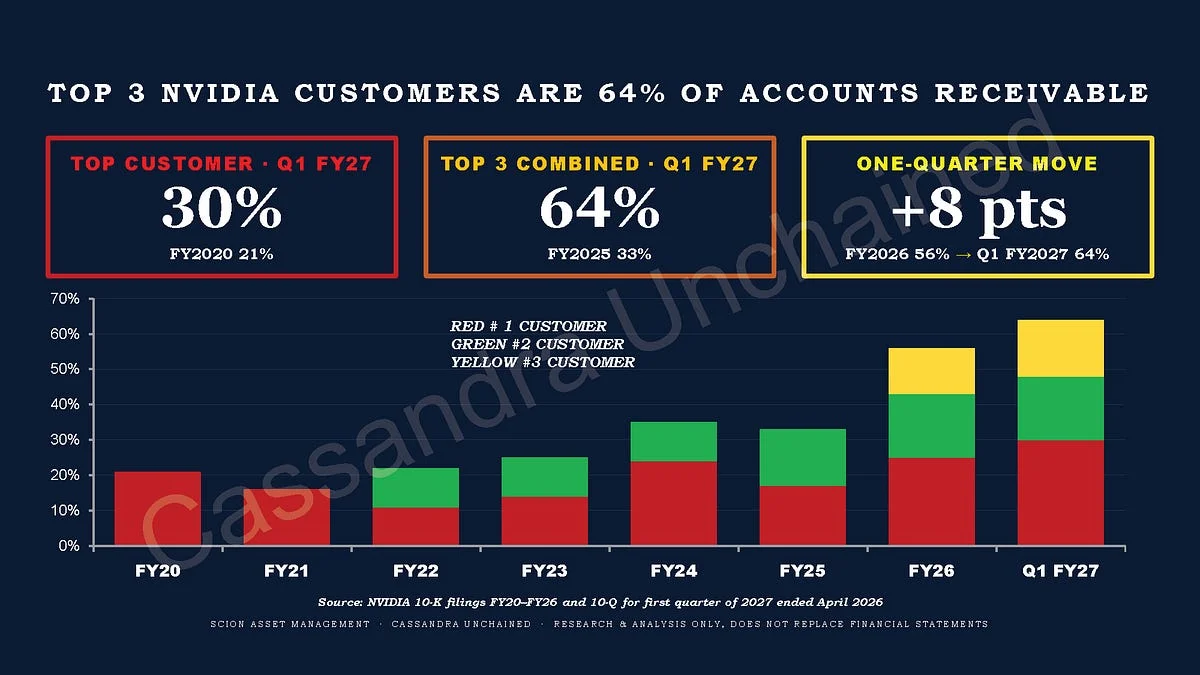
Burry flagged the concentration problem directly: "Customer concentration is off the charts." 1 The article is behind a paywall; the public preview runs to roughly 400 words. A fresh NVIDIA 10-Q is the dataset Burry says he's working from — he noted that "Luminous" and "Grace" reported positive headline numbers this week, prompting him to dig in: "I love the smell of 10-Qs in the morning." 2
The bezzle: risk that only exists while it's hidden
The more conceptually unusual piece of this post is the "bezzle" — a term Burry borrows from the economist John Kenneth Galbraith. In Galbraith's original framework (from The Great Crash 1929), the bezzle is the stock of undiscovered embezzlement: it inflates apparent wealth while hidden, and annihilates that wealth the moment it surfaces. Burry applies the concept to undiscovered misallocation in AI infrastructure financing: "Looming over it all is the bezzle, which once seen, cannot be unseen, and once revealed, does not exist." 1
The implication is that the danger is not a crash in AI sentiment or a broad valuation re-rating — it is the quiet unwinding of specific financing structures and supply commitments that were extended against demand that turns out to be phase-specific rather than structural. Investors evaluating NVIDIA's revenue durability or data-center REITs carrying AI infrastructure exposure would need to disaggregate training-phase demand from inference-phase demand to test whether Burry's concern applies to their holdings.
Cargando tarjeta de contenido…
This is the third consecutive Burry AI critique in the past two weeks. His May 8–11 posts argued the market had "jumped the shark," while a separate series analyzed 46 software stocks for AI-exposure risk. The consistent thread: the training-phase capex cycle is producing demand that cannot be extrapolated forward, and the financing structures built around that demand have not yet priced in what happens when the phase ends.
Cover image: The Heretic's Guide to AI's Stars Part III, Substack OG image. 1
Añade más opiniones o contexto en torno a este contenido.