July 12: decisions became systems
A July 12 business-history briefing on three verified events: Frederick McKinley Jones’s refrigeration patents, Eisenhower’s interstate highway proposal, and Surgeon General Leroy Burney’s smoking-cancer statement.
July 12 has three clean business-history mirrors: a patent that helped build the cold chain, a speech that became the Interstate Highway System, and a public-health statement that forced the tobacco business onto a different path. Each started as a bounded action. Each became a system other operators had to live inside.
The useful lesson is not that every speech, patent, or memo changes an industry. Most do not. The lesson is that some decisions change the operating environment itself. When that happens, competitors are no longer reacting to an announcement; they are adapting to new infrastructure, new regulation, or new customer expectations.
1949: Frederick McKinley Jones turns refrigeration into logistics
On July 12, 1949, Frederick McKinley Jones received three U.S. patents tied to mobile refrigeration technology, including US 2,475,841 for an air-conditioning unit, US 2,475,842 for a starter generator, and US 2,475,843 for cooling a gas engine. 1 2
The date matters because the primary patent trail is more precise than the shorthand often attached to Jones's story. Jones and Joseph A. Numero filed the earlier vehicle-air-conditioning patent on November 16, 1939, and that patent was granted on December 1, 1942; the July 12 date belongs to the later 1949 patent grants. 3 1
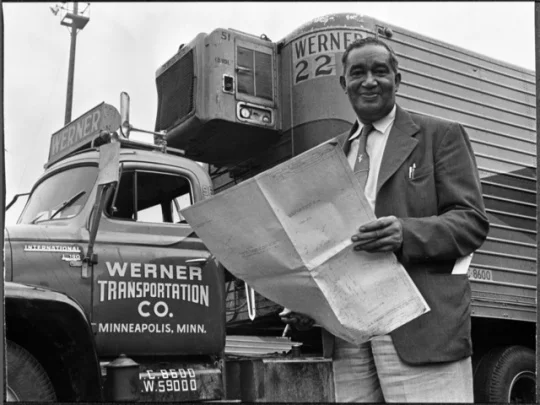
Jones was a self-taught Black engineer whose formal education ended after sixth grade, and he eventually received 61 patents, 40 of them in refrigeration. 4 That background is not a biographical flourish. It explains why the invention did not come from the obvious center of an industry. The trucking problem arrived through a customer complaint: Harry Werner wanted to move food without spoilage, Numero challenged Jones to build the solution, and the U.S. Thermo Control Company became Thermo King in 1941. 5 6
The technical shift was direct. Jones's system was designed to "condition the air" in a truck compartment by "tempering, humidifying and circulating" it. 5 During World War II, Thermo King produced Model C units for the U.S. military, where refrigerated transport helped move blood plasma, medicine, and food. 5 After the war, the same capability moved into grocery distribution, frozen foods, and eventually vaccine logistics. 6
By 1949, Thermo King was already a $3 million business, and more than 75% of food transported in the United States used refrigeration by 2015. 2 5 The decision mirror is clear for product builders: a narrow operational bottleneck can be a larger market than the original customer can describe. Jones did not merely improve a truck. He made distance less hostile to perishables.
1954: Eisenhower's highway plan becomes a platform
On July 12, 1954, Vice President Richard Nixon addressed the Governors' Conference at the Sagamore Inn in Bolton Landing, New York, on behalf of President Dwight D. Eisenhower. 7 Nixon read Eisenhower's proposal for a "grand plan for a properly articulated system" of national highways and told the governors that "a 50 billion dollar highway program in ten years is a goal toward which we can -- and we should -- look." 7
Eisenhower's conviction came from experience as much as policy theory. He had joined the 1919 Transcontinental Motor Convoy, which took 62 days to travel from Washington, D.C., to San Francisco, and he later saw Germany's autobahns during World War II. 8 The 1954 speech framed highways as an economic, safety, and defense problem at once: transcontinental travel, farm-to-market movement, metropolitan congestion, bottlenecks, and access roads all sat inside the same operating constraint. 7
The announcement did not settle the business model. It opened the financing fight. The Clay Committee followed in December 1954, the House rejected the Interstate bill on July 27, 1955, and the eventual Federal-Aid Highway Act of 1956 used a different funding structure. 8 9 The 1956 law authorized $25 billion for 41,000 miles of interstate highways, created the Highway Trust Fund, used a 3-cent-per-gallon gas tax, and set the federal share at 90%. 8 9
The outcome arc ran for decades. The original system's final cost reached about $114 billion, and the last original segment, 12.5 miles of I-70 through Glenwood Canyon, Colorado, opened on October 14, 1992. 8 The network now spans 48,756 miles, and about one-quarter of U.S. vehicle miles traveled used the Interstate Highway System as of 2020. 8
The business mirror is the financing mechanism. The highway system became a platform because the country paired a bold map with a durable payment model. Operators face the same pattern at smaller scale: a strategic plan without funding architecture is usually a presentation; a strategic plan with a funding architecture can become an operating environment.
1957: a one-page smoking statement changes tobacco's risk curve
On July 12, 1957, U.S. Surgeon General Leroy E. Burney released an official Public Health Service statement that moved the federal position on smoking from statistical association toward causation. 10 The statement said, "The Public Health Service feels the weight of the evidence is increasingly pointing in one direction: that excessive cigarette smoking is one of the causative factors in lung cancer." 10
The shift was cautious, but it was official. The day before the statement, Burney had convened scientists from the American Cancer Society, the American Heart Association, the National Cancer Institute, and the National Heart Institute to review 18 independent studies. 10 The 1957 wording also differed from the Public Health Service's 1954 position, which had acknowledged a statistical association without adopting the same causal language. 10
The commercial stakes were already large. Americans consumed about 400 billion cigarettes a year at the time, and U.S. lung-cancer deaths had risen from fewer than 3,000 in 1930 to nearly 27,000 in 1955. 11 The tobacco industry's response came through the Tobacco Industry Research Committee. Its scientific director, Clarence Cook Little, said three years of TIRC research had produced "no evidence that cigarette smoking or other tobacco use contributes to the origin of lung cancer." 12
Burney's own public stance showed how far the regulatory environment still had to move. Three weeks after the statement, a radio interviewer asked whether people should quit smoking, and Burney answered, "No, sir, I do not believe they should quit smoking." 10 For tobacco companies, that gap between causation and action created time. It did not remove the direction of travel.
The later path is the point. Surgeon General Luther Terry's 1964 report, Smoking and Health, concluded that cigarette smoking was causally related to lung cancer in men and that its effect outweighed all other factors. 10 The policy chain then ran through the 1965 Federal Cigarette Labeling and Advertising Act, the January 2, 1971 broadcast advertising ban, the 1998 Tobacco Master Settlement Agreement requiring the four largest U.S. tobacco companies to pay $206 billion over 25 years, and the 2009 law giving the FDA authority over tobacco. 11 13
The decision mirror is regulatory timing. A cautious statement can look manageable in the quarter it lands. If it changes the accepted causal story, it can reset litigation, marketing, product labeling, and capital allocation for decades.
July 12's three events point to one operating question: does the decision create a system that compounds? Jones's refrigeration patents changed what food distribution could promise. Eisenhower's highway proposal changed how goods and people could move. Burney's statement changed what a giant consumer industry could plausibly deny. For business leaders, the warning is practical. The first signal may arrive as a document, a speech, or a patent notice, but the real issue is whether it rewrites the constraints around everyone else's decisions.
Cover image: Frederick McKinley Jones beside a Werner Transportation truck with a Thermo King refrigeration unit, from Minnesota Historical Society / MNopedia.
Fuentes de referencia
- 1US2475841A - Air conditioning unit
- 2Frederick McKinley Jones - Wikipedia
- 3US2303857A - Air conditioner for vehicles
- 4Frederick McKinley Jones - National Inventors Hall of Fame
- 5Thermo King Model C - MNopedia
- 6About Frederick McKinley Jones - Thermo King
- 7Address of Vice President Richard Nixon to the Governors Conference Lake George New York July 12 1954
- 850th Anniversary Interstate Highway System - FHWA
- 9Kill The Bill - FHWA
- 10The other Surgeon General's report - Annals of Cancer Epidemiology
- 11July 12 1957 Surgeon General links smoking and lung cancer
- 12U.S. LINKS CANCER WITH CIGARETTES
- 13Blowing Smoke - Center for the Study of Tobacco and Society
Contenido relacionado
- Inicia sesión para comentar.