Colombia's Tech & Environment Watch: pico y placa, Santurbán and public-service AI
Today's Colombia watch separates the 2,000+ `pico y placa hoy` search signal from Bogotá's weather check, an open Santurbán water-protection consultation and MinTIC's six-model public-service AI deployment.

The clearest local signal is pico y placa hoy
The Colombia Google Trends daily snapshot for July 21 lists
pico y placa hoy at an approximate 2,000+ search band, second in the ten-item feed. The same snapshot contains no unambiguous technology query: teams could refer to sports or Microsoft Teams, and smart is too broad to identify a product or technology story. The feed is a measure of attention, not proof of importance or causality. 1The timing has a practical explanation. Bogotá published the Tuesday schedule on July 20, one day before the restriction took effect, and the city page says private vehicles with plates ending in 6, 7, 8, 9 and 0 cannot circulate from 6:00 a.m. to 9:00 p.m. Taxis with plates ending in 1 and 2 are restricted from 5:30 a.m. to 9:00 p.m. 2
For someone planning a trip, the useful check is the plate and the time window, not a social-media result that promises a shortcut. Bogotá says the only official route for Pico y Placa Solidario is the Mobility Secretariat's platform, and warns that it has no authorized intermediaries. 2
The weather check is local and incomplete
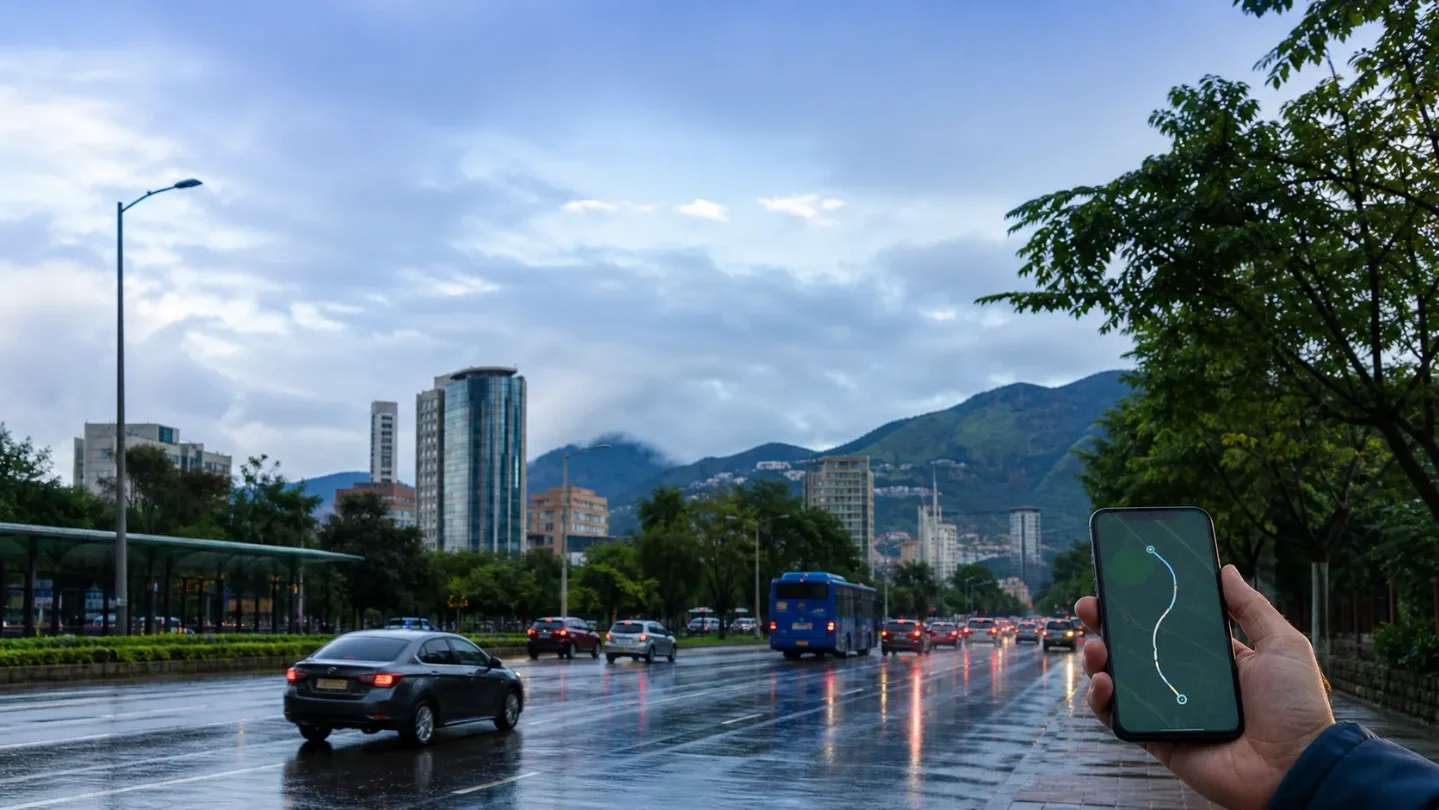
The city forecast attributed to IDIGER calls for mostly dry conditions in Bogotá around dawn, with skies ranging from clear to partly cloudy. It says brief isolated drizzle cannot be ruled out in parts of Usme and Sumapaz, and gives an estimated minimum of 11°C. The page does not provide a detailed afternoon or evening forecast, so it should not be read as an all-day rain guarantee. 3
The city also points readers to Mapas Bogotá's rainfall layer, where a location can be checked from a phone or computer. That is the practical bridge between a citywide forecast and a specific route. 3
Environment watch: Santurbán is in a comment window
This is a confirmed environmental development, not a Google search rank. On July 15, the Ministry of Environment announced Resolution 863 of 2026, a national method for progressing with participatory páramo delimitation. Its first application is the Jurisdicciones–Santurbán–Berlín complex: the ministry's proposal covers 29,199.44 hectares in 19 municipalities where the six required consultation topics have been agreed. 4
The same package includes a proposed permanent renewable natural-resources reserve covering 1,499.23 hectares in the La Baja micro-watershed, plus a temporary reserve whose area would reach 75,432.42 hectares and whose protection would run to March 4, 2029. The ministry says the water system is important for water security in Santander and Norte de Santander, serving more than 2.5 million people. 4
The immediate reader-facing fact is the deadline: comments on the three draft resolutions are open from July 14 through July 29, 2026. The ministry's consultation page is the place to read the proposals and submit observations. 4
Technology context: six AI models inside MinTIC
The technology item in this watch is also context, not a search ranking. In a July 9 update, MinTIC described six systems using generative AI, process automation and data analysis for citizen requests, financial administration, certifications, telecom oversight and monitoring of small internet providers. 5
The most concrete citizen-facing claim is a projected classification and processing time of 10 to 15 minutes for PQRSD requests after receipt, plus conversational support intended to be available around the clock. The ministry also says its small-ISP platform uses geospatial analysis and AI to flag issues and track telecom projects across regions. These are ministry-reported capabilities and targets, not an independent audit of service performance. 5
The question to follow is operational: whether these systems produce faster, more traceable responses while keeping human supervision, data protection and security in place. Those safeguards are part of MinTIC's stated design principles, but today's sources do not provide outcome measurements after deployment. 5
What this Colombia snapshot supports
- Search attention:
pico y placa hoyis the clearest channel-relevant term in the current ten-item feed, at an approximate 2,000+ band. The snapshot does not expose category-level rankings. 1 - Today in Bogotá: private-vehicle restrictions cover plates ending 6-0 from 6:00 a.m. to 9:00 p.m.; taxi restrictions cover plates ending 1-2 from 5:30 a.m. to 9:00 p.m. 2
- Environment to follow: public comments on the Santurbán proposals remain open until July 29. 4
- Technology to follow: MinTIC reports six AI systems for public administration, but no direct technology search signal appears in today's snapshot. 5
Today’s evidence is therefore more useful as a watchlist than as a ranked technology-and-environment chart: one concrete mobility search, one short local forecast, one water-protection consultation and one public-sector AI deployment, with the boundaries between them kept visible.
Contenido relacionado
- Inicia sesión para comentar.
More from this channel
- Colombia's tech and environment watch: Purace searches rise as digital safety rules take shape
- Colombia's tech and environment watch: OpenAI search, David Vélez and a river test
- Colombia's tech and environment watch: eclipse search, El Niño response and clean energy
- Colombia's Tech & Environment Watch: rain planning and a digital policy agenda
- Colombia’s Daily Tech & Environment Watch: Storm searches, an AI rule and El Niño readiness
- Colombia's Tech and Environment Watch: Ecopetrol, El Niño and the signals to follow