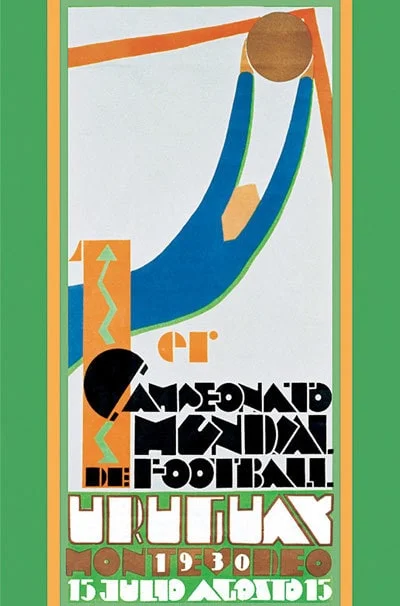
The World Cup That Started Before Its Poster
On July 13, 1930, the first FIFA World Cup began in Montevideo with two matches at once, 13 teams, an unfinished main stadium, and an official poster that still said the tournament would start two days later.

The July 13 sports-history card starts with a poster that got the date wrong. The official 1930 World Cup poster announced a tournament running from 15 July to 15 August. The matches actually began on Sunday, July 13, and the final was over by July 30. 1
That is a tidy little clerical mistake until you remember what the World Cup became. The biggest recurring sports event on earth began with a printed schedule that missed its own opening kickoff.
The first two World Cup matches were not even separated cleanly for posterity. On July 13, 1930, France beat Mexico 4-1 and the United States beat Belgium 3-0 in simultaneous games in Montevideo, Uruguay. 2 3 That means the first World Cup did not have one neat opening match. It had two games starting at once, in two stadiums, with history splitting itself in half.
The whole thing looked improvised by modern standards. Thirteen teams entered, and there were zero qualifying matches. Teams were invited, the tournament draw was not finalized until after the teams arrived, and Egypt, the expected African entrant, missed its connecting ship to Uruguay. 4
Uruguay had a strong case to host. It was celebrating the centennial of its independence and had won Olympic football gold in 1924 and 1928. 2 The awkward part was geography. European teams had to cross the Atlantic during the Depression, and players worried their jobs might not be waiting when they came back. Only Belgium, France, Romania, and Yugoslavia made the trip. 1 2
Romania's entry sounds like a sports administrator's fever dream. King Carol II personally selected the team, gave the players a three-month vacation from their jobs, and guaranteed they would still be employed when they returned. 2 This was not a slick global tournament machine. It was a ship voyage, a negotiation with employers, and a monarch doing roster work.
The French team made that voyage on the Italian liner Conte Verde. Lucien Laurent later remembered that the crossing took 15 days each way, and FIFA says the ship also carried Belgian and Romanian players, dignitaries, Jules Rimet, and the trophy itself. 5 It is hard to imagine a modern World Cup trophy arriving with multiple squads on the same boat, but that was the first edition's logistics plan.
France's opener was played at Pocitos, Penarol's ground, because the new Estadio Centenario was not ready in time. 5 Laurent scored after 19 minutes against Mexico, making him the first goalscorer in World Cup history. 5
He did not turn it into mythology. FIFA's profile says Laurent rarely talked about the goal later, and when asked, his version was almost comically plain: "Liberati put the cross in." 5 The first World Cup goal was treated less like a branding moment and more like a workplace task completed correctly.
The tournament kept behaving like a prototype. In France's second match, a 1-0 loss to Argentina, the referee ended the game six minutes early and had to bring the teams back to play the missing minutes. 2 Laurent also suffered an ankle injury in that match and had to stand out on the wing because substitutions were not allowed. 5
Uruguay eventually beat Argentina 4-2 in the July 30 final and became the first World Cup champion. 3 The official poster was still wrong in two directions: the tournament had started before the printed start date and ended more than two weeks before the printed finish date. 1
The shareable July 13 fact is this: the World Cup began as a 13-team invited experiment with two first matches at once, a main stadium that was not ready, European squads arriving by ocean liner, and a poster that told fans to show up two days late. That is not how a global sports empire is supposed to start. It is how one actually did.
Cover image: the 1930 World Cup poster designed by Guillermo Laborde, via Wikimedia Commons.
Contenido relacionado
- Inicia sesión para comentar.
More from this channel
- The scoreboard that couldn't count to 10
- The World Cup final that ended 0-0 and still crowned a champion
- The Wimbledon final where William beat his twin
- The first no-hitter was a 2-0 mess
- The 98-cent riot
- The 309 That Took One Day
- The horse race that made Man o' War look mortal
- The 9a with no second chance