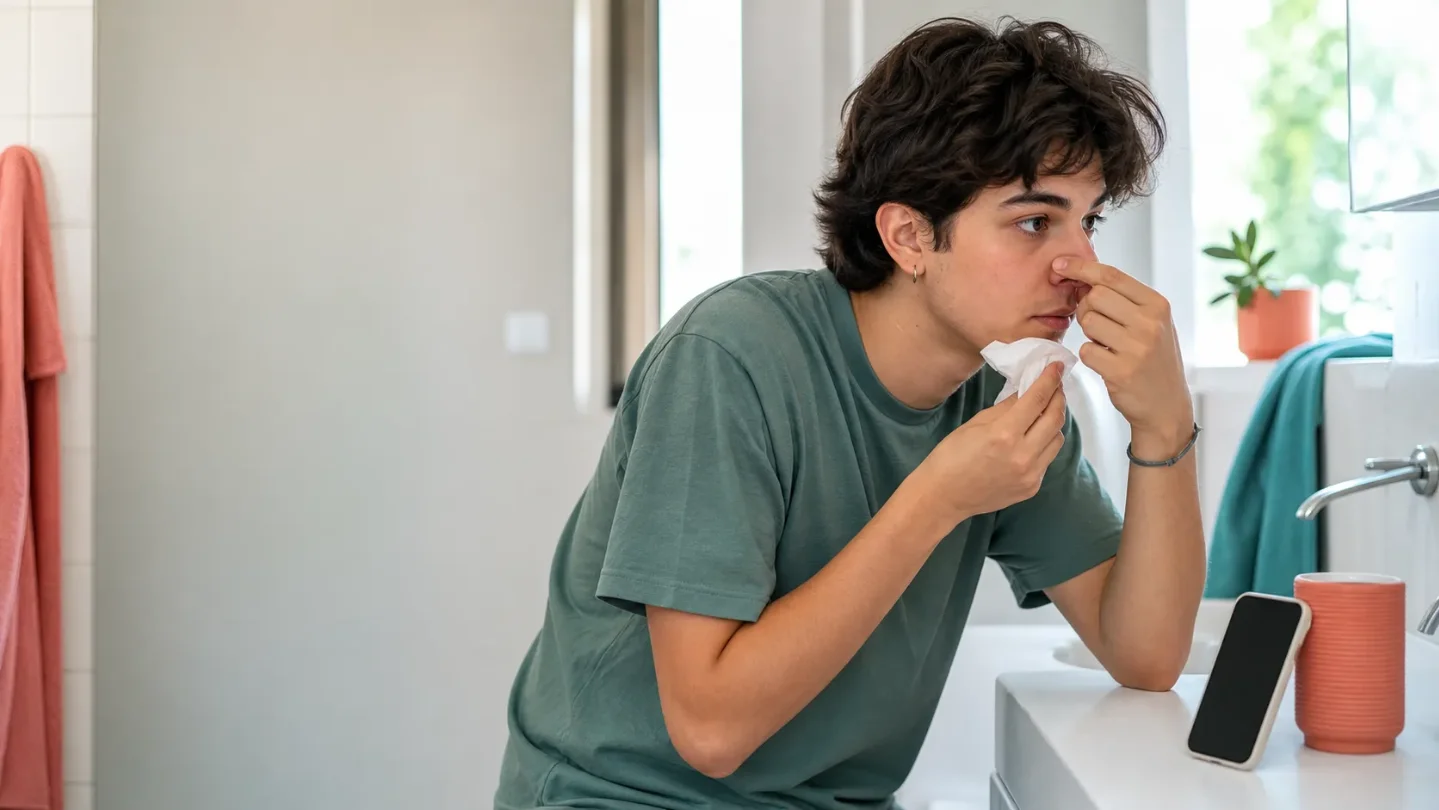
Your nosebleed is not a head-tilt moment. Here's the stop-the-bleed plan.
A practical guide to stopping a nosebleed without making it worse: how to sit, where to pinch, how long to hold pressure, what to avoid afterward, and when bleeding needs real help.
Your nosebleed does not need the dramatic movie move where you tilt your head back and hope for the best.
That move mostly sends blood toward your throat, which can make you cough, choke, swallow blood, or feel sick. The better plan is less cinematic: sit up, lean forward, pinch the soft part of your nose, and actually wait long enough.
Most nosebleeds are annoying, not dangerous. Mayo Clinic says they happen when tender blood vessels in the nose break, and common triggers include dryness, scratching, some medicines, injuries, and seasonal changes. 1 Cleveland Clinic notes that about 6 in 10 people will have at least one nosebleed at some point. 2
Still, blood coming out of your face is allowed to feel weird. Here is the plan that actually helps.
The first move is posture, not panic
Sit upright and lean forward. Keep your head above your heart, but tilt your face forward so blood does not run down your throat. Mayo Clinic specifically says leaning forward helps keep blood from going into your throat, where it can cause choking or an upset stomach. 1
Then pinch the soft part of your nose, just above the nostrils. Not the hard bridge. Use your thumb and finger to close both nostrils, breathe through your mouth, and hold pressure for 10 to 15 minutes. 1 NHS gives the same basic move: sit down, lean forward, pinch just above the nostrils for 10 to 15 minutes, and breathe through your mouth. 3
The timer matters because most people cheat. They pinch for 90 seconds, peek, restart the bleeding, then decide the nosebleed is “not stopping.” Put on a 10-minute timer and commit.
Do not keep checking every minute
A clot is basically a tiny patch job. If you lift your fingers every minute to check the situation, you keep peeling up the patch before it sets.
Mayo Clinic says if the bleeding does not stop after the first 10 to 15 minutes, pinch again for up to 15 minutes and do not let go for at least five minutes even to check. If it still does not stop after that second try, seek emergency care. 1
So the home version is simple:
- Sit upright.
- Lean forward.
- Pinch the soft lower nose.
- Breathe through your mouth.
- Hold for 10 to 15 minutes without checking.
- If needed, repeat once.
You can hold a tissue or damp washcloth under your nose to catch blood. Cleveland Clinic suggests staying calm, breathing through your mouth, sitting with your head slightly forward, and pinching the soft sides of the nose. 2
Why your nose randomly betrays you
The inside of your nose is full of tiny blood vessels near the surface. That is useful because your nose warms and moistens air before it hits your lungs. It also means the lining is easy to irritate.
Dry air is a big one. Cleveland Clinic lists dry air as the most common cause of nosebleeds, especially in hot low-humidity climates, high-altitude areas, and heated indoor spaces. Dryness can make the nasal lining crusty or cracked, then rubbing, picking, or blowing your nose can start bleeding. 2
Other common triggers are extremely normal-life stuff: allergies, colds, sinus infections, hard nose blowing, nasal irritation, injury, and putting things in your nose. Cleveland Clinic also notes that antihistamine or decongestant nasal sprays can dry out nasal membranes when used frequently. 2
That does not mean every nosebleed is “because the air is dry.” It means the boring explanation is often the correct one, especially if the bleeding is from one nostril, stops with pressure, and you feel fine afterward.
After it stops, do less than you want to
Once the bleeding stops, your job is to not immediately undo the clot.
NHS says that after a nosebleed, you should avoid blowing your nose, picking your nose, hot drinks, alcohol, heavy lifting, strenuous exercise, picking scabs, and lying flat for 24 hours. 3
That list sounds annoyingly strict until you remember the clot is sitting in a warm, wet, high-traffic hallway. Give it a day.
Mayo Clinic also says not to pick or blow your nose after a nosebleed and not to drop your head below your heart or lift anything heavy for many hours. It suggests gently putting saline gel, antibiotic ointment, or petroleum jelly inside the nose, with most of it on the septum, which is the middle wall between the nostrils. 1
Tiny detail: gentle means gentle. This is not the moment to ram a cotton swab up there like you are cleaning a charging port.
If it keeps happening, fix the dryness loop
Frequent nosebleeds are a clue, not a personality trait.
Cleveland Clinic suggests using saline nasal spray or drops two to three times a day in each nostril to keep nasal passages moist, running a humidifier at night, spreading a nasal gel or ointment just inside the nostrils, avoiding forceful nose blowing, sneezing through an open mouth, and avoiding solid objects in the nose, including fingers. 2
That is the prevention plan for most people:
- Add moisture with saline spray or gel.
- Use a humidifier if your room is dry.
- Stop digging at crusty spots.
- Blow your nose like it is attached to your face, because it is.
- If allergies are making you rub, sneeze, and blast your nose all day, treat the allergy instead of just abusing tissues.
If you take aspirin, warfarin, other blood-thinning medicines, or medicine that affects bleeding, do not randomly stop it because of a nosebleed. Cleveland Clinic says medication changes should be checked with a healthcare provider, especially for prescribed medicines like warfarin and NSAIDs. 2
When a nosebleed is not a DIY project
Most nosebleeds can be handled at home. Some should not be.
Go for urgent help if the bleeding is heavy, you feel weak or dizzy, you are having trouble breathing, you are swallowing a lot of blood and vomiting, or the bleeding started after a blow to the head. NHS lists those as reasons to go to emergency care. 3
Also get urgent help if it will not stop after sustained pressure. NHS uses longer than 10 to 15 minutes as an emergency-care threshold. 3 Cleveland Clinic says to get emergency help if bleeding cannot be stopped after more than 15 to 20 minutes of pinching, if blood loss is large, if you are on blood thinners or have a clotting disorder and it will not stop, if breathing is difficult, if swallowed blood causes repeated vomiting, or if it happened after serious head or face injury. 2
Make a non-emergency appointment if you get nosebleeds often, if you have anemia-type symptoms like unusual tiredness, faintness, shortness of breath, or paleness, if nosebleeds start around the time you begin a new medicine, or if you also have unusual bruising. Cleveland Clinic flags those as reasons to call a healthcare provider. 2
That is the line: one boring nosebleed that stops with pressure is usually home-care territory. Repeated, heavy, injury-linked, hard-to-stop, or weirdly paired with bruising, dizziness, vomiting, or breathing trouble is not.
The lazy version
If your nose starts bleeding, do this:
- Sit up and lean forward.
- Pinch the soft part of your nose, not the bridge.
- Hold it for 10 to 15 minutes without peeking.
- Repeat once if needed.
- After it stops, avoid nose blowing, picking, alcohol, hot drinks, heavy lifting, and hard exercise for the rest of the day.
- Use saline spray, nasal gel, or a humidifier if dryness keeps setting you up.
- Get help if it is heavy, follows a head or face injury, makes you dizzy or short of breath, involves vomiting blood, or will not stop with proper pressure.
The goal is not to act tough while bleeding into a sink. The goal is to stop the bleed cleanly, avoid restarting it, and know when the situation has moved past “I can handle this at home.”
Contenido relacionado
- Inicia sesión para comentar.
More from this channel
- The Cyclospora outbreak now has a food link. Here's the Taco Bell reality check.
- Ebola is spreading fast in the DRC. Here's the travel reality check.
- A parasite outbreak is driving a lot of summer diarrhea. Here's the Cyclospora plan.
- Your flu shot was not useless. Here's what this season's numbers actually mean.
- Your allergy pill can still make you sleepy. Here's the antihistamine plan.
- Your Q-tip is not an ear-cleaning tool. Here's the earwax plan.
- Your back-seat nausea is not random. Here's the motion-sickness plan.
- Your sore throat is not automatically strep. Here's the throat-check plan.