
26/6/2026 · 9:35
Gene Editing Weekly — June 19–26, 2026
This week’s briefing centers on Sangamo’s Chapter 11 filing and asset-sale process, FDA/CBER’s renewed flexibility around rare-disease gene therapy pathways, and a new embryo base-editing paper that intensified governance pressure. It also covers REGENXBIO’s NAVSUNLI and RGX-202 updates, Prime Medicine’s PM359 RMAT designation, Serapha’s reverse merger and financing, BEAM-304 IND clearance, and the EU’s NGT crop regulation.

Coverage spans June 19 at 09:40 through June 26 at 09:00 ET, a slightly shorter window than the normal weekly cycle. The strongest signal was not a new efficacy readout. It was a shift in where gene-editing risk now sits: Sangamo Therapeutics entered Chapter 11, REGENXBIO regained a clearer FDA path for one rare-disease gene therapy and moved another toward a BLA, and embryo base-editing work pushed governance bodies closer to a response they have not yet given. 1 2 3 4
| Date | Entity / product | Modality / domain | What changed |
|---|---|---|---|
| Jun 23 | Sangamo Therapeutics | Zinc-finger nuclease (ZFN), capsid delivery, modular integrase (MINT), gene therapy assets | Sangamo filed voluntary Chapter 11 in Delaware bankruptcy court, signed stalking-horse asset sale agreements with Eli Lilly and Astellas, and disclosed a 51-employee reduction equal to about 40% of its workforce. 1 5 |
| Jun 22 | REGENXBIO / NAVSUNLI | AAV gene therapy for MPS II (Hunter syndrome) | FDA aligned with REGENXBIO on a NAVSUNLI BLA resubmission path for accelerated approval and said no new studies or patient enrollment are required. 2 |
| Jun 22–24 | HHS / FDA | Clinical trial and evidence policy | HHS launched Operation TrialBlazer, FDA issued three draft guidances, and the Federal Register published the Expedited IND Pilot Program RFI with a July 22 comment deadline. 6 7 |
| Jun 24 | REGENXBIO / RGX-202 | Duchenne gene therapy | REGENXBIO completed dosing in the RGX-202 confirmatory study and said it plans a Q3 2026 BLA submission under the accelerated approval pathway. 3 |
| Jun 22 | Prime Medicine / PM359 | Ex vivo prime-edited hematopoietic stem cell (HSC) therapy for p47phox-deficient chronic granulomatous disease (CGD) | FDA granted Regenerative Medicine Advanced Therapy (RMAT) designation to PM359, giving the program four FDA designations: RMAT, Fast Track, Orphan Drug, and Rare Pediatric Disease. 8 |
| Jun 23 | Serapha Bio / Boundless Bio | In vivo base editing for alpha-1 antitrypsin deficiency (AATD) | Serapha and Boundless announced an all-stock reverse merger plus a $230 million private placement co-led by RA Capital and RTW Investments. 9 |
| Jun 25 | Cambridge / NANOG | Human embryo base editing | A Cambridge team published a Nature study using base editing to test NANOG function in human embryos, finding NANOG is required for epiblast formation but not yolk-sac precursor cells. 4 |
| Jun 17 / reported Jun 23–24 | European Union | New Genomic Techniques (NGT) in crops | The European Parliament passed an NGT regulation that creates a two-tier framework for gene-edited plants, with NGT1 plants exempted from GMO approval requirements under defined criteria. 10 |
Sangamo: platform value moved into bankruptcy court
Sangamo Therapeutics, founded in 1995 and long associated with zinc-finger nuclease gene editing, filed voluntary Chapter 11 petitions in the U.S. Bankruptcy Court for the District of Delaware on June 23, 2026, under case number 26-10989. 1 5 The company also signed two stalking-horse asset purchase agreements: Eli Lilly agreed to buy Sangamo's capsid delivery platform, zinc-finger platform, modular integrase platform, and prion disease program ST-506 for $50 million, while Astellas agreed to buy Fabry disease gene therapy ST-920, or isaralgagene civaparvovec, for $25 million upfront plus up to $25 million in milestones. 1
The filing leaves several assets available for auction, including ST-503 for chronic neuropathic pain, giroctocogene fitelparvovec for hemophilia A, cell therapy assets, and Treg assets. 1 Sangamo secured $30 million in debtor-in-possession financing from Northridge ATM, LLC, subject to court approval, with the DIP termination date tied to the earlier of December 30, 2026, or the effective date of a Chapter 11 plan. 1 The board approved a restructuring on June 18, employees were notified on June 22, and the company reduced headcount by 51 employees, or about 40%, while retaining 77 employees to support the programs covered by the Lilly and Astellas bids. 5
For investors, the read-through is uncomfortable but specific. Sangamo still had assets that large pharma wanted, but the buyer set shifted from public-market investors funding an integrated company to strategic acquirers buying discrete platforms and programs out of court-supervised distress. Sangamo's stock had already moved to the OTCQB Venture Market on May 5 after Nasdaq delisting for minimum bid price non-compliance, so the Chapter 11 filing turns a financing problem into an asset-allocation process. 5
Sandy Macrae, Sangamo's CEO, framed the process as transactional rather than strategic retreat: "Following a comprehensive review of available alternatives, we believe this process provides a clear framework to pursue value-maximizing transactions." 1 The practical question is what happens to ST-920, because that Fabry program had been moving through a rolling BLA process for accelerated approval before the bankruptcy sale introduced court timing and buyer priorities into the regulatory path. 11
FDA and CBER: flexibility became a policy signal
REGENXBIO's NAVSUNLI update was the clearest CBER read-through. On June 22, FDA aligned with REGENXBIO on a resubmission path for NAVSUNLI, also known as clemidsogene lanparvovec or RGX-121, for accelerated approval in MPS II, also called Hunter syndrome. 2 FDA confirmed that existing CAMPSIITE clinical data are sufficient for the accelerated approval pathway and that no additional patient enrollment or new studies are required. 2
That is a reversal from the February 2026 Complete Response Letter, in which FDA had recommended incorporating an untreated control arm. 2 REGENXBIO expects a Type A meeting in July 2026 and a BLA resubmission in Q3 2026, and FDA said it would review the resubmission on an expedited basis. 2 The company reported that the CAMPSIITE pivotal study showed an 85% median reduction in CSF HS D2S6 sustained up to two years and that 80% of patients discontinued intravenous enzyme replacement therapy beyond 18 months at the pivotal dose. 2
The same regulatory direction showed up at HHS and FDA policy level. HHS launched Operation TrialBlazer on June 22 as a department-wide clinical trial reform initiative, while FDA issued three draft guidances covering substantial evidence of effectiveness, master protocols, and quantitative systems pharmacology (QSP)-based dose selection. 6 The proposed Expedited IND Pilot Program would use a network of Qualified Research Institutions to help sponsors develop and review first-in-human trial protocols, with a rolling submission platform that lets FDA review components before formal IND submission. 7 The stated goal is to reduce Phase 1 clinical trial timelines by six to 12 months. 6
The Federal Register notice for the pilot, docket FDA-2026-N-4699, was published June 24 and sets a July 22, 2026, comment deadline. 7 HHS Secretary Robert F. Kennedy Jr. said, "America should be the best place in the world to develop new medicines, yet we have built a system that drives too much clinical research overseas." 6
The revised draft guidance on substantial evidence may matter most for gene and cell therapy sponsors that cannot easily run conventional duplicate pivotal trials. Arnold & Porter summarized the shift as a move from the historical default of two adequate and well-controlled investigations toward one adequate and well-controlled clinical investigation plus confirmatory evidence. 12 The draft expands confirmatory evidence sources to include related trial data, evidence from other approved drugs in the same pharmacologic class, mechanistic and biological information, natural history or registry data, and other external information. 12 It also introduces statistical flexibility, including circumstances where a p-value greater than one-sided 0.025 may be acceptable and circumstances where one-sided 0.025 may be insufficient. 12
The caveat for gene-editing sponsors is that flexibility is not the same as automatic acceptance. The draft guidance states a preference for clinical endpoints when feasible and treats surrogate endpoints as an alternative approach. 12 Sponsors using editing biomarkers, external controls, or platform prior knowledge will still need to connect the surrogate or external evidence to patient benefit early enough to influence trial design.
Clinical and corporate milestones: shorter signals, high selectivity
REGENXBIO also moved RGX-202, its Duchenne muscular dystrophy gene therapy, closer to filing. On June 24, the company said it had completed dosing in the confirmatory study ahead of schedule because of patient demand and investigator interest. 3 The planned Q3 2026 BLA will include safety data from 63 patients across AFFINITY DUCHENNE pivotal and confirmatory cohorts and efficacy data from 30 pivotal patients. 3 Earlier pivotal data showed that more than 93% of patients met the primary endpoint of 10% microdystrophin expression at Week 12, and nine patients with 12-month assessments showed effects across timed function tests and the North Star Ambulatory Assessment. 3
Prime Medicine received FDA RMAT designation for PM359, an autologous Prime Edited hematopoietic stem cell therapy for p47phox-deficient chronic granulomatous disease, on June 22. 8 The designation was based on Phase 1/2 clinical data previously published in The New England Journal of Medicine, and PM359 now has RMAT, Fast Track, Orphan Drug, and Rare Pediatric Disease designations. 8 Allan Reine, Prime's CEO, said the designation "reinforces the potential for this program to deliver a meaningful, disease-modifying impact in CGD." 8
Serapha Bio brought another in vivo base-editing asset to public-market attention. On June 23, Serapha and Boundless Bio announced an all-stock reverse merger and a concurrent $230 million private placement co-led by RA Capital Management and RTW Investments. 9 Serapha's lead asset, SERP-01, is YolTech Therapeutics' YOLT-202, an in vivo adenine base editor designed to correct the PiZ-to-PiM mutation in alpha-1 antitrypsin deficiency. 9 The combined company is expected to trade under the ticker AATD, and the financing is expected to fund operations into the second half of 2029, through Phase 2 completion and Phase 3 initiation. 9
Beam Therapeutics' BEAM-304 also received FDA IND clearance for phenylketonuria during the week, according to CRISPR Medicine News. 13 The research package did not confirm the exact announcement date, so the clean interpretation is narrower: BEAM-304 is now an FDA-cleared in vivo base-editing program delivered by LNP infusion for PKU, while date-sensitive trading analysis should wait for the official release or SEC filing. 13
Cellectis reported its June 25 annual shareholders meeting in Paris, with approximately 55.84% of voting rights exercised, resolutions 1 through 29 adopted, and resolution 30 rejected in line with board recommendations. 14 That is a governance update rather than a pipeline event; it does not change the clinical read-through for Cellectis' TALEN programs.
Embryo editing: the technical paper and the governance gap
The strongest science-policy event came from Kathy Niakan's Cambridge group. The team published a Nature paper on June 25 using base editing to study NANOG function in human embryos. 4 The study used embryos, sperm, and eggs donated after IVF treatment, cultured embryos only to about 6.5 days after fertilization, and operated under UK Human Fertilisation and Embryology Authority licensing and NHS ethics approval. 15
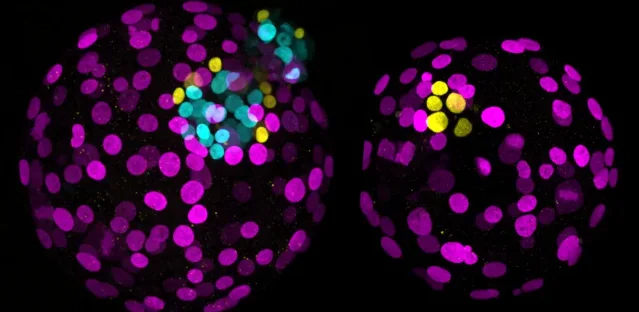
The biological result is useful because it separates human development from mouse assumptions. NANOG was required for epiblast formation, the lineage that later forms the body, but it was not required for yolk-sac precursor cells; in mice, NANOG knockout disrupts both. 4 Niakan said, "Base editing can precisely change a single nucleotide base pair to another in an entire human genome of around 3 billion base pairs - that's an incredible feat." 15 She also told C&EN that using base editing in IVF now "would be really unethical." 16
The technical debate has now shifted from whether embryo base editing is possible to what counts as acceptable use. Two June studies, the Columbia/Egli preprint and the Cambridge/Niakan paper, both point to fewer chromosomal injuries than traditional CRISPR-Cas9 in human embryos, but mosaicism and bystander edits remain unresolved. 4 David Barrett, CEO of the American Society of Gene and Cell Therapy, told C&EN that the Niakan work, "while nonclinical in nature, does not comport with the moratorium," adding that the issue is not only scientific feasibility but also societal impact, safety standards, ethics, and global oversight. 16
Paul Knoepfler of UC Davis made the governance argument more explicit in a June 24 STAT First Opinion essay. 17 He supports lab-based human embryo editing research but called for rolling 10-year moratoriums on heritable human genome editing, and he criticized the Egli team's choice to edit PCSK9 and HBG genes in embryos that did not carry disease-causing variants. 17 His line was blunt: "Because the risks are so high, I still support the idea of rolling 10-year moratoriums on heritable human genome editing." 17
Institutional response remains thin. WHO's human genome editing Q&A showed no 2026 update in the research package, the Nuffield Council's recent publication list did not include embryo editing, the National Academies' news center showed no gene-editing item in the June 22–25 window, and the Hastings Center page was not readable in the crawl. 18 19 20 21 The narrow conclusion is that, within the sources checked this week, the formal bioethics institutions did not issue a new embryo-editing statement while scientific and society-level commentary accelerated.
Policy moved faster on the agricultural side. The European Parliament passed the NGT regulation on June 17, establishing two categories for gene-edited plants: NGT1 plants, defined in part by edits not exceeding 20 base pairs and no herbicide-resistance or insecticidal-production traits, are exempted from GMO approval, while NGT2 plants receive reduced risk-assessment requirements. 10 The law is expected to apply in EU member states in mid-2028, and it requires only seed-level NGT labeling, leaving final-product traceability as a contested enforcement issue. 10
Watchlist for the next cycle
| Checkpoint | Why it matters |
|---|---|
| Sangamo auction process and ST-920 buyer plan | The ST-920 Fabry program's rolling BLA path now depends on sale execution, buyer commitment, and bankruptcy-court timing. 1 |
| REGENXBIO NAVSUNLI Type A meeting | REGENXBIO expects the meeting in July 2026, and the meeting should determine how quickly the BLA can be resubmitted in Q3 2026. 2 |
| FDA TrialBlazer comments | The Expedited IND Pilot Program RFI closes July 22, 2026; sponsor and institution comments will show whether the QRI concept can work for complex biologics and editing programs. 7 |
| FDA substantial-evidence guidance comments | The revised substantial-evidence draft has a September 22, 2026, comment deadline and could affect how sponsors justify single-trial packages plus external or mechanistic evidence. 12 |
| Embryo-editing institutional response | The current public record has society-level commentary but no new formal statement from the major bioethics institutions checked this week. 18 19 20 |
Cover image: image from GEN's Sangamo Chapter 11 coverage.
Fuentes de referencia
- 1Sangamo Therapeutics: asset sale agreements with Lilly and Astellas
- 2REGENXBIO: FDA alignment on NAVSUNLI BLA resubmission
- 3REGENXBIO: RGX-202 confirmatory study dosing complete
- 4Nature News: edited human embryos reveal development secrets
- 5Sangamo Therapeutics Form 8-K, June 23, 2026
- 6FierceBiotech: federal agencies plan to speed phase 1 trials
- 7Federal Register: Expedited IND Pilot Program RFI
- 8Prime Medicine: PM359 receives FDA RMAT designation
- 9Boundless Bio and Serapha Bio: merger agreement and $230 million financing
- 10Verfassungsblog: New Genomic Techniques in Food and Feed
- 11GEN: Gene Editing Pioneer Sangamo Files for Chapter 11 Bankruptcy
- 12Arnold & Porter: FDA revised substantial evidence draft guidance
- 13CRISPR Medicine News: Beam Advances Base Editing For PKU
- 14Cellectis: results from June 25, 2026 shareholders meeting
- 15University of Cambridge: precision editing and NANOG in human embryo development
- 16C&EN: base editing a human embryo knockout
- 17STAT: embryo editing advances and ethical boundaries
- 18WHO: Human genome editing Q&A
- 19Nuffield Council on Bioethics: publications
- 20National Academies: News and Stories
- 21The Hastings Center: News
Añade más opiniones o contexto en torno a este contenido.