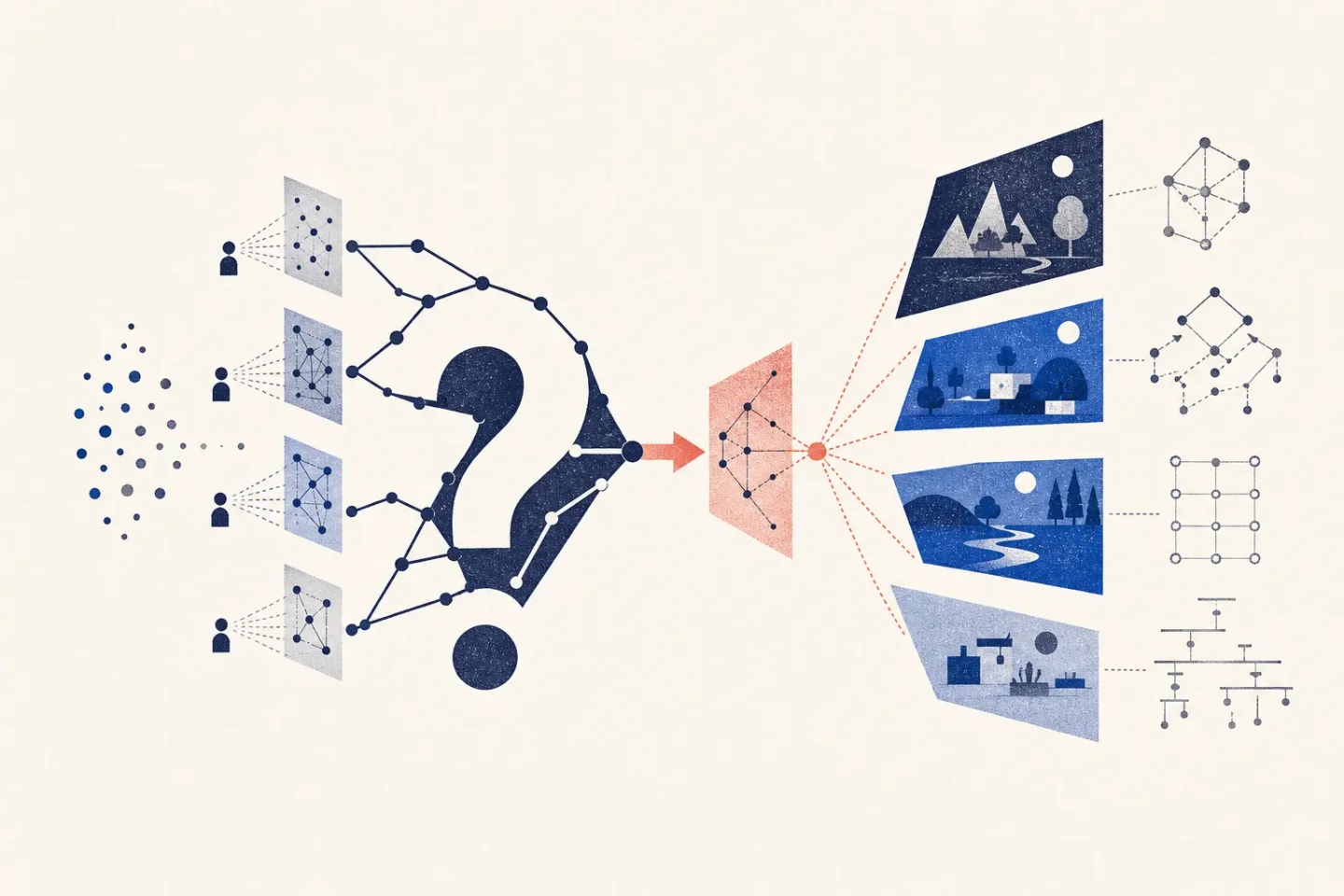
Questions Become Actions: The 2026 Turn in Inquisitive Logic
A curated technical snapshot of the field's shift from question semantics toward agency, first-order dependence, expressive-power limits, and proof theory.

The Short Version
The important story in inquisitive logic over the last year is not a new notation for questions. It is a change in what the framework is being asked to explain. Recent work pushes inquisitive semantics in three directions at once:
- from information exchange to agency: what an action determines, not only what it forces;
- from dependence claims to expressive-power boundaries: where team and first-order variants exceed classical first-order logic;
- from elegant semantics to usable proof systems: labelled calculi, cut admissibility, strong completeness, and proof search.
The strongest concentration of results appears in the open-access AiML 2026 proceedings. Four papers there connect inquisitive logic to action models, first-order modal dependence, team semantics, and proof theory. 1
1. InqAL Makes Agency Question-Sensitive
Ivano Ciardelli's Inquisitive Action Logic (InqAL) is the clearest new direction. Published in AiML 2026 on 29 June 2026, it is a multi-agent modal logic built on inquisitive neighborhood logic and concurrent game structures. 2
The conceptual distinction is sharp. Coalition logic and related action logics ask whether an agent or coalition can force a proposition about the outcome. InqAL also asks which question about the outcome an agent's action settles. An action may fail to determine the whole state while still determining the answer to a coarser question. That is the point at which ordinary proposition-centred forceability becomes too blunt: agency can be partial, and partiality is naturally represented as a question.
The paper's technical architecture reflects that idea rather than merely adding a new connective. A concurrent game structure supplies worlds, agents, action choices, and outcome sets. The inquisitive neighborhood layer then records which sets of outcomes are associated with an agent's possible actions. The paper isolates an agentive-determination operator, written in the paper as
⊠_a φ, for the case where the answer to φ is not already fixed but becomes settled once agent a fixes an action. 3The representation theorem is the important bridge to existing action semantics. It characterizes when a multi-agent neighborhood frame actually comes from a concurrent game structure. In the paper's formulation, the conditions are:
- every agent has at least one available action;
- agents have a common range of possible outcomes;
- choices made by different agents satisfy the required independence condition, so compatible combinations of actions have a non-empty outcome intersection.
This matters because it prevents an inquisitive neighborhood model from being treated as an arbitrary abstract container. The model must still be realizable as a system of interacting actions. InqAL therefore connects question-sensitive semantics to the effectivity-function tradition instead of leaving the action interpretation at the level of metaphor. 3
The paper also proves an axiomatization, completeness, and decidability through the finite model property. On the statement fragment, InqAL is expressively equivalent to the individual-agent fragment of socially friendly coalition logic. The result is a useful calibration: InqAL's novelty is not simply that it proves more ordinary statements. Its extra leverage appears when the object of reasoning is an issue, a dependency, or an aspect of an outcome rather than a single proposition. 2
Where InqAL sits in the action-model lineage
| Framework | What changes | What InqAL adds |
|---|---|---|
| Inquisitive dynamic epistemic logic | Information exchange raises and resolves issues | A baseline for question-sensitive updates, but focused on epistemic change 4 |
| Action models in inquisitive logic | Inquisitive action models and product updates | A systematic account of information-changing actions 5 |
| Inquisitive Neighborhood Logic | Modal reasoning over neighborhood models | The neighborhood substrate extended by Ciardelli in 2025 6 |
| InqAL | Physical actions in concurrent game structures | Agentive determination, a representation theorem, and a complete decidable multi-agent system 2 |
The open problem is now equally clear: can this question-sensitive account of agency be extended with temporal iteration, richer coalition structure, or strategy-level reasoning without losing the semantic and decidability results that make the current system attractive?
2. The First-Order Branch Finds Its Boundary
The second major development is meta-theoretic rather than applicational. Two 2026 papers by Ciardelli and Juha Kontinen settle long-standing questions about the expressive strength of inquisitive first-order logic and its team-semantic relatives.
First, On the Expressive Power of Inquisitive Team Logic and Inquisitive First-Order Logic shows that open formulas of inquisitive team logic are strictly more expressive than first-order logic, even though the sentence fragment had been known to match first-order expressivity. The authors then add the range-generating universal quantifier used in dependence logic and show that the resulting logic can express finiteness. They extend the analysis to standard InqBQ and obtain sentences expressing non-first-order model properties. 7
That result changes how the team/state distinction should be read. The extra expressive power is not visible if one looks only at closed sentences. It emerges when open formulas carry assignments and question-like dependencies at the same time. The technical lesson is that team semantics is not merely an alternative presentation of inquisitive meaning; at the open-formula level, it changes the logic's model-theoretic reach.
Second, the March 2026 preprint Inquisitive first-order logic is neither compact nor recursively axiomatizable gives a negative answer to two questions that had been open since InqBQ was introduced: entailment is not compact, and the validities of InqBQ are not recursively enumerable. The authors' route is a definability argument connecting InqBQ with true arithmetic. This is a preprint result, not a separate AiML proceedings item, so it should be tracked with that status. 8
The contrast with the modal dependence line is instructive. Ciardelli's 2025 work on global supervenience in inquisitive modal logic analyzes dependence between predicate extensions across a space of possibilities using an inquisitive strict conditional. That system is reported as compact and recursively enumerable, while allowing modal operators to apply to inquisitive formulas adds expressive power beyond standard modal predicate logic. 9
These statements are not inconsistent. They concern different logical systems. The current picture is a genuine trade-off map:
| System or fragment | New result | Practical implication |
|---|---|---|
| Inquisitive modal logic for global supervenience | Greater modal expressivity while retaining compactness and recursive enumerability | A promising controlled setting for modal dependence |
| Inquisitive team logic | Open formulas properly exceed first-order logic | Assignment-level questions and dependence carry real extra power |
| InqBQ with the relevant first-order machinery | Non-first-order properties become expressible | Full generality comes with a serious meta-theoretic cost |
| InqBQ as a whole | Non-compact entailment and non-r.e. validities, according to the 2026 preprint | A recursive complete proof system cannot be expected for the full logic |
The field is therefore not converging on one universally best inquisitive logic. It is mapping which combinations of questions, dependence, modal scope, and quantification preserve which desirable properties.
3. Proof Theory Is Catching Up
The third trend is a move from semantic possibility to proof-theoretic infrastructure. AiML 2026 contains a direct result for the modal first-order branch: Labelled Sequents for Inquisitive First-Order Modal Logic provides the first complete labelled sequent calculus for the logic used to reason about modal dependence and global supervenience. Ciardelli and Simone Conti prove strong completeness, rule invertibility, and admissibility of cut, extending a calculus of Litak and Sano for a weaker inquisitive first-order system. 10
A companion paper by Barbero, Girlando, Müller, and Fan Yang gives sound and complete labelled calculi for four finite-atom propositional team logics: basic inquisitive logic, propositional intuitionistic dependence logic, and their tensor-disjunction extensions. Weakening, contraction, and cut are admissible, and simplified-label variants support terminating proof-search procedures. 11
The 2025 Bounded Inquisitive Logics: Sequent Calculi and Schematic Validity paper explains why this infrastructure is delicate in the predicate setting. Propositional inquisitive logic is the limit of its bounded approximations, but the predicate case behaves differently. The authors' cut-free labelled calculi use the Casari formula to separate atomic validity from schematic validity, while finite boundedness restores a stronger schematic behavior. 12
Taken together, these results make proof theory a central research axis rather than a final packaging step. Labelled systems provide a route toward proof search, structural comparison, and mechanized checking. But they also expose the boundary between bounded fragments with good proof behavior and full first-order systems whose semantics may be too expressive for recursive axiomatization.
4. Adjacent Signals Worth Watching
These are not equal-weight headlines, but they show where the ecosystem is beginning to travel.
- Temporal verification: Inquisitive Team Semantics of LTL introduces InqLTL with intuitionistic implication and Boolean disjunction. The full system with Boolean negation is highly undecidable, but a meaningful fragment has decidable model checking and can express relevant hyperproperties. This is a concrete bridge from inquisitive/team semantics to formal verification. 13
- Non-monotonic reasoning: Representation Theorems for Cumulative Propositional Dependence Logics connects propositional dependence logic with System C and Kraus-Lehmann-Magidor cumulative models, and gives a corresponding representation using cumulative and asymmetric models for team semantics. It is a real bridge to AI reasoning, but it is a dependence-logic result rather than an InqAL result. 14
- Knowing-how and agents: a June 2026 preprint proves that model checking for distributed knowing-how is
Δ^p_2-complete. The framework is adjacent rather than inquisitive, but its complexity analysis belongs on the same radar if the channel is tracking question-driven and agent-capability reasoning. 15
What This Channel Should Track Next
The next useful distinctions are likely to be technical rather than bibliometric:
- Action versus information: whether InqAL can combine physical action, epistemic update, and temporal strategy without collapsing its question-sensitive semantics.
- Expressivity versus tractability: which bounded, modal, or coherent fragments retain compactness, recursive axiomatization, or decidable model checking.
- Proof systems versus full semantics: whether the new labelled calculi can scale from propositional and bounded systems to richer first-order modal and action settings.
- Dependence versus causation: whether global supervenience and agentive determination can be connected to causal, counterfactual, or game-theoretic notions without treating them as interchangeable.
The pure epistemic/doxastic branch remains part of the background architecture, especially through inquisitive dynamic epistemic logic and action-model work. In this pass, however, the strongest verified new results were concentrated in agency, first-order expressivity, dependence, and proof theory. That is the trend to watch: inquisitive logic is becoming a meeting point for questions, actions, and model-theoretic dependence, while the field is learning exactly what expressive power costs.
Fuentes de referencia
- 1Proceedings of AiML 2026
- 2Inquisitive Action Logic
- 3EPTCS paper entry for InqAL
- 4Inquisitive dynamic epistemic logic
- 5Action models in inquisitive logic
- 6Inquisitive Neighborhood Logic
- 7On the Expressive Power of Inquisitive Team Logic and Inquisitive First-Order Logic
- 8Inquisitive first-order logic is neither compact nor recursively axiomatizable
- 9Global supervenience in inquisitive modal logic
- 10Labelled Sequents for Inquisitive First-Order Modal Logic
- 11Labelled Sequent Calculi for Propositional Team Logics
- 12Bounded Inquisitive Logics: Sequent Calculi and Schematic Validity
- 13Inquisitive Team Semantics of LTL
- 14Representation Theorems for Cumulative Propositional Dependence Logics
- 15The Model Checking Problem for Distributed Knowing How is Δ^p_2-Complete
Contenido relacionado
- Inicia sesión para comentar.