25/6/2026 · 12:26
Your dishwasher is not the problem: 7 free fixes for cleaner dishes
A practical dishwasher reset with seven free loading and maintenance fixes for cleaner dishes, fewer rewashes, and better filter and spray-arm performance.

If you are opening the dishwasher to find oatmeal flecks, cloudy mugs, or a fork that somehow stayed dirty, do not start by buying a new detergent. Start with the boring stuff: where the water can reach, where food can drain, and whether the filter is doing its job.
This stack is for a dishwasher that still runs, but makes you rewash too often. All seven fixes are free or near-free, and none require a special cleaner.
Quick map: what to change first
| If you keep seeing... | Try this first |
|---|---|
| Food specks on bowls or glasses | Scrape, do not prerinse; then clean the filter |
| Water pooled on mugs | Angle cups more steeply and unload bottom rack first |
| Spoons still dirty | Stop spoon nesting by mixing directions |
| Detergent pod residue or weak cleaning | Put detergent in the dispenser, not loose in the tub |
| Random whole sections still dirty | Check for blocked spray arms or an overcrowded rack |
1. Scrape plates; stop giving them a full sink rinse
Do it
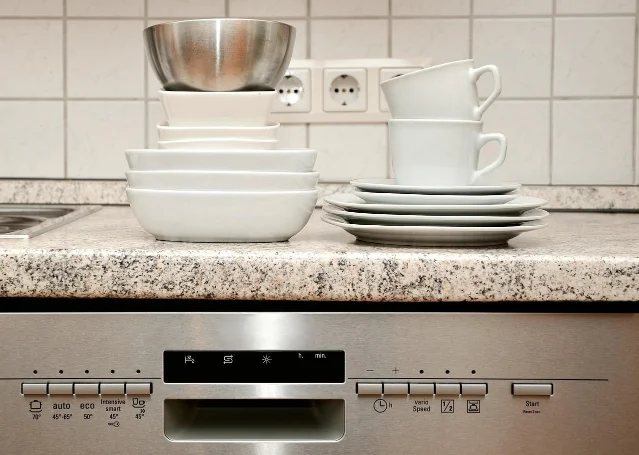
- Before loading, scrape bones, shells, thick sauce, rice clumps, and large food scraps into the trash or compost.
- Skip the full rinse if you are running the dishwasher soon.
- If dishes will sit all day, use the machine's rinse-only option or give only the worst pieces a quick rinse so food does not dry into concrete.
Why it works
Good Housekeeping says that if you are running a cycle right away, scraping food and leaving the rest is enough; detergent is designed to work on stuck-on food rather than on plates you have already washed by hand. 1 Consumer Reports gives the same basic rule: scrape off large debris, but do not prerinse, because modern machines can sense soil levels and detergent enzymes need residue to cling to. 2
Watch out
Do not turn "no prerinsing" into "load whole leftovers". Consumer Reports notes that large chunks can reduce water flow into the fine filter and hurt wash performance. 2
2. Load by water path, not by what fits fastest
Do it
- Put cups, glasses, small bowls, and dishwasher-safe plastics on the top rack.
- Put plates, serving bowls, pots, and large dishwasher-safe items on the bottom rack.
- Face dirty surfaces toward the strongest spray, usually the center or lower spray arm.
- Put large platters, pans, and cutting boards along the sides and back, not in the front by the door.
Why it works
Consumer Reports recommends the top rack for cups, glasses, small bowls, and dishwasher-safe plastics, and the lower rack for plates, large bowls, platters, and other oversized pieces; it also warns that oversized pieces should stay toward the sides and back so the spray arm can move freely. 2 Good Housekeeping adds a simple loading rule: if water cannot reach it, it will not get clean. 1
Watch out
Do not put flat pans or platters in front of the detergent dispenser. Good Housekeeping warns that they can stop the dispenser from opening and keep detergent from reaching the load. 1
3. Give every item a tilt and a gap
Do it
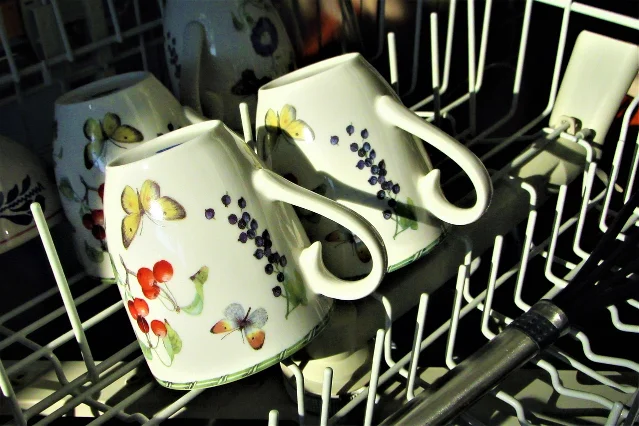
- Angle cups, mugs, bowls, pots, and casseroles downward so water drains instead of pooling.
- Leave a small gap between bowls and plates.
- Spin the spray arm by hand before starting the cycle; if it hits anything, reload that area.
- Run the machine full, but not crammed.
Why it works
Consumer Reports says overfilling is a common mistake because water may not reach all dish surfaces when plates or bowls are too close together or piled on top of one another. It also says angled placement matters because blocked spray arms keep water from reaching dishes effectively. 2 Good Housekeeping similarly advises angling pots, pans, casseroles, and cups so water can clean and drain. 1
Watch out
A half-empty dishwasher wastes cycles, but an overpacked one creates rewashing. Good Housekeeping UK makes both points: wait until both racks are reasonably filled, but do not cram plates, pots, and cutlery so tightly that water cannot rinse them. 3
4. Stop spoons from nesting, and load knives for your hands
Do it
- Mix forks, spoons, and knives instead of grouping every spoon together.
- If you use a basket, alternate some spoon handles up and some down so the bowls cannot stack inside each other.
- Load forks with tines up if your basket and household safety allow it.
- Load knives blade-down or handles-up so you do not grab a sharp edge when unloading.
Why it works
Good Housekeeping recommends mixing utensil directions so spoons do not nest and all surfaces get washed, while putting knives blade-down for safety. 1 Consumer Reports also recommends mixing spoons, forks, and knives so they do not nest, and says eating utensils should be separated so water and detergent can reach all surfaces. 2
Watch out
If you have small kids unloading the dishwasher, choose the safer direction over the technically perfect direction. Clean utensils are not worth a hand cut.
5. Keep plastics and fragile troublemakers out of danger zones
Do it
- Put dishwasher-safe plastics on the top rack.
- Secure lightweight plastic pieces so they cannot flip, fill with water, or fall.
- Keep wood, cast iron, valuable knives, glued-label jars, and non-dishwasher-safe nonstick pans out.
- Separate stainless steel from silver or silver-plated flatware if you own both.
Why it works
Good Housekeeping warns that loose plastics can flip over, fill with water, or fall onto a heating element and melt; it also lists wood, cast iron, valuable knives, and glued-label jars as items to keep out of the dishwasher. 1 Consumer Reports says dishwasher-safe plastics belong on the top rack away from heating elements, and that some metals, wood, china with gold leaf, and nonstick pans not labeled dishwasher-safe should be hand-washed. 2
Watch out
Do not treat "dishwasher-safe" as "safe anywhere". The top rack is usually the safer zone for plastic because it keeps it farther from the heating element.
6. Put detergent where the machine expects it
Do it
- Put pods, powder, or gel in the detergent dispenser.
- Check that no tray, pan, or handle is blocking the dispenser door.
- Store detergent in a cool, dry place.
- If powder or pods have clumped, lost fragrance, or sat open for months, replace them before blaming the machine.
Why it works
Good Housekeeping warns that tossing a detergent pack into the bottom of the machine can make it dissolve during prewash and wash away before the main cycle. It also recommends buying only what you can use within about two months and storing detergent somewhere cool and dry. 1
Watch out
More detergent is not a fix for bad loading. If the spray arm is blocked or the filter is clogged, extra detergent just gives you a different mess.
7. Make the filter and spray arms part of the routine
Do it
- Find your dishwasher manual, or search the manufacturer and model number online.
- Confirm whether you have a self-cleaning filter or a manual filter.
- For a manual filter, remove it, rinse under warm water, soak with mild dish soap if greasy, and use a soft toothbrush for stuck residue.
- Wipe the filter compartment before replacing the filter, and make sure it locks back into place.
- If cleaning still looks weak, rinse the spray arms and clear clogged holes with a toothpick or wooden skewer.
Why it works
Lifehacker explains that newer dishwashers often have manual filters and that the safest way to identify the type and cleaning method is to check the owner's manual. It recommends rinsing the filter under warm water, soaking with mild dishwashing liquid if needed, gently brushing residue away, wiping the compartment, and locking the filter back into place. 4 Consumer Reports says newer removable filters capture scraps but need manual cleaning; it warns that neglected filters can smell, recirculate food particles through the spray arms, clog, or reduce water flow. 5
Watch out
Do not force parts. Some filters turn clockwise, others counterclockwise, and some have two pieces. If you are unsure, stop and check the manual before cracking plastic tabs. Lifehacker notes that some filters include upper and lower assemblies, and Consumer Reports gives different rotation directions depending on model. 4 5
The 5-minute version before tonight's cycle
If you only have five minutes:
- Scrape, do not rinse.
- Move cups and plastics to the top rack.
- Face plates and bowls toward the spray.
- Spin the spray arm once by hand.
- Mix spoons so they cannot nest.
- Put detergent in the dispenser.
- If the last load smelled bad or came out gritty, clean the filter before running another cycle.
That is the whole reset: fewer hidden blockages, less water pooling, and more surfaces actually exposed to the wash.


Añade más opiniones o contexto en torno a este contenido.