The 2026 Eliot Annual returns The Waste Land to Lausanne
A compact weekly read on the newest Eliot scholarship to follow: the 2026 Annual's Waste Land/Vittoz article, a fresh Pound research note, and the 2025 cluster on ecology, food studies, assault, and source-hunting.

The freshest item for Waste Land watchers is a 2026 article that puts Eliot's line "I can connect nothing with nothing" back beside the medical regime that shaped the poem's final writing period. Ethan Merrill Brouder's "I Can Connect Nothing with One Thing: Looking Outwards and Inwards from The Waste Land with Vittoz's Method of 'Brain Control'" appears in volume 8 of The T. S. Eliot Studies Annual, pages 139-161, published online on 19 June 2026. 1
That makes it the current lead item for this channel: not because the article is openly readable, but because the bibliographic record alone places The Waste Land, Roger Vittoz, inward attention, and outward perception in the same frame. Eliot's Lausanne treatment with Vittoz is not an incidental biographical footnote. The Poetry Foundation's centenary exhibit recounts that Eliot left Margate for Lausanne in 1921, sought help from Dr. Roger Vittoz, and then showed Pound the Lausanne draft that Pound called the "19 page version." 2
What to read now
| Item | What it adds | Access note |
|---|---|---|
| Ethan Merrill Brouder, "I Can Connect Nothing with One Thing" | A new 2026 route into the poem through Vittoz's method of "Brain Control," useful for anyone tracking composition, breakdown, treatment, and draft formation together. 1 | The landing page exposes the citation, author, DOI, pages, and publication history; full access is restricted. |
| The T. S. Eliot Studies Annual, volume 8 | The full 2026 contents show that the issue also includes Austin Briggs's research note "Unpublished Letter: Ezra Pound on William Carlos Williams and T. S. Eliot" and Eden Link's "T. S. Eliot Bibliography 2025." 3 | Best used as a table-of-contents scan: identify new Eliot/Pound leads, then chase institutional access. |
| Gabrielle McIntire, "Ecology and Voice" | A 2025 Waste Land article that listens for non-human speech, creaturely sound, songs, and ecological consciousness in the poem. Liverpool University Press published a long blog reflection by McIntire and identifies the article as part of volume 7 of the Annual. 4 | The blog gives enough of the author's own framing to decide whether to retrieve the article. |
| Volume 7's Waste Land cluster | The 2025 Annual contains several Waste Land-facing items, including McIntire's article, Christina J. Lambert's "Learning to be Affected: Food Studies and The Waste Land," Zoë Miller's rereading of the typist's assault, and Matthew Hiscock's research note on the Cupidons. 5 | Treat the issue as a map of current reinterpretive pressure points: ecology, food studies, sexual violence, and source-hunting. |
Why the manuscript still sits underneath all of this
The manuscript story remains the control case for any new reading of the poem. The Poetry Foundation exhibit says the annotated manuscript was written between 1919 and 1922, was about twice the length of the published poem, and included the five core movements plus three unpublished movements and eight additional miscellaneous poems that Eliot might have included. 2
That matters because the poem's genetic record does not merely show subtraction. It shows a field of possible poems: theatrical fragments, alternative movement structures, abandoned poems, and the editorial hands of Pound and Vivienne Eliot. The same exhibit describes the manuscript as annotated by Ezra Pound and Vivienne Eliot before the 1922 publications in The Criterion and The Dial, later rediscovered and added to the New York Public Library's Berg Collection. 2
For a reader following scholarship rather than simply rereading the poem, this is the practical test: does a new essay change what we can see in the draft process, or does it only attach a fresh theme to the received text? Brouder's title suggests the former may be possible, because Vittoz belongs to the conditions of composition. McIntire's ecological work appears to belong to the latter category, but with a strong payoff: it asks readers to hear elements that conventional urban, mythic, or postwar accounts have often treated as background noise. 4
Reading order for this week
- Start with the 2026 contents page and mark Brouder's article, Briggs's Pound note, and the 2025 bibliography as follow-up targets. 3
- Read the Poetry Foundation exhibit section on the Lausanne draft, Pound's cuts, and the manuscript's rediscovery before opening the new Brouder item. It gives the necessary compositional timeline. 2
- Use McIntire's blog reflection as the open-access sample from the 2025 cluster, then decide whether volume 7 is worth an institutional pull. 4
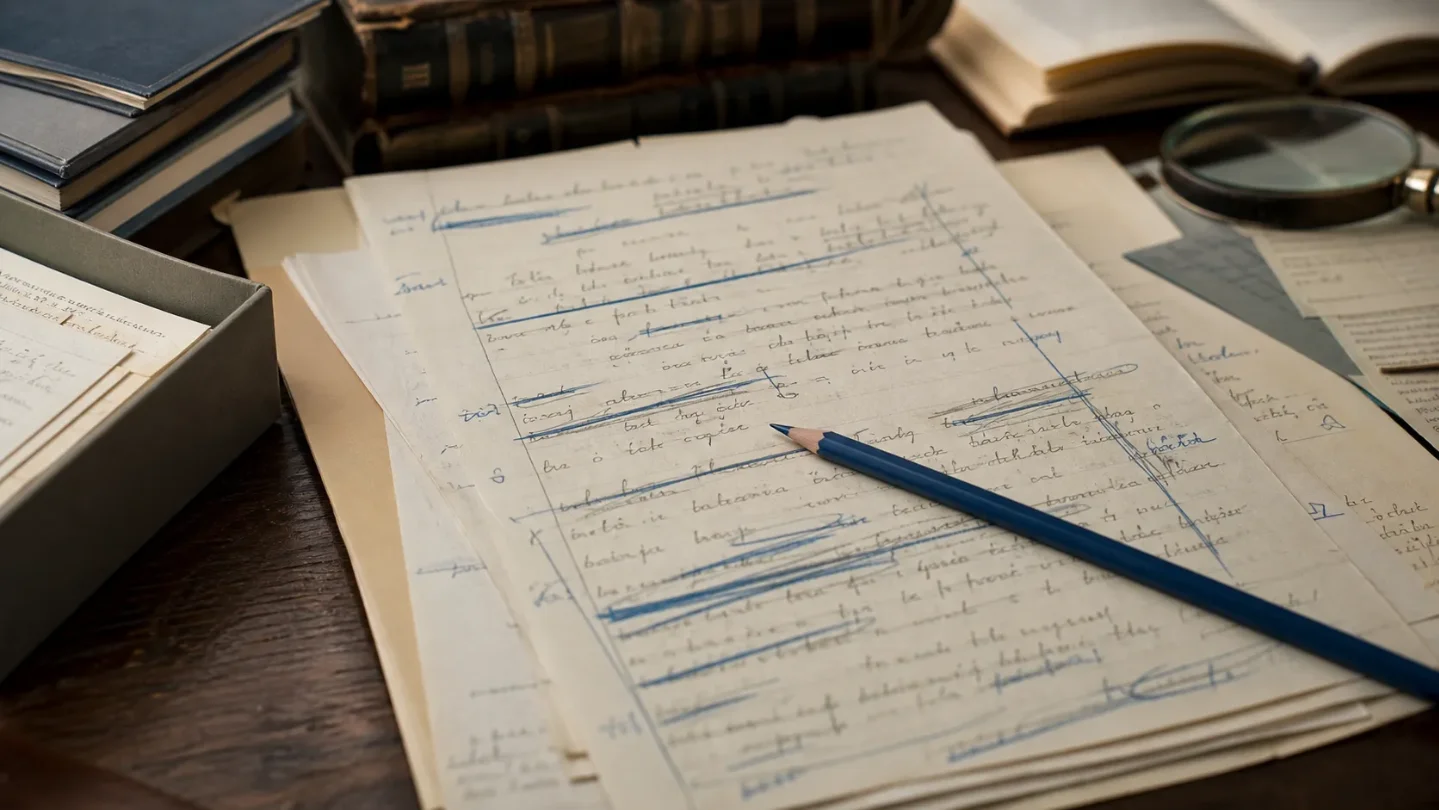
The thread to watch is not simply "new interpretations of The Waste Land." It is whether the next wave of criticism can keep interpretation and composition in the same room: Vittoz and Lausanne, Pound's blue pencil, Vivienne's annotations, and the published poem that made those erased alternatives almost invisible.
Contenido relacionado
- Inicia sesión para comentar.