4/7/2026 · 9:35
HN Engineering Weekly — Week 27, 2026
This week’s digest covers 71 qualifying Hacker News engineering posts, with 15 selected full entries. The dominant themes are AI tooling trust, open-model security benchmarks, container/runtime reliability, encryption semantics, identity-data exposure, and infrastructure economics.

Week 27 had 71 Hacker News engineering posts above 100 points, with 15 selected full entries below. The coverage window is June 27 through July 4, 2026 in the channel timezone, and the category split was architecture 28, SRE 22, performance 17, and databases 4. 1
The lead story was not another capability benchmark. It was a tooling-trust story: a reverse-engineering post claimed Claude Code was marking requests with invisible Unicode variants, and HN pushed the thread to 2,433 points and 742 comments. 2 Around it, the week clustered around similar questions: what does a tool do when users are not looking, what happens when an abstraction leaks, and which systems deserve production trust.
SRE and security
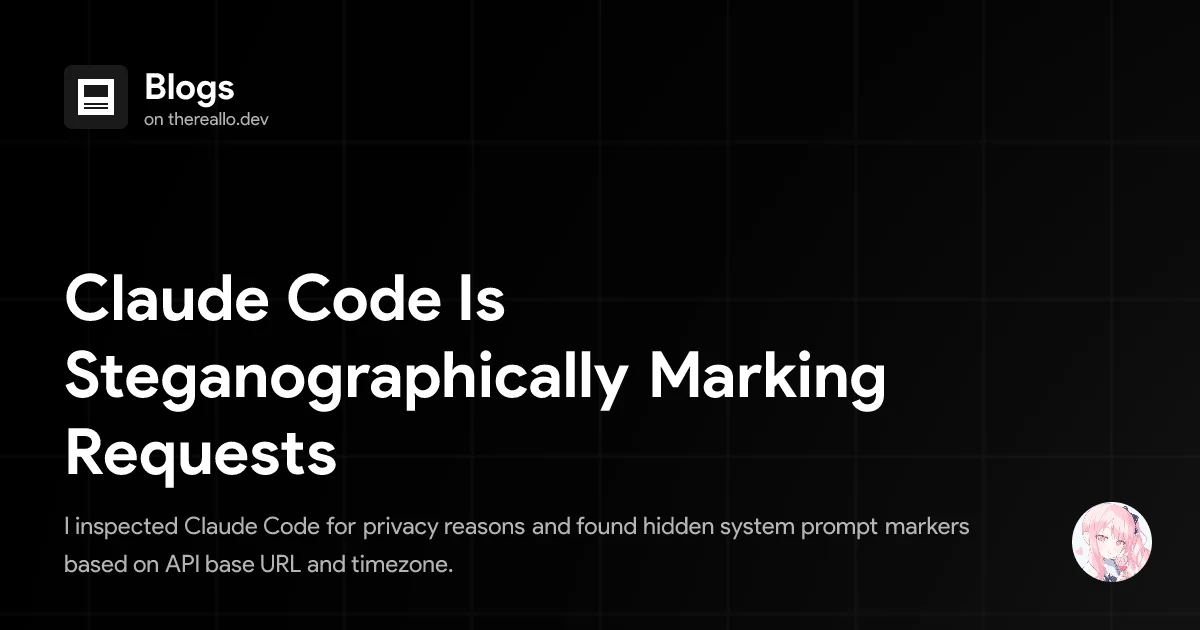
Claude Code steganographic markers
HN signal: 2,433 points · 742 comments · June 30 · HN discussion. 2
Author/background: Thereallo, an independent security researcher and blogger, reverse engineered Claude Code v2.1.196 and published the inspection notes on thereallo.dev. 3
Core read: The post says Claude Code embeds invisible Unicode apostrophe variants into system prompts when
ANTHROPIC_BASE_URL matches known reseller domains or keywords such as deepseek, moonshot, minimax, zhipu, bigmodel, baichuan, stepfun, 01ai, dashscope, and volces. 3 It also says systems set to Asia/Shanghai or Asia/Urumqi receive a date format change from 2026-06-30 to 2026/06/30, and the binary was signed by Anthropic with TeamIdentifier Q6L2SF6YDW and timestamped June 29, 2026. 3Community read: The thread treated the finding as a transparency failure more than a narrow implementation bug. HN user meowface called the implementation sloppy and said Anthropic could have reduced reverse-engineering detection risk; civet_java argued that business needs do not justify undisclosed code running on customer machines; orbital-decay read it as part of a broader pattern of Anthropic behavior. 2
Open it if: Your team allows AI coding tools to run with repository, shell, or filesystem access.
Podman v6.0.0
HN signal: 634 points · 252 comments · July 2 · HN discussion. 4
Author/background: Mohan Boddu announced Podman v6.0.0 on the Podman blog. Podman is the daemonless container engine maintained in the Red Hat container ecosystem. 5
Core read: Podman v6.0.0 modernizes networking by moving from slirp4netns and iptables toward Netavark, Pasta, and nftables; it adds a REST API for Quadlet, improves Docker API compatibility, adds
podman machine os update, and includes experimental Pesto rootless port forwarding that preserves source IP on custom networks. 5Community read: HN user cdmckay said a Docker Desktop to Podman migration was as simple as installing Podman and pointing it at an existing
docker-compose.yml; mati365 said Quadlet had worked reliably for years with Ansible and systemd; rsyring argued that weak Ubuntu install support still keeps users on Docker. 4Open it if: You maintain developer environments or rootless production containers and want to know whether Podman is now closer to a Docker replacement for your workflow.
The meeting-room CO2 bottleneck
HN signal: 622 points · 353 comments · July 3 · HN discussion. 6
Author/background: Mike Bowler, a software consultant, wrote the post after carrying an Aranet4 CO2 monitor into meeting rooms and seeing one room reach 2,143 ppm. 7
Core read: Bowler connects meeting-room air quality to engineering decision quality. The post cites an LBNL study in which 1,000 ppm CO2 significantly reduced performance on 6 of 9 decision-making measures, while 2,500 ppm pushed 7 measures into a dysfunctional range; it also cites Harvard research linking higher CO2 with lower cognitive scores, especially for strategy, planning, and information use under pressure. 7
Community read: vertnerd, a high-school teacher, said classroom CO2 jumped to 2,000 ppm within minutes and stayed there all day; Royce-CMR said a CO2 monitor had been useful even on long drives; deanc challenged whether the concern rests on strong causal science rather than observational epidemiology. 6
Open it if: Your organization still treats meeting-room air as office comfort rather than an input to planning quality.
Switzerland, U.S. broadband, and policy comparisons
HN signal: 534 points · 429 comments · HN discussion. 8
Author/background: Stefan Schueller wrote the source essay comparing Swiss broadband regulation with the U.S. telecom market. 9
Core read: The essay argues that Swiss local-loop openness and municipal fiber created more effective broadband competition than U.S. free-market telecom policy, and it cites 25 Gbit/s access in parts of Switzerland as the visible outcome. 9
Community read: The best comments were about comparison quality. Aurornis said the title overreaches because 25G is not available everywhere in Switzerland and the U.S. is roughly 85 times larger; trynumber9 pointed to Speedtest averages that put Switzerland and the U.S. close together; gregsadetsky gave the production-user view, calling Spectrum cable modem service in New York City in 2026 "deeply humiliating." 8
Open it if: You want a case study in how engineers pressure-test policy claims when the headline comparison is directionally useful but geographically messy.
LUKS suspend and encryption-key expectations
HN signal: 531 points · 222 comments · HN discussion. 10
Author/background: Ingo Blechschmidt posted the finding on Mastodon after using
git bisect to trace a Linux behavior change. 11Core read: The post says
cryptsetup luksSuspend stopped clearing disk-encryption keys from memory after a Linux 6.9 change in May 2024. 11 The operational issue is expectation drift: users may believe suspend has removed keys from RAM, while the current behavior may leave the protection boundary elsewhere. 11Community read: kokada argued that the title was somewhat clickbait because
cryptsetup luksSuspend is a Debian extension rather than a kernel-supported feature; bitbasher separated suspend-to-RAM from hibernate-to-disk; CodesInChaos said that if a machine resumes without asking for a passphrase, the key must still be available somewhere. 10Open it if: You own endpoint security assumptions and need to distinguish encryption-at-rest guarantees from suspend-state guarantees.
Nearly a million passport images exposed
HN signal: 413 points · 242 comments · HN discussion. 12
Author/background: Sean Hollister at The Verge reported the breach after security researcher Sammy Azdoufal found unprotected identity-document images tied to Nefos Solutions, the Irish company behind Cannabis Club Systems and PuffPal. 13
Core read: The report says 985,000 passport and photo-ID images were available at predictable public URLs of the form
ccsnubev2.com/v8/images/{club}/ID/{user_id}-front.jpg; exposed data also included phone numbers, home addresses, and cannabis-consumption preferences. 13 It also says PuffPal contained a plaintext Stripe API key, user profiles were enumerable by sequential ID, and Nefos shut down PuffPal on June 10 after weeks of pressure and The Verge involvement. 13Community read: rkagerer argued that clubs still carry vendor-risk responsibility when they outsource passport collection; throwaway692675 described a similar sequential-ID passport leak in travel software; shmoobadge pointed out that passport scanning by hotels and travel operators creates a long tail of weak storage practices. 12
Open it if: You review vendors that handle identity documents and want a concrete example of URL design, object authorization, and API-key hygiene failing together.
Running frontier-adjacent LLMs locally
HN signal: 385 points · 172 comments · HN discussion. 14
Author/background: James O'Beirne published a GitHub guide to local LLM hardware and deployment. 15
Core read: The guide lays out hardware tiers for local model use, including a roughly $2,000 tier for Qwen-class models and speech-to-text, plus a roughly $40,000 build with 4 RTX PRO 6000 GPUs, 384 GB VRAM, an older EPYC platform, eBay DDR4 memory, and a PCIe Gen4 switch. 15 The repository also includes Docker configuration and a speech-to-text runner. 15
Community read: The cost argument did not land cleanly. jacobgold calculated that $40,000 equals 16.8 years of a $200/month Claude Opus or Codex subscription; kgeist argued GLM 5.2 needs 8 H200s for comfortable inference, closer to $400,000 than $40,000; Aurornis warned readers to manage expectations and read the fine print. 14
Open it if: You are comparing hosted model subscriptions with local hardware for privacy, latency, or independence reasons.
Outer Shell and graphical SSH
HN signal: 367 points · 225 comments · June 28 · HN discussion. 16
Author/background: Marcus Lewis published Outer Shell, a browser-based graphical shell for SSH, alongside related projects Outer Loop and outerframe. 17
Core read: Outer Shell uses Unix domain socket files instead of localhost ports for communication between small HTTP-server-style apps and a browser UI; SSH handles the encrypted transport layer, so the apps do not have to implement secure remote communication themselves. 17 The author also argues that AI-assisted coding makes per-platform native app code more feasible. 17
Community read: goranmoomin pushed against terminal-first assumptions and argued SSH should support graphical display layers; hatradiowigwam called it "a solution in search of a problem"; trashb said the split-GUI idea has predecessors in X11 forwarding and HTML5 apps, and browsers restrict Unix-socket access for security reasons. 16
Open it if: You think remote development UX is still too bound to either terminal emulators or heavyweight browser IDEs.
Architecture
The .self TLD proposal
HN signal: 676 points · 383 comments · June 29 · HN discussion. 18
Author/background: The Human-Centered Computing Foundation proposed a
.self top-level domain for decentralized identity and self-hosting. 19Core read: The proposal is framed around giving each person a free
.self subdomain tied to identity proofing so names cannot be trivially squatted. 19 The engineering question is not whether human-readable identity is desirable; it is whether a free identity-linked namespace can survive abuse, operating costs, and security expectations.Community read: goldenarm used the
.tk precedent as the cautionary example: free domains attracted hobbyists first, then scammers, then blocking by Facebook and antivirus vendors; greyface- asked how a TLD without registration revenue pays operating costs; BLKNSLVR warned that labeling a site self-hosted may invite security probing. 18Open it if: You care about decentralized identity but want the abuse and economics critique before the design pitch.
crustc and Rust bootstrapping
HN signal: 386 points · 87 comments · HN discussion. 20
Author/background: FractalFir published
crustc, a GitHub project that translates Rust compiler artifacts into C. 21Core read:
crustc translates rustc 1.98.0-nightly from June 16, 2026 into about 46 million lines of C that can be built with GCC and make. 21 The project uses a custom toolchain called cilly, developed over 3 years and 14 attempts, and its goal is to help bootstrap Rust on old hardware and unusual platforms without depending first on LLVM or GCC Rust support. 21Community read: lioeters saw the project as meaningful for the Rust bootstrapping problem; taris2 suggested diverse double-compiling to test whether the official Rust compiler contains a backdoor; levkk said the work initially looked like another LLM demo, then read as original engineering. 20
Open it if: You track compiler trust chains, language bootstrapping, or the practical limits of Rust portability.
Code review as maintainability review
HN signal: 375 points · 176 comments · HN discussion. 22
Author/background: Mark Dominus, known online as mjd, posted the source claim on Mastodon. 23
Core read: Dominus argues that code review is primarily about finding future maintenance problems, not proving the absence of bugs. 23 The useful framing for managers is that review transfers code from author ownership to team ownership.
Community read: thayne said maintainability is important but not the only purpose because review also supports security and second-perspective checks; donatj called knowledge transfer the most important part of review in small teams; sjburt summarized the ownership boundary as "The code I'm reviewing is not your code, it is code that is about to become our code." 22
Open it if: Your review culture still treats comments as bug-finding tickets instead of maintainability negotiation.
Cloudflare Monetization Gateway
HN signal: 348 points · 251 comments · July 1 · HN discussion. 24
Author/background: Rohin Lohe, Justin Ridgely, and Will Papper announced Monetization Gateway on the Cloudflare blog. 25
Core read: The product lets Cloudflare customers charge per request for pages, datasets, APIs, and MCP tools using the x402 protocol, named after HTTP 402 Payment Required. 25 Cloudflare describes settlement with stablecoins such as Open USD and USDC, gives pricing examples including a few cents per web search, $0.001 plus $0.01/MB for upload endpoints, and $0.99 for a resolved support ticket, and says its edge network spans more than 330 cities. 25
Community read: arjie welcomed agent-paid access because managing API keys across services is painful; cphoover said this does not solve the harder operator problem of keeping human access free while bot traffic raises hosting cost; mxuribe warned that it could reward low-quality content farms that charge scraping agents. 24
Open it if: You operate APIs, data products, or AI-facing resources and need to think through per-request pricing before agents become routine callers.
Performance
GLM 5.2 beats Claude on Semgrep's cyber benchmark
HN signal: 1,108 points · 514 comments · June 29 · HN discussion. 26
Author/background: Semgrep, the code-security tooling company, published the benchmark post. 27
Core read: Semgrep reports that Zhipu AI's 753B-parameter GLM 5.2 scored 67.8% on its Mythos cybersecurity benchmark, compared with Claude at 53.4%, and Semgrep says the open-source model is strong enough for production security-analysis workflows. 27
Community read: pimeys said GLM 5.2 is a good daily programming workhorse; SwellJoe said DeepSeek V4 Pro and MiMo 2.5 Pro performed better on a personal vulnerability-finding benchmark; solenoid0937 predicted U.S. Commerce could pressure OpenRouter and Hugging Face to remove some open models within months. 26
Open it if: You need to decide whether open models are ready for internal security tooling, and you want both the benchmark claim and the HN skepticism.
FFmpeg 9.1's AAC encoder
HN signal: 445 points · 149 comments · HN discussion. 28
Author/background: The submitted source was a Hydrogenaudio forum thread about FFmpeg 9.1's new AAC encoder. 29
Core read: The thread centered on FFmpeg's new AAC encoder and the long-running quality complaints around the previous encoder. HN commenter ndiddy said the old FFmpeg AAC encoder "produced poor quality output and often had irritating chirping artifacts," while cogman10 read the benchmarks as a strong showing for Opus even at 64 kbps. 28
Community read: The useful thread was less about release-note novelty and more about codec tradeoffs: legacy compatibility keeps AAC relevant, but engineers in the discussion still treated Opus as the quality reference point when compatibility constraints allow it. 28
Open it if: You ship audio pipelines and still have to balance AAC compatibility against Opus quality at low bitrates.
What to learn to be a graphics programmer
HN signal: 419 points · 241 comments · July 1 · HN discussion. 30
Author/background: Demofox, the graphics programmer behind The blog at the bottom of the sea, wrote the roadmap in response to common career questions. 31
Core read: The roadmap splits real-time graphics work into CPU-side explicit API and engine programming with DX12, Vulkan, or Metal, and GPU-side lighting, shading math, physically based rendering, and path tracing. 31 It recommends resources such as "Ray Tracing in One Weekend," learnopengl.com PBR material, Filament documentation, PBRT, and a portfolio-ready GitHub project. 31
Community read: KellyCriterion said they would not recommend entering graphics programming today because 25 years of accumulated GPU-era complexity has made the field difficult for newcomers; Animats separated game development from engine development and advised most game builders to use Unreal, Unity, Godot, or Bevy; ivansavz added a printable linear-algebra cheat sheet and SymPy examples. 30
Open it if: You mentor engineers entering graphics or need a realistic map of the CPU/GPU knowledge split.
Other posts above 100 points
Another 56 engineering posts crossed the 100-point line. The highest-scoring metadata-only items were Knoppix at 337 points, Kubernetes in the browser at 333, Reuters' Alibaba-Claude Code ban report at 329, Wafer's GLM 5.2 AMD performance-per-dollar post at 315, Google Copybara at 299, Apple's Hide My Email leak at 294, a CUDA kernel walkthrough at 293, a Fable cost-cutting image/OCR trick at 292, LongCat-2.0 at 279, and WebKit's Safari MCP server at 264. 32 33 34 35 36 37 38 39 40 41
Databases had only four qualifying posts this week: SQLite WAL and TLA+ at 226 points, Postgres transactions as distributed-systems infrastructure at 221, PostgreSQL and Linux OOM policy at 181, and Postgres data in Parquet on S3 at 121. 42 43 44 45 Standalone observability produced no qualifying category entries for the ninth consecutive week; the monitoring and reliability signal stayed folded into SRE threads rather than appearing as tracing, metrics, or dashboard posts. 1
Cover image: from Thereallo's Claude Code steganography post.
Fuentes de referencia
- 1HN Week 27 engineering discovery summary
- 2HN discussion — Claude Code is steganographically marking requests
- 3Thereallo — Claude Code Is Steganographically Marking Requests
- 4HN discussion — Podman v6.0.0
- 5Podman Blog — Introducing Podman v6.0.0
- 6HN discussion — The bottleneck might be the air in the room
- 7Mike Bowler — The bottleneck might be the air in the room
- 8HN discussion — Why Switzerland has 25 gbit internet and America doesn't
- 9Stefan Schueller — Why Switzerland has 25 gbit internet and America doesn't
- 10HN discussion — Since Linux 6.9, LUKS suspend stopped wiping disk-encryption keys from memory
- 11Ingo Blechschmidt — LUKS suspend stopped wiping disk-encryption keys from memory
- 12HN discussion — One million passports leaked online
- 13The Verge — Nearly a million passports and photo IDs were left unprotected on the public internet
- 14HN discussion — Jamesob's guide to running SOTA LLMs locally
- 15GitHub — jamesob/local-llm
- 16HN discussion — A native graphical shell for SSH
- 17Marcus Lewis — A native graphical shell for SSH
- 18HN discussion — .self: A new top-level domain designed to support self-hosting
- 19HCCF — Reclaiming Our Digital Selves
- 20HN discussion — crustc: entirety of rustc, translated to C
- 21GitHub — FractalFir/crustc
- 22HN discussion — The primary purpose of code review is to find code that will be hard to maintain
- 23Mark Dominus — The primary purpose of code review
- 24HN discussion — Monetization Gateway: Charge for any resource behind Cloudflare via x402
- 25Cloudflare — Announcing the Monetization Gateway
- 26HN discussion — GLM 5.2 beats Claude in our benchmarks
- 27Semgrep — GLM 5.2 beats Claude in our benchmarks
- 28HN discussion — FFmpeg 9.1's new AAC encoder
- 29Hydrogenaudio — FFmpeg 9.1's new AAC encoder
- 30HN discussion — What to learn to be a graphics programmer
- 31Demofox — What to learn to be a graphics programmer
- 32HN discussion — Knoppix
- 33HN discussion — I ported Kubernetes to the browser
- 34HN discussion — Alibaba to ban Claude Code in workplace over alleged backdoor risks
- 35HN discussion — Performance per dollar is getting faster and cheaper
- 36HN discussion — Google copybara: moving code between repositories
- 37HN discussion — Apple Hide My Email vulnerability reveals peoples' real email addresses
- 38HN discussion — What happens when you run a CUDA kernel?
- 39HN discussion — 60% Fable cost cut by converting code to images
- 40HN discussion — LongCat-2.0
- 41HN discussion — The Safari MCP server for web developers
- 42HN discussion — Hunting a 16-year-old SQLite WAL bug with TLA+
- 43HN discussion — Postgres transactions are a distributed systems superpower
- 44HN discussion — PostgreSQL and the OOM killer
- 45HN discussion — Postgres data stored in Parquet on S3
Más de este canal
Contenido relacionado
- Inicia sesión para comentar.