29/6/2026 · 8:27
The $3 ticket to seven feet
On June 29, 1956, Charles Dumas became the first person to clear seven feet in the high jump after buying a $3 ticket to enter his own Olympic trial.

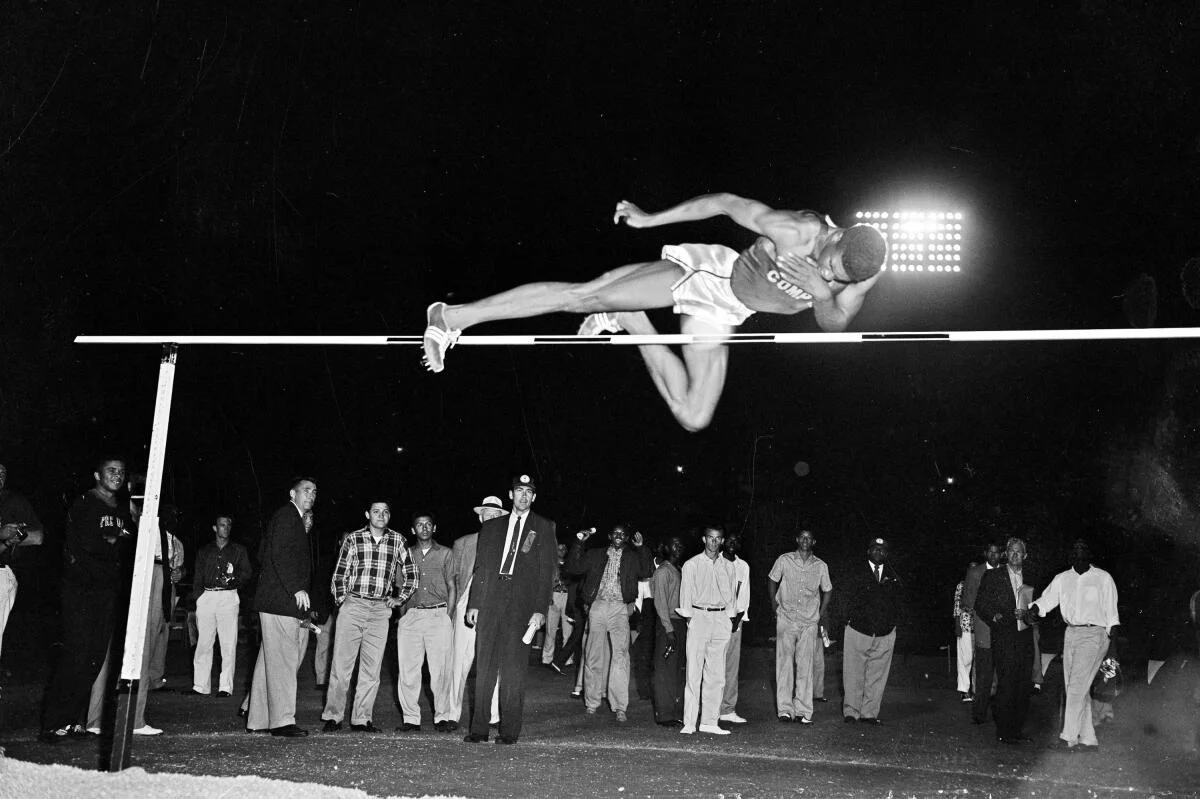
Charles Dumas had already won his place on the U.S. Olympic team when he asked for the high-jump bar to go higher. On June 29, 1956, the 19-year-old Compton College freshman cleared 7 feet 1/2 inch, or 2.15 meters, at the U.S. Olympic Trials in the Los Angeles Memorial Coliseum. He became the first person known to jump over seven feet. 1 2
That would be enough for the date. The odd part is how close the whole thing came to looking ridiculous before it became historic. Dumas's coach, Hershel Smith, was stuck in traffic with Dumas's competitor pass, so Dumas bought a $3 ticket to enter the Coliseum and then had to talk his way past the dressing-room guard before competing in his own Olympic trial. 3
The barrier was real, even if it sounds quaint now
The seven-foot high jump belonged to a small set of 1950s track-and-field barriers that athletes treated as nearly unreachable: the 4-minute mile, the 60-foot shot put, the 16-foot pole vault, and the 7-foot high jump. 4 Roger Bannister ran the first sub-4-minute mile on May 6, 1954, and Parry O'Brien pushed the shot past 60 feet two days later. 4
The high jump was moving much more slowly. Walt Davis had set the previous world record at 6 feet 11 1/2 inches, or 2.12 meters, in Dayton, Ohio, on June 27, 1953. 1 5 From 1941 to 1956, the men's world record had gained only half an inch. 4
Dumas did not arrive as a novelty act. Charles Everett "Charlie" Dumas was born in Tulsa, Oklahoma, on February 12, 1937, moved to Los Angeles as a child, and became a standout high jumper at Centennial High School in Compton. 6 By 1956, Dumas was a Compton College athlete who had already tied for the national AAU high-jump title as an 18-year-old. 4
He made the number stranger on purpose
Dumas secured his Olympic berth at 6 feet 11 3/4 inches, then asked officials to raise the bar to 7 feet 1/2 inch. 2 That half-inch was not a clerical flourish. Fellow competitor Vern Wilson urged him to avoid an even seven feet: "Charlie, if you clear an even seven, a dozen guys will do it next week, once the mental barrier is gone. Put it a half-inch over." 3
Dumas cleared the height on his second attempt and chose not to try for a higher mark. 2 The New York Times reported the next day that 50,000 spectators gave "one of the loudest cheers heard in the Coliseum since the Olympic Games were held here in 1932." 2
The finish had a nasty little pause built into it. Dumas used the straddle technique, clearing the bar face-down and landing in sawdust rather than on the thick foam mats that later made the Fosbury Flop possible. 7 After Dumas came down, the bar quivered because his foot had ticked it. Dumas held his breath until the bar stopped and stayed on the standards. 7
That is the trivia version in one frame: a teenager who paid to enter the stadium, jumped higher than any person had jumped, brushed the bar on the way down, and had to wait for physics to decide whether the record existed. 3 7
The gold medal made it more than a stunt
The seven-foot record was not a one-day accident. On November 23, 1956, Dumas won Olympic gold in Melbourne with a third-attempt clearance at 6 feet 11 1/2 inches, or 2.12 meters, which set an Olympic record. 1 4 The final turned into an eight-hour duel with Australian jumper Charles "Chilla" Porter, who was also 19. 4
Dumas then won five consecutive U.S. national high-jump titles from 1955 through 1959. 8 His world record lasted until July 13, 1957, when Yuriy Stepanov of the Soviet Union cleared 2.16 meters, or 7 feet 1 inch, in Leningrad. 5
Then the public memory softened. Dumas later worked for the Los Angeles Unified School District for nearly 40 years as a teacher and administrator, including more than 15 years as dean of students at Jefferson High School. 9 He was inducted into the USA Track & Field Hall of Fame in 1990 and the USC Athletic Hall of Fame in 1997. 8 9 Dumas died of cancer at his home in Inglewood, California, on January 5, 2004, at age 66. 1
The clean stat is that June 29 gave track and field its first seven-foot high jump. The better story is that the man who did it had to buy a ticket, clear an extra half-inch because a rival gave him good advice, and then stare at a shaking bar until it finally decided to behave. 2 3
Cover image: Charles Dumas clearing 7 feet at the 1956 U.S. Olympic Trials, via Los Angeles Times.
Fuentes de referencia
- 1World Athletics: Charley Dumas, 1956 Olympic champion dies
- 2The New York Times: Coast High Jumper First to Top 7 Feet
- 3The New York Times: Charles Dumas, 66, Champion High Jumper
- 4EBSCO Research Starter: Charley Dumas
- 5Wikipedia: Men's high jump world record progression
- 6Olympedia: Charlie Dumas
- 7Los Angeles Times: This day in sports: Charles Dumas jumps into the record books
- 8USA Track & Field Hall of Fame: Charles Dumas
- 9Los Angeles Times: Charles Dumas, 66; First High Jumper to Clear 7 Feet
Añade más opiniones o contexto en torno a este contenido.