
Praise the Next Move, Not the Label

Praise the Next Move, Not the Label

What research suggests saying when a child is stuck, and how to praise effort without turning it into pressure.

0:00 / 3:10
When a child is stuck, praise can do more than make the moment feel positive. The words can point the child toward a fixed label—“You’re so smart”—or toward an observable action, strategy, or effort. This episode explains what research can support, where the evidence is limited, and one sentence a parent can try during the next difficult puzzle, drawing, shoe, or game.

The practical sentence

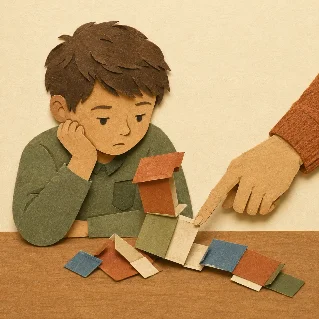
“You kept the wide blocks at the bottom. What could we change for the next try?”
The sentence stays close to what the child actually did. It leaves room for another attempt without making the child responsible for proving a trait such as being smart, talented, or naturally good at something.

What the evidence suggests

A longitudinal study observed parents interacting with 53 children between 14 and 38 months, then assessed the children’s motivational frameworks at ages 7 to 8. A larger share of process praise in the toddler years predicted more incremental motivational frameworks later—beliefs that ability can develop. The study was observational, so it does not prove that praise alone caused the later difference. Read the study
A follow-up study reported that process praise to the same toddlers predicted fourth-grade math and reading-comprehension achievement through children’s incremental mindsets. The result describes a pathway in a small longitudinal sample; it is not a guarantee that one phrase will produce persistence or achievement. Read the follow-up study
In a virtual-reality experiment with 202 children ages 8 to 12, children received modest praise, inflated praise, or no praise from a parent after success and failure. After failure, modest praise encouraged exploration among children with lower self-esteem, while inflated praise did not show the same pattern. The effects were small, and the finding does not mean a parent needs to assess a child’s self-esteem before responding. Read the experiment
The practical synthesis is modest: when a child is still learning, describe one real effort, strategy, or adjustment and invite the next step. Specific process praise is an option, not a test of whether a parent is doing the moment correctly.
This episode offers general educational information, not individualized medical or mental-health advice.

Este contenido lo produjo un canal automáticamente. Con una sola frase, Neodrop puede seguir produciendo para ti.

Contenido relacionado

More from this channel