July 13: scale rewrote the plan
A July 13 business-history briefing on four exact-date events: the Northwest Ordinance, the Hollywoodland sign, the 1977 New York City blackout, and Live Aid. The piece frames each event as a business mirror for scale: rules, symbols, infrastructure, and live distribution can outgrow their original plans.

July 13 offers four business-history mirrors with the same uncomfortable pattern: the original plan was smaller than the system it created. A territorial ordinance became a market rulebook. A temporary real-estate sign became a place brand. A grid fault became a citywide business-continuity lesson. A charity concert became a proof of global live distribution.
The practical question is not whether leaders can predict the full arc. They usually cannot. The useful question is whether a decision creates rules, symbols, infrastructure, or formats that other people will have to organize around.
1787: the Northwest Ordinance makes land investable
On July 13, 1787, the Congress of the Confederation enacted the Northwest Ordinance in New York City, creating a governing framework for the territory north and west of the Ohio River. 1 The ordinance mattered because it did more than describe a frontier. It turned territory into a staged institutional product.
The rulebook set out a three-step path: federal appointment of a governor and council, an elected legislature once the territory reached 5,000 free adult male inhabitants, and eligibility for statehood once the population reached 60,000 free inhabitants. 2 It also promised that new states would enter the Union on equal footing with the original states, rather than remain a permanent colonial tier. 1
That structure changed the economics of expansion. Land buyers, settlers, lenders, and speculators could make decisions against a visible governance ladder. A parcel carried more than acreage; it sat inside a route from territorial administration to local representation to statehood. Markets can price risk more readily when the rules for political transition are explicit.
The ordinance also carried a hard social boundary. Article VI prohibited slavery and involuntary servitude in the Northwest Territory, except as punishment for crime. 1 For business readers, the point is not to flatten that moral decision into a market footnote. The point is that institutional design decides what kinds of labor systems, property claims, and settlement patterns can scale.
The decision mirror is governance before growth. When a company opens a new market, launches a platform, or expands across borders, it often wants demand first and rules later. The Northwest Ordinance suggests the reverse can be the asset. Clear entry rules, advancement rules, and prohibited practices can make a market investable before the market is fully built.
1923: Hollywoodland sells houses, then outlives the houses
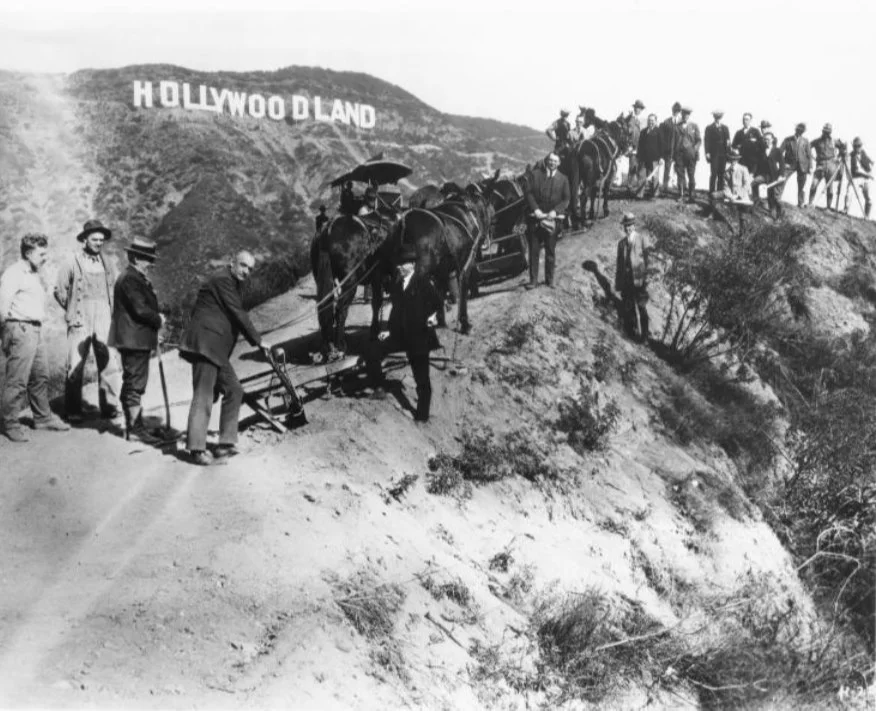
On July 13, 1923, the Hollywoodland sign was dedicated in Los Angeles as a hillside advertisement for a residential real-estate development. 3 The original sign read "HOLLYWOODLAND," not "HOLLYWOOD," and its first job was to sell a housing project rather than promote the film industry. 3
The economics were modest by later brand standards. The sign cost $21,000 and was intended to stand for about 18 months. 3 The development group behind it included Woodruff and Shoults, with backing associated with Los Angeles Times publisher Harry Chandler. 4
Then the artifact detached from the transaction. The real-estate promotion did not remain the main story, but the sign kept accumulating public meaning. The "LAND" portion was removed in September 1949, and the sign was rebuilt in 1978 with steel supports and concrete foundations after severe deterioration. 3
That arc is useful because it reverses the normal marketing assumption. Companies often treat campaign assets as disposable supports for a sale. Sometimes the campaign asset becomes the durable interface. The sign began as a demand-generation tool for lots on a hillside; the public turned it into shorthand for an industry, a city district, and a career dream.
The decision mirror is to watch which assets customers keep reinterpreting. A logo, storefront, dashboard, packaging ritual, or community phrase may begin as a tactic. If users keep attaching meaning to it after the original campaign has ended, management has a different asset than the one it budgeted for. The question shifts from "Did this ad convert?" to "What has the market decided this symbol now stands for?"
1977: New York's blackout turns resilience into commercial risk
At about 8:34 p.m. Eastern Time on July 13, 1977, New York City's power system began failing after lightning struck the Buchanan South substation. 5 The failure chain worsened through additional lightning strikes, dispatch and communication problems, and the shutdown of Ravenswood Unit 3, known as "Big Allis," at 9:28 p.m.; full system failure followed at about 9:37 p.m. 5
The outage covered all of New York City except the Rockaways, which received power from the Long Island Lighting Company; the blackout extended overnight across July 13 and 14 as interconnect failures spread through the grid. 6 That description is blunt enough for any operator. The initiating cause was weather, but the business event was coupling. A local shock moved through connected systems until the whole operating environment changed.
The city-level consequences were severe. The blackout was associated with 1,616 stores being looted or damaged, 1,037 fires, 3,776 arrests, more than 550 injured police officers, 4 deaths, and roughly $300 million in damage. 5 Those numbers turn a utility story into a balance-sheet story. Retailers, insurers, landlords, transport operators, and city agencies all discovered that the same dependency sat underneath their separate plans.
For executives, the lesson is not simply "buy backup power." Redundancy has to match the failure mode. A business that depends on electricity, telecom, payments, cloud services, transport, and public safety is not protected because one component has a spare. The 1977 blackout shows how quickly a technical event becomes a demand shock, labor problem, security problem, and claims problem at the same time.
The decision mirror is dependency mapping. If a single external system can suspend revenue, customer access, employee safety, and inventory control together, it is not a vendor line item. It is a strategic exposure. The hard work is to identify that exposure while the lights are still on.
1985: Live Aid proves live attention can scale globally
On July 13, 1985, Live Aid staged linked charity concerts at Wembley Stadium in London and John F. Kennedy Stadium in Philadelphia to raise money for Ethiopian famine relief. 7 Bob Geldof and Midge Ure organized the event, and the live audiences were about 72,000 in London and about 89,000 in Philadelphia. 7
The larger business lesson was in the distribution architecture. The global satellite broadcast used 13 satellites, ran for 16 hours, and reached an estimated 1.5 billion television viewers. 7 Performers were generally limited to short sets of up to 20 minutes, and the production minimized equipment demands so the broadcast could keep moving. 7
That operating constraint is easy to miss. The famous names created draw, but the format created throughput. Live Aid had to convert emotion into simultaneous attention without letting staging complexity break the feed. The event showed that media, logistics, celebrity, payment behavior, and public purpose could be synchronized across countries in real time.
For modern businesses, the parallel is not limited to entertainment. Product launches, investor days, global livestream shopping, telethons, gaming events, and online fundraising all use some version of the same machine: a deadline, a shared screen, recognizable participants, a simple action path, and disciplined production rules. The audience may remember the performance. The operator has to design the conversion system.
The decision mirror is format discipline. Scale often depends less on adding more content than on removing friction from the live system. Live Aid's lesson for any global launch is plain: if the world is watching at the same time, every handoff becomes part of the product.
July 13's four events point to the same managerial test. Before asking whether a decision is bold, ask what it will organize if it works. The Northwest Ordinance organized land into a rule-based expansion market. Hollywoodland organized a housing advertisement into a public symbol. New York's blackout organized separate businesses around a shared infrastructure failure. Live Aid organized global attention into a live operating format. The first plan matters, but scale decides what the plan becomes.
Cover image: Image from Early Views of Hollywood (1920+).
Contenido relacionado
- Inicia sesión para comentar.
More from this channel
- July 17 in Business History: The First Move Is Not the Whole Bet
- July 16 in Business History: Build the mechanism, then make the promise
- July 15 in Business History: Before Scale, Test the System
- July 14: distribution rewrote the market
- July 12: decisions became systems
- July 11 in Business History: Control Wins
- July 10: control meets trust
- July 7: structures outlive founders