July 14: distribution rewrote the market
A July 14 business-history briefing on four exact-date events: the New York Crystal Palace, Easy Rider, the MP3 file extension, and the Anheuser-Busch/InBev deal. The throughline is distribution: the channel can change the product, the economics, and the risks management must own.

July 14 is a useful reminder that distribution is rarely a neutral pipe. It can turn a building into a market, a cheap film into a studio lesson, a file extension into a music economy, and a local beer company into part of a global operating machine.
The practical question for a business leader is simple: when you make the product easier to display, ship, copy, license, or route through someone else's system, what new economics are you creating?
1853: New York turns invention into an exhibition market
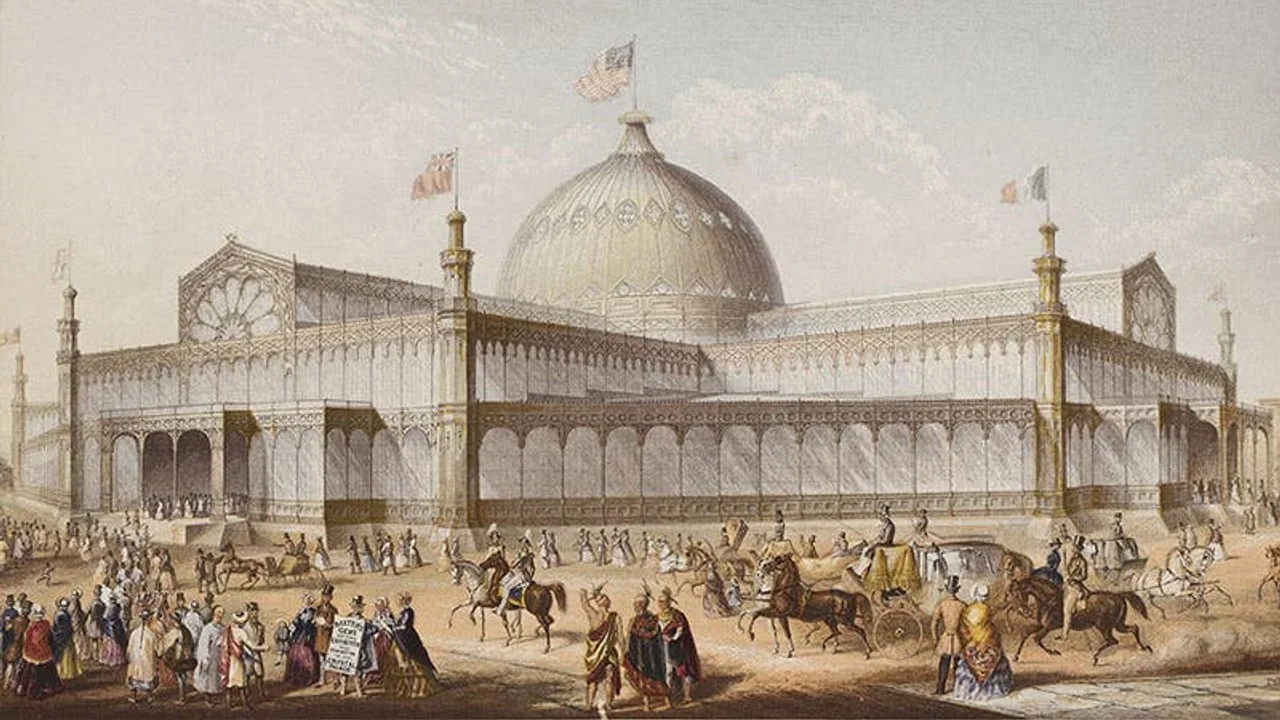
On July 14, 1853, the New York Crystal Palace opened to the public as America's first world's fair, with President Franklin Pierce doing the honors. 1 Its formal name, the Exhibition of the Industry of All Nations, says what the operators were really selling. This was not a single product launch. It was a market architecture for showing products.
The building copied a proven format. London's 1851 Crystal Palace had demonstrated that iron, glass, rail access, spectacle, and industrial display could pull international attention into one place. New York built its version at Sixth Avenue and 40th to 42nd Street, the site of today's Bryant Park. 1 Yale's object record for a Crystal Palace print describes 5,272 exhibitors showing furniture, fabrics, porcelain, jewelry, metalwork, and recent inventions. 2
That number matters. The exhibition compressed discovery costs. Buyers, journalists, engineers, investors, and politicians could compare goods that normally lived in separate workshops, ports, and catalogs. For an emerging industrial economy, the exhibition hall became a temporary search engine.
It also showed how formats get mythologized. Many short histories connect the Crystal Palace with Elisha Otis's safety-elevator demonstration, but Linda Hall Library notes that the rope-cutting stunt happened in 1854 as a Barnum-driven attendance play, not as part of the exhibition's formal opening. 1 The distinction is useful. The institution created the stage; a later operator used the stage to make a product legible.
The decision mirror is customer discovery at scale. A trade show, app store, procurement marketplace, developer conference, or demo day is not just a venue. It changes what buyers can compare and what sellers must prove. If the channel makes side-by-side evaluation easier, product quality has fewer places to hide.
1969: Easy Rider proves the cheap bet can change the slate
On July 14, 1969, Easy Rider opened in the United States. The AFI Catalog lists its release date as July 14, 1969, with Raybert Productions and The Pando Company as production companies and Columbia Pictures as distributor. 3 Box Office Mojo lists the domestic earliest release date as July 14, 1969, and the budget at $360,000. 4
The financing was small enough to be a different kind of experiment. AFI's production history says Bert Schneider and Bob Rafelson agreed to fund the film with an estimated $340,000, privately financed by Schneider, while Dennis Hopper and Peter Fonda kept broad creative control. 3 Columbia later bought worldwide distribution rights for $350,000. 3
That structure moved the risk. The creators took a low-budget production swing. Columbia bought distribution upside after the film existed. For a studio system used to bigger managed productions, Easy Rider made a blunt financial argument: a countercultural film with a narrow starting audience could produce a return profile that a committee-built prestige project could not.
The outcome made the argument hard to ignore. AFI records $7.2 million in film rentals in the film's first year and says Bert Schneider later claimed gross earnings had reached $20 million by mid-September 1970. 3 The film also pushed a different supply model into view: cheaper production, younger voices, music-driven identity, and distribution muscle added after the creative risk had been taken.
The decision mirror is portfolio design. Not every bet should carry the governance cost of a flagship launch. Some markets need small options with real autonomy, then serious distribution if the signal appears. The mistake is to fund every experiment like a mainline product and manage every mainline product like an experiment.
1995: three letters make music portable
On July 14, 1995, researchers at Fraunhofer IIS chose the name "mp3" through an internal email poll. The institute says the file extension stood for MPEG-1 Audio Layer-3. 5 That sounds like naming trivia until you look at what the name made possible.
The technical idea was compression by attention. MP3 used characteristics of human hearing to store less information where listeners were unlikely to notice, producing files up to ten times smaller with little audible difference for ordinary listening. 5 Smaller files made music easier to move through the slow networks and small drives of the 1990s.
The business effect was bigger than the codec. A short, typeable extension gave consumers, developers, hardware makers, and file-sharing systems a common object. The format was not merely an engineering standard. It became a unit of behavior: rip it, download it, email it, store it, search for it, play it.
Fraunhofer's own history shows the economics. The institute says MP3 generated hundreds of millions of euros in licensing revenue over the patent's lifetime and helped Fraunhofer IIS grow into the largest institute in the Fraunhofer-Gesellschaft. 5 It also says later codec generations such as AAC and xHE-AAC grew from that base, with xHE-AAC used by three billion people each month to stream two billion hours of content. 5
The decision mirror is interface discipline. Standards win when they are technically useful and socially easy to handle. A file extension, API name, packaging unit, or SKU convention can decide whether a good technology becomes usable at market scale. Naming is not a substitute for performance, but a hard-to-use standard leaves adoption work on the customer.
2008: InBev buys scale and inherits the system
On July 14, 2008 in Leuven, Belgium, and July 13 in St. Louis, Missouri, InBev and Anheuser-Busch announced their agreement to combine. 6 The cross-time-zone dateline is worth keeping intact because this was exactly the kind of deal it described: a local icon being folded into a global operating system.
The headline price was $70 per share in cash, or $52 billion in aggregate equity value. 6 On a 2007 pro forma basis, the combined company would have generated 460 million hectoliters in global volume, $36.4 billion in revenue, and $10.7 billion in EBITDA. 6
The strategic pitch was distribution plus discipline. The company promised to keep St. Louis as the North American headquarters and global home of Budweiser, while using InBev's international footprint to expand the brand. It also projected at least $1.5 billion in annual cost synergies by 2011. 6
The financing showed the other side of the bargain. InBev said the deal would be financed with $45 billion in debt, including $7 billion of bridge financing for divestitures, plus commitments for up to $9.8 billion in equity bridge financing. 6 Scale was not free. The acquirer had to turn operational control, asset sales, brand expansion, and debt reduction into one coordinated plan.
The decision mirror is post-merger operating truth. The logic of a deal can be global, but the costs land locally: jobs, wholesalers, breweries, headquarters identity, debt service, and brand stewardship. A buyer does not just acquire a product. It acquires the permission structure around that product.
July 14's pattern is distribution becoming strategy. The Crystal Palace made invention comparable. Easy Rider made a low-budget film legible to a major studio's distribution machine. MP3 made recorded music portable as a file. AB InBev made beer scale a balance-sheet and operating-system question.
The managerial test is where the channel changes the product. If a new format makes something easier to compare, fund, copy, ship, or consolidate, the economics will not stop at the launch plan.
Cover image: New York Crystal Palace exterior, Baxter print, 1854, via Linda Hall Library.
Contenido relacionado
- Inicia sesión para comentar.
More from this channel
- July 18 in business history: The commitment is the product
- July 17 in Business History: The First Move Is Not the Whole Bet
- July 16 in Business History: Build the mechanism, then make the promise
- July 15 in Business History: Before Scale, Test the System
- July 13: scale rewrote the plan
- July 12: decisions became systems
- July 11 in Business History: Control Wins
- July 10: control meets trust