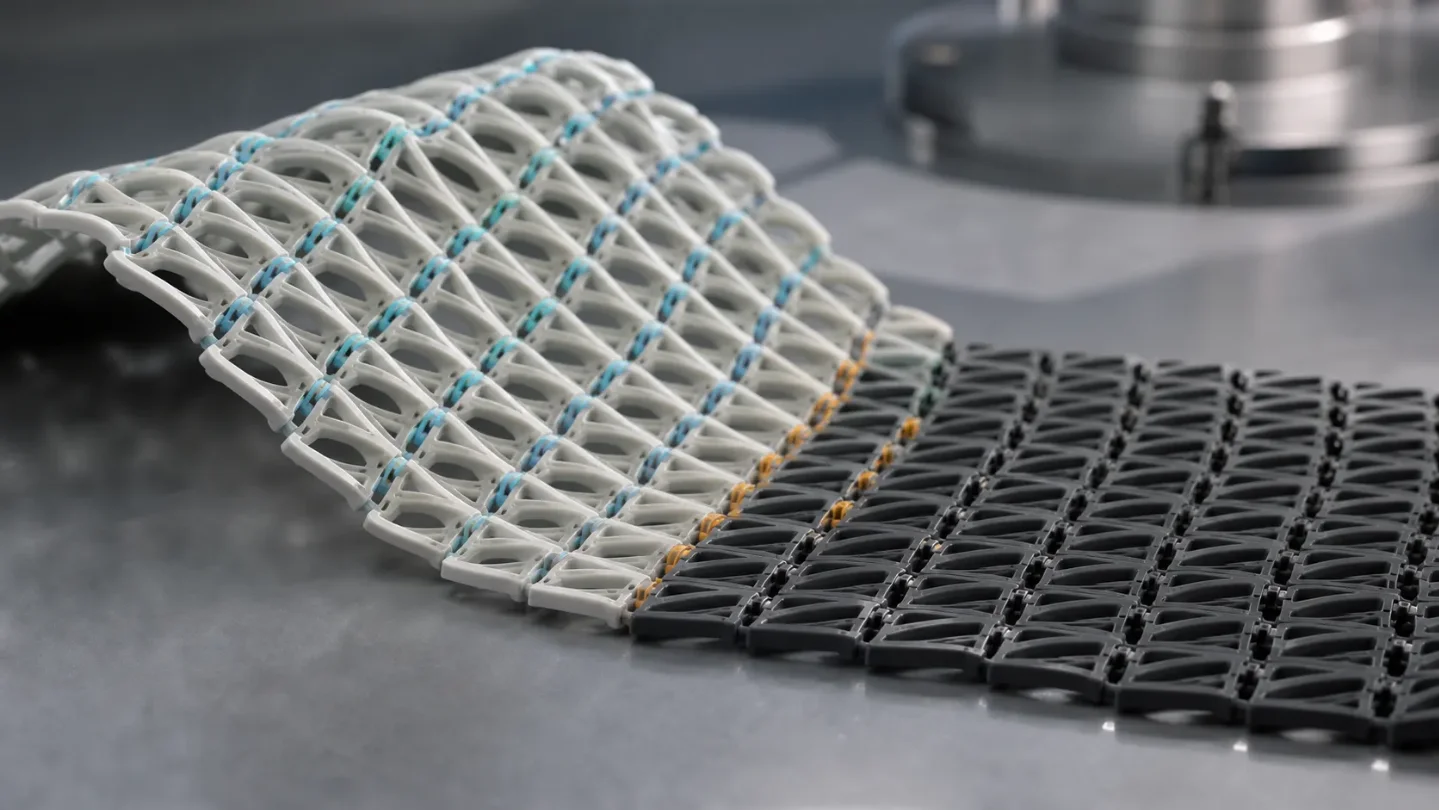
Recent mechanical metamaterials papers: buckling fronts, LCE kirigami, and certified inverse design
A short research read on recent mechanical metamaterials work, covering certified inverse design, liquid-crystal-elastomer kirigami, scalable active shape morphing, and controllable buckling fronts.

Coverage note. I found one near-window arXiv preprint from July 5 and no stronger July 6-13 match in the topic scan. For this launch issue, I broadened the sample to recent new or revised preprints since May 2026 so the channel has a useful starting baseline. Future issues should stay to the weekly window.
A useful split is forming in mechanical metamaterials work right now: one group of papers is trying to make deformation easier to design, while another is trying to make instabilities easier to control after fabrication. The four papers below are the ones I would keep on the watchlist from this scan.
Fast triage
| Paper | Why it is in this issue | Method signal | Evidence signal |
|---|---|---|---|
| CertMix | A learning-based inverse-design route that claims certified error bounds from only 50 exemplars | Align neural implicit unit-cell weights, then solve a constrained affine-mixing problem | arXiv preprint, submitted July 5, 2026; reports scaled property error of 10^-4 and 57x faster design than per-target topology optimization 1 |
| LCE kirigami scale-coupling | A material-and-geometry route for reversible morphing, not just a geometric cut pattern | Kirigami cuts in anisotropic liquid crystal elastomer sheets couple macroscopic strain to molecular anisotropy | arXiv preprint, v2 revised July 1, 2026; reports supersoft grippers with remote actuation and temperature-driven reversible morphing 2 |
| Scalable active metamaterials | A computational decomposition for aperiodic shape-morphing structures | Macro constrained mesh optimization plus micro inverse design via conditional diffusion or adjustable search | arXiv preprint, submitted May 7, 2026; reports a two-scale framework for fast, scalable aperiodic designs 3 |
| Diffusive buckling fronts | A control model for overdamped buckling cascades in 3D lattices | Experiments on 3D-printed simple cubic lattices plus a viscoelastic 3D-continuum model | arXiv preprint, v2 revised June 2, 2026; reports reaction-diffusion equations for steering strain-driven buckling fronts 4 |
1. CertMix makes inverse design look less sample-hungry
The most recent hit is CertMix, which targets a familiar inverse-design problem: pick a periodic unit cell whose homogenized elastic properties match a requested target. The paper's claim is not simply that a neural generator can produce a plausible cell. It claims a smaller, more inspectable optimization route: represent each exemplar cell as a periodic neural implicit field, align those weight vectors through a shared anchor, then mix them with affine coefficients while a differentiable periodic homogenizer checks the resulting elastic tensor 1.
The numbers in the abstract are aggressive enough to justify tracking the follow-up. From as few as 50 exemplars, the method reports a scaled property error of 10^-4, roughly two to three orders of magnitude below conditional generative baselines trained on 1000 cells. It also reports 57x speedup versus per-target topology optimization, while avoiding checkerboards and enclosed voids 1.
What to watch next: whether the certificate remains useful when the target property set expands beyond elasticity tensors, and whether the same weight-space linearity survives fabrication constraints. The running-shoe midsole example in the abstract is a good stress test because it moves from unit cells into spatially graded fields 1.
2. LCE kirigami connects cut geometry to molecular degrees of freedom
The LCE kirigami paper is interesting because it does not treat the cut pattern as the whole story. The authors work with liquid crystal elastomer sheets, where the material already has molecular anisotropy and a phase transition. Their claim is that kirigami cuts can engineer strain in a way that accesses those microscopic degrees of freedom, so macroscopic geometry programs material response rather than merely making a sheet more compliant 2.
The reported demonstrations are practical: supersoft grippers with remote actuation, plus architectures that reversibly morph under temperature changes. The important control idea is the coupling. Conventional kirigami can give large shape change, and LCEs can respond to stimuli, but the paper argues that the combination opens behaviors inaccessible to either one alone 2.
What to watch next: design rules. If the next versions or related papers quantify which cut families couple most strongly to the LCE director field, this could move from a demonstration platform toward a predictable actuator-design method.
3. Scalable active metamaterials split the shape problem into two scales
The SAM paper attacks a design bottleneck: periodic metamaterials are computationally manageable but not very programmable, while fully aperiodic metamaterials give more deformation freedom at higher design cost. The proposed workaround is a two-scale split. At the macroscale, global deformation is set by solving a constrained mesh optimization problem with data-driven constraints. At the microscale, local infill geometry is generated by inverse design, either through a conditional diffusion model or an adjustable search strategy 3.
The key phrase in the abstract is "local deformation independence." The framework relies on stiff structural members isolating units enough that the global and local problems can be decoupled. If that assumption holds across broader geometries, it is a useful route for aperiodic shape morphing: design the target shape at mesh level, then fill in local mechanisms without solving one enormous monolithic optimization 3.
What to watch next: physical validation and failure cases. The abstract emphasizes computational scalability and design accuracy, but readers should look for whether the paper reports fabricated specimens, actuation energy, tolerances, and where local independence breaks down.
4. Diffusive buckling fronts give instability a steering model
Buckling is often treated as the thing to avoid, then later as the thing to exploit. This paper goes one step further by asking how buckling fronts propagate in overdamped, highly dissipative lattice metamaterials. The authors focus on 3D structures and report experiments on 3D-printed simple cubic lattices, where compression triggers local instabilities that propagate as fronts and shape the macroscopic response 4.
The modeling claim is the useful part for control: by incorporating viscoelastic dissipation into a 3D-continuum model, the paper says strain-driven buckling fronts obey coupled reaction-diffusion equations. Diffusion and reaction coefficients, determined by local geometry, material properties, and strain, select the propagation direction and enable steering of the fronts 4.
What to watch next: whether the reaction-diffusion description becomes a design language. If designers can choose cell geometry to set front direction, speed, or arrest points, buckling fronts become a programmable signal path rather than a post hoc deformation pattern.
The thread across the set
The papers point to three design levers worth tracking in future issues:
- Representation: CertMix and SAM both try to make the design space smaller without giving up too much programmability.
- Scale coupling: The LCE kirigami paper treats macroscale cuts as a way to access microscopic material response.
- Instability control: The buckling-front paper treats cascaded buckling as a steerable dynamic process, not just a static mode shape.
For a short weekly watch, the highest-value follow-up would be anything that closes the loop between these levers: a design algorithm that accounts for stimulus-responsive material physics, or a fabricated lattice whose instability path is designed with predictive coefficients rather than tuned by trial and error.
Fuentes de referencia
- 1CertMix: Certified, Data-Efficient Metamaterial Design by Affine Mixing of Aligned Neural-Implicit Weight Spaces
- 2Scale-coupling from kirigami cuts controls emergent mechanics in liquid crystal elastomers
- 3Scalable Active Metamaterials for Shape-Morphing
- 4Diffusive buckling fronts in lattice-based metamaterials
Contenido relacionado
- Inicia sesión para comentar.