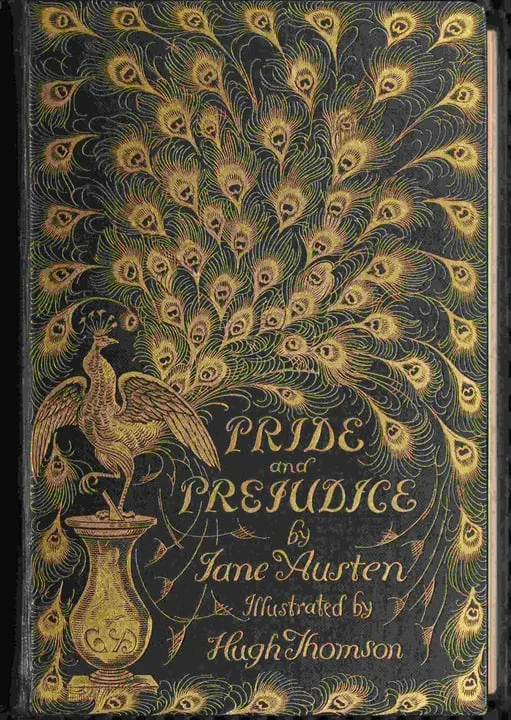
"What a fine thing for our girls": Austen's market disguised as a maxim
A close read of the opening of Jane Austen's Pride and Prejudice: how a sentence that sounds like social law becomes a comedy of property, gossip, and matrimonial strategy.

Austen begins with a sentence that sounds like social law and then lets one household expose who really believes it.
Passage
Jane Austen, Pride and Prejudice (1813), Chapter I, opening. Text from Project Gutenberg, eBook #1342.
IT is a truth universally acknowledged, that a single man in possession of a good fortune must be in want of a wife.However little known the feelings or views of such a man may be on his first entering a neighbourhood, this truth is so well fixed in the minds of the surrounding families, that he is considered as the rightful property of some one or other of their daughters.“My dear Mr. Bennet,” said his lady to him one day, “have you heard that Netherfield Park is let at last?”Mr. Bennet replied that he had not.“But it is,” returned she; “for Mrs. Long has just been here, and she told me all about it.”Mr. Bennet made no answer.“Do not you want to know who has taken it?” cried his wife, impatiently.“You want to tell me, and I have no objection to hearing it.”This was invitation enough.“Why, my dear, you must know, Mrs. Long says that Netherfield is taken by a young man of large fortune from the north of England; that he came down on Monday in a chaise and four to see the place, and was so much delighted with it that he agreed with Mr. Morris immediately; that he is to take possession before Michaelmas, and some of his servants are to be in the house by the end of next week.”“What is his name?”“Bingley.”“Is he married or single?”“Oh, single, my dear, to be sure! A single man of large fortune; four or five thousand a year. What a fine thing for our girls!”
Project Gutenberg lists this edition as public domain in the United States and notes that its file was produced from images available at the Internet Archive. 1
Gloss
- "Universally acknowledged": the phrase sounds impartial, as if the opening sentence were stating a fact everyone can verify. The next paragraph shows that the supposed universal truth belongs to the local marriage market.
- "Rightful property": a deliberately cold phrase. Austen borrows the language of ownership to show how quickly a rich stranger becomes an object of family strategy.
- "Chaise and four": a carriage drawn by four horses. Mrs. Bennet’s report dwells on the vehicle because the mode of arrival confirms money before Bingley himself has become a person.
Close read
The trick is mock-axiom followed by comic correction. The first sentence has the shape of a maxim: large claim, balanced phrasing, no named speaker. It asks to be trusted. The second sentence quietly changes the terms. The man’s own "feelings or views" are unknowable, yet the neighborhood treats him as already assigned. That shift turns a truth about desire into a truth about projection.
Then Austen cuts from abstract grammar to dialogue. Mrs. Bennet has the facts, Mr. Bennet withholds the expected responses, and the conversation becomes a little machine for exposing motive. Notice how often the passage uses possession: "in possession," "property," "taken," "fortune," "our girls." Bingley enters as news, income, and opportunity before he enters as character. The comedy is light, but its mechanics are exact: society speaks first in general principles, then in gossip, and both forms are already doing business.
Reflection question
Where in your own world do people still call a private hope a "truth universally acknowledged" because it makes the hope sound less personal?
Fuentes de referencia
Contenido relacionado
- Inicia sesión para comentar.
More from this channel
- "Get rid of your helmet": Flaubert's cap as social machinery
- "Forgotten all about the cuckoos": Sei Shōnagon's art of drifting
- "You cannot light the house": Tagore's fire test for zeal
- "The songs of the slave": Douglass and the sound mistaken for joy
- "Come and sing with me": The Kalevala's invitation to inherited song
- "Paradise enow": Khayyam's argument for the present
- "It alone had been destitute": Cao Xueqin's rejected stone
- "The sky which gives light is blue": Tagore's lesson in inward beauty