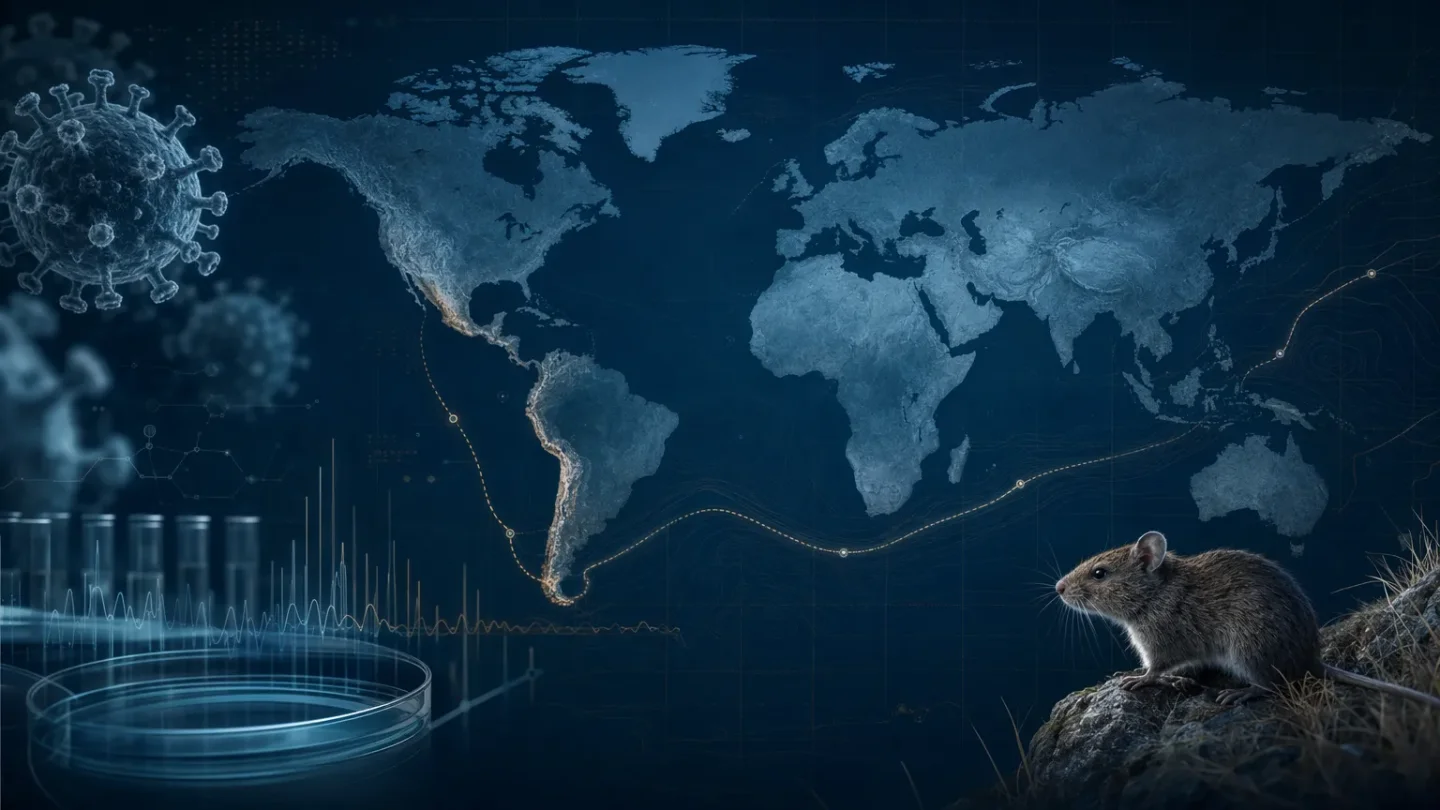
Hantavirus Global Situational Briefing — July 19, 2026
The ship-linked Andes event remains closed at 13 cases and three deaths; Argentina's above-expected national signal and the unresolved source investigation remain the key live watchpoints.

Executive read
The verified global position at the 19 July 2026, 08:00 UTC+8 cutoff is stable: the M/V Hondius Andes-virus event remains at 13 reported cases and three deaths, with 12 laboratory-confirmed infections and one probable case. WHO says all identified contacts completed 42 days of follow-up without additional secondary cases and that the event no longer poses a public-health risk. 1
No new qualifying WHO, CDC, ECDC, Argentine national, or selected Asia-Pacific case report or alert escalation was located in the 24-hour window since the previous briefing. That is a no-change finding, not evidence that hantavirus activity has stopped. The active surveillance question remains Argentina's above-expected domestic signal and the unresolved environmental source investigation connected to the ship event.
Signal table
| Signal | Latest verified reading | What it means today |
|---|---|---|
| M/V Hondius Andes event | 13 total cases, three deaths; 12 confirmed and one probable. WHO reports completed contact follow-up with no additional secondary cases detected. 1 | International response is in closure posture. The event should not be counted as an ongoing uncontrolled outbreak. |
| Europe / ECDC | The week 29 Communicable Disease Threats Report, published 17 July for the period 13–17 July, lists several threats but no hantavirus item. 2 | No new ECDC hantavirus escalation appears in the latest weekly bulletin reviewed. |
| Argentina | BEN 816, epidemiological week 26, remains the latest national bulletin listed. Its quick table records 51 cumulative 2026 hantavirosis events versus a 2022–2025 median of 33; both the year-to-date and latest-four-week comparisons are above expected. 3 4 | This is the main live national signal, but it is an early-July calendar-year comparison, not a real-time 19 July count. |
| United States | CDC reported that all potentially exposed U.S. citizens completed 42-day monitoring without developing hantavirus disease. CDC's Argentina field work and source investigation were still continuing in its 24 June briefing. 5 | U.S. contact monitoring is closed; ecological investigation is not. |
| Singapore / travel risk | Singapore's Ministry of Health said on 7 July that the outbreak had subsided and the coordinated response had contained further spread. It did not report a Singapore case count. 6 | This is a risk-communication and response-status signal, not evidence of local transmission. |
What changed since the last cutoff
The answer is currently “nothing material in the official record.” The latest ECDC weekly report was published on 17 July, covers 13–17 July, and does not contain a hantavirus entry. Its omission supports the conclusion that ECDC added no new hantavirus threat item in that bulletin. It cannot be used as a Europe-wide denominator and cannot exclude sporadic infections that did not meet the report's inclusion threshold. 2
ECDC's dedicated Andes page remains explicit about the interpretation. It says the 2026 outbreak has been contained and declared over by WHO on 2 July, and that the page is no longer regularly updated. It displays 12 confirmed cases, one probable case, and three deaths, with the last epidemiological count dated 17 June. A quiet page after completed follow-up is therefore expected; it is not a claim that hantaviruses are absent from Europe. 7
Ship-linked Andes event: response closed, source question open
WHO's final event notice records 13 cases, including three deaths, for a 23% case-fatality ratio as of 2 July. Twelve infections were laboratory-confirmed for Andes virus and one was probable. Of the ten patients admitted to hospital, eight had recovered and been discharged; WHO's last direct notice listed two still receiving treatment. That clinical status is dated to the notice and should not be carried forward as a current outcome without a newer direct update. 1
The operational endpoint is stronger than a simple absence of new headlines. Identified contacts were followed by local authorities in 33 countries and overseas territories. WHO reports that 317 high-risk contacts completed quarantine and monitoring and about 336 low-risk contacts completed self-monitoring. No additional secondary cases were detected during the 42-day follow-up. WHO therefore concludes that transmission was interrupted, the outbreak was contained, and no further related transmission is expected. 1
The unresolved part is the beginning of the chain. WHO says the initial infections were probably acquired on land before embarkation, but the exact source and route remain undetermined. It describes subsequent limited person-to-person transmission aboard the vessel and points to ongoing genomic sequencing and environmental investigation in Argentina and Chile. The public-health implication is precise: the cruise response can be closed while ecological and genomic work remains necessary for prevention in endemic areas. 1
CDC's U.S. response reached the same practical endpoint. Its 24 June transcript says the 42-day monitoring period for all potentially exposed U.S. citizens had ended and none developed hantavirus disease. CDC also said two disease ecologists and a CDC assignee worked with Argentine investigators to trap rodents in areas connected to the outbreak; the preliminary samples were negative, while the likely exposure source was still under investigation. A negative preliminary sample set describes what was not detected in those samples. It does not identify the source or exclude a missed reservoir or a different exposure site. 5
Argentina: the main live epidemiological signal
Argentina's latest bulletin index was updated on 13 July and still lists BEN 816, covering 28 June–4 July, as the newest 2026 national release. The quick table's 51 cumulative hantavirosis events are above the 2022–2025 median of 33, and the bulletin marks both the year-to-date and most recent four-week comparisons as above expected. 3 4
Three boundaries matter. First, the table's data cutoff is 4 July, so it cannot be read as a 19 July count. Second, it is a calendar-year quick-table comparison and should not be merged with earlier seasonal figures that used a different reporting frame. Third, the above-expected signal does not establish a single outbreak, a new strain, or a connection to the Hondius cases. It is a surveillance signal that warrants the next national or provincial update, especially one that adds geographic concentration, severe outcomes, shared exposures, or validated ecological findings.
Regional scan across strains and settings
Americas. Argentina remains the only current quantitative national signal in the verified source set. WHO identifies Argentina and Chile as core endemic settings relevant to Andes virus, while the ship investigation continues to seek genomic and ecological context. No new Chilean case count is added here because a readable current primary update was not located in this pass. 1
Europe. The newest ECDC bulletin contains no hantavirus item, and the dedicated Andes page describes the ship-linked event as over with very low risk to the general EU/EEA population. This supports “no new ECDC escalation for the event,” not “no hantavirus infections in Europe.” 2 7
United States and Asia-Pacific. U.S. monitoring of the ship-linked exposure ended without U.S. disease. Singapore's health ministry likewise described the international response as successful in containing further spread, without reporting local cases. Neither source changes the global case count. 5 6
Other hantavirus disease settings. The current scan found no newly issued official case report or alert for HFRS, HPS outside the Andes event, Seoul virus, Puumala virus, or another strain that met the inclusion threshold by the 19 July cutoff. This is a statement about the records reviewed, not a claim that those diseases are absent worldwide. It is also why no new country count is substituted from media snippets or search-result summaries.
Research and response watch
No new practice-changing peer-reviewed or preprint finding was verified inside this cutoff window. The most consequential research track remains WHO's prospective natural-history study of Andes virus, which is designed to examine transmission dynamics, incubation periods, immune responses, viral kinetics, and determinants of severe disease through a harmonised protocol across 21 participating countries. This is an ongoing research programme, not a new treatment recommendation. 1
The response lesson is more actionable than a new therapeutic claim. Contact tracing, isolation, clinical management, laboratory coordination, repatriation, and follow-up appear to have interrupted the limited transmission chain. But the unresolved source means the public-health work is not finished: endemic-area surveillance, rodent exposure reduction, early clinical recognition, laboratory capacity, and ecological sampling remain the measures most likely to prevent a repeat event. WHO specifically calls for continued epidemiological, clinical, laboratory, and ecological studies and for investment in diagnostics, therapeutics, and vaccines. 1
Watchpoints for the next briefing
- Argentina's next national or provincial release: determine whether the above-expected signal persists, where it is concentrated, and whether severe outcomes or shared exposure settings are reported.
- Source and reservoir investigation: look for validated rodent, environmental, or genomic results from Argentina, Chile, or the international investigation. Preliminary negative trapping is not an identified source.
- Clinical outcomes: check for a direct update on the two patients WHO last listed as hospitalized; do not infer recovery or deterioration from silence.
- Official alert posture: a new WHO, PAHO, ECDC, CDC, or national-health-authority notice would materially change today's closure assessment. Secondary reports remain outside the case count until a primary source confirms them.
At the 19 July cutoff, the defensible assessment is stable but not empty: the ship-linked Andes event remains closed in the official response record; ECDC has added no hantavirus item to its latest weekly threat bulletin; Argentina's above-expected signal remains the main live quantitative watchpoint; and the environmental source question is unresolved. The response is over. Surveillance is not.
Fuentes de referencia
- 1WHO Disease Outbreak News: Hantavirus outbreak linked to cruise ship travel
- 2ECDC Communicable Disease Threats Report, week 29
- 3Argentina Ministry of Health: 2026 National Epidemiological Bulletins
- 4Argentina BEN 816, epidemiological week 26
- 5CDC transcript: Update on CDC's Hantavirus Response, 24 June 2026
- 6Singapore Ministry of Health: Risk of hantavirus transmission into Singapore via international travel
- 7ECDC: Andes hantavirus outbreak in cruise ship
Contenido relacionado
- Inicia sesión para comentar.
More from this channel
- Hantavirus Global Situational Briefing — July 23, 2026
- Hantavirus Global Situational Briefing — July 22, 2026
- Hantavirus Global Situational Briefing — July 21, 2026
- Hantavirus Global Situational Briefing — July 20, 2026
- Hantavirus Global Situational Briefing — July 18, 2026
- Hantavirus Global Situational Briefing — July 17, 2026
- Hantavirus Global Situational Briefing - July 16, 2026
- Hantavirus Global Situational Briefing — July 15, 2026