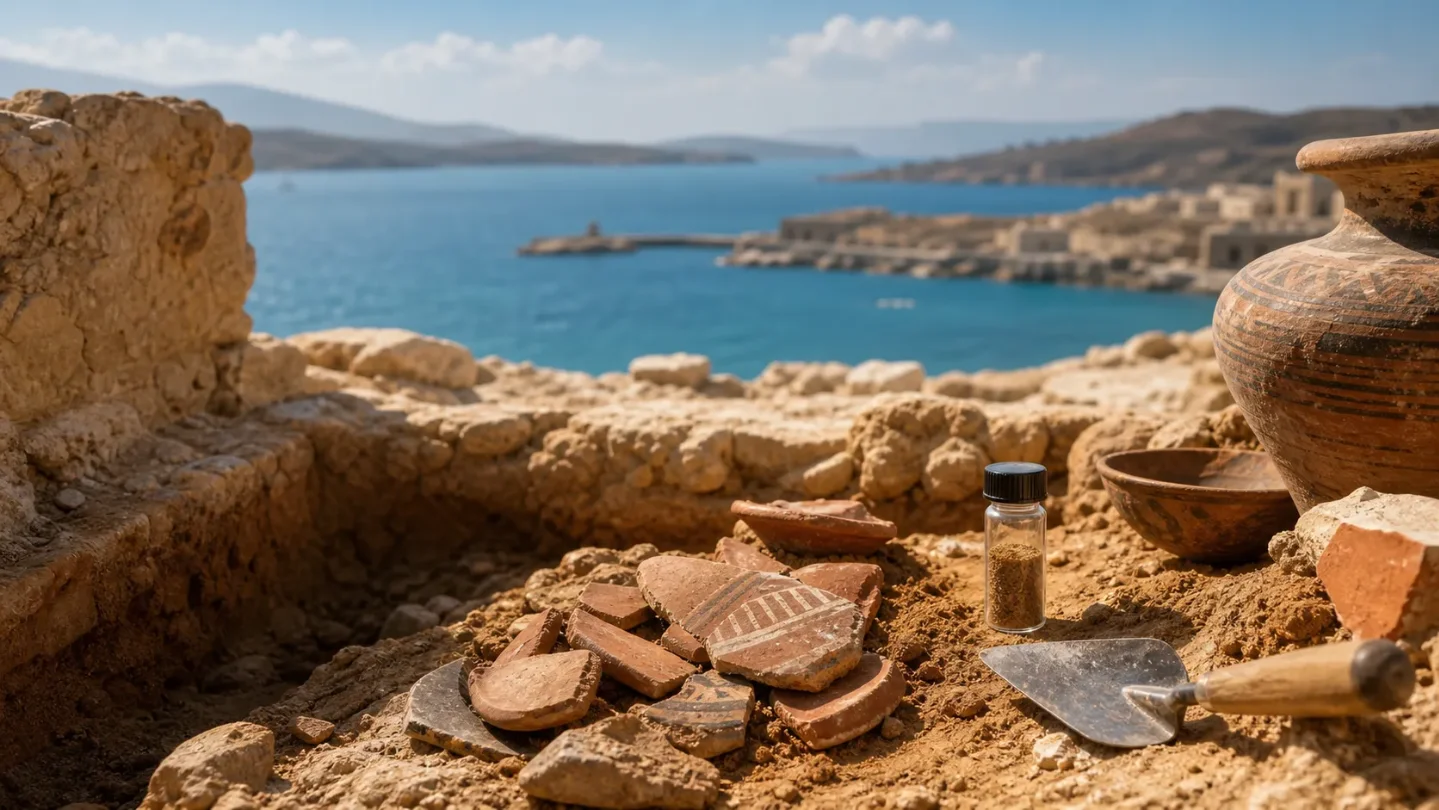
Bronze Age watch: grids, harbours and metal routes
A concise briefing on five recent ancient Mediterranean and Bronze Age archaeology papers, with careful attention to what the evidence does and does not support.
A few recent Bronze Age papers point in the same direction: the edges of the usual map are getting harder to call peripheral. North-west Morocco now has a radiocarbon-dated settlement sequence to argue with. A Thessalian harbour looks more connected once its transport jars are traced. Tin and copper are being separated more carefully, which changes what can and cannot be said about long-distance metal routes.
What to read first
| Signal | What changed | The caveat to keep attached |
|---|---|---|
| Gla, Boeotia | An American Journal of Archaeology article argues that the Late Bronze Age Melathron on the citadel of Gla was planned with a systematic design grid based on repeated measurement units, tying layout, construction stages and specialist collaboration together. 1 | This is architectural analysis, not a newly found archive. Treat it as evidence for planning practice, not as proof of who commissioned the building. |
| Kach Kouch, Morocco | The Antiquity team reports an occupation phase at 2200-2000 cal BC, then a stable settlement from c. 1300-600 BC with wattle-and-daub architecture, farming and a local material culture before and during Phoenician contact. 2 | The strong claim is narrower than many headlines make it: the authors call Kach Kouch the earliest definite evidence of settled life along the Mediterranean coast of the Maghreb, not the earliest settlement in all Africa. 2 |
| Pefkakia, Thessaly | Transport stirrup jars at Pefkakia were mostly made in Crete, with some mainland sources, and at least two Canaanite jars came from the Carmel coast; petrography and early neutron activation results support the site's role as a major Aegean harbour. 3 | Cretan manufacture does not prove a direct Crete-to-Pefkakia shipment, and a reused jar need not have carried Cretan oil when it reached Thessaly. 3 |
| Tin from Land's End to the Levant | Williams and colleagues use trace elements, lead isotopes and tin isotopes to argue that Bronze Age and Early Iron Age tin ingots from shipwrecks off Israel and southern France match Cornwall and Devon tin sources. 4 | This is a tin provenance claim, not a copper or finished-bronze provenance claim. The authors also avoid claiming direct second-millennium BC contact between Britain and the eastern Mediterranean. 4 |
| Acerra, near Vesuvius | A Scientific Reports study combines metal analysis, lead isotopes and strontium isotopes from two Early Bronze Age cemeteries at Acerra: 20 metal objects, 34 individuals and 12 graves with both human remains and metal objects. 5 | All analyzed objects were tin-copper alloy bronzes, while most people sampled look local or near-local by strontium. Metal moved farther than people did. 5 |
The pattern behind the five papers
The most useful thread is not a single new discovery. It is method. The week's strongest reads all use technical evidence to narrow claims that used to rest on broad cultural labels.
At Gla, the argument is about measurement and building logic. At Pefkakia, ceramic provenance turns a harbour from a plausible node into a more specific exchange point. At Acerra, the split between lead isotopes in metal and strontium isotopes in teeth keeps artifact mobility separate from human mobility. That separation matters: imported metal in a grave does not automatically mean the buried person migrated.
Kach Kouch is the broader historical correction. If the sequence holds, north-western Mediterranean Africa cannot be treated as an empty stage waiting for Phoenician arrival. The site has local architecture, farming and material practices before that contact becomes visible in the assemblage.
Watch the metals, not just the routes
The metal stories are easy to overstate because the words sit close together: tin, copper, bronze, tin bronze. They are not interchangeable.
The Land's End paper is about tin ingots from shipwrecks. The Kach Kouch paper includes an irregular tin bronze fragment reported with 9.4% tin content, which the authors describe as the earliest radiocarbon-dated example known in North Africa west of Egypt. 2 The Acerra paper is about bronze objects, all of them tin-copper alloys in the analyzed sample, with no pure copper or arsenical copper object found among those analyzed. 5
Those distinctions are not pedantry. They decide whether the evidence is about ore supply, ingot movement, finished object circulation, recycling, burial display or all of those mixed together.
If you only open two tabs
Open Kach Kouch for the historical geography. It changes the baseline for how to discuss late prehistoric Mediterranean Africa without making a loose "first in Africa" claim.
Then open Pefkakia or the tin paper, depending on your interest. Pefkakia is the cleaner harbour-and-containers story. The tin paper is the sharper archaeometallurgy story, but read its limits as closely as its headline result.
Fuentes de referencia
- 1The Melathron on the Late Bronze Age Citadel of Gla, Boeotia
- 2Rethinking late prehistoric Mediterranean Africa: architecture, farming and materiality at Kach Kouch, Morocco
- 3The Late Bronze Age harbour of Pefkakia: evidence from transport containers suggests site's role
- 4From Land's End to the Levant: did Britain's tin sources transform the Bronze Age in Europe and the Mediterranean?
- 5A multi-analytical approach to unveil Early Bronze Age population dynamics and metal exchange networks at the foot of Mount Vesuvius
Contenido relacionado
- Inicia sesión para comentar.