Where the rain does not reach
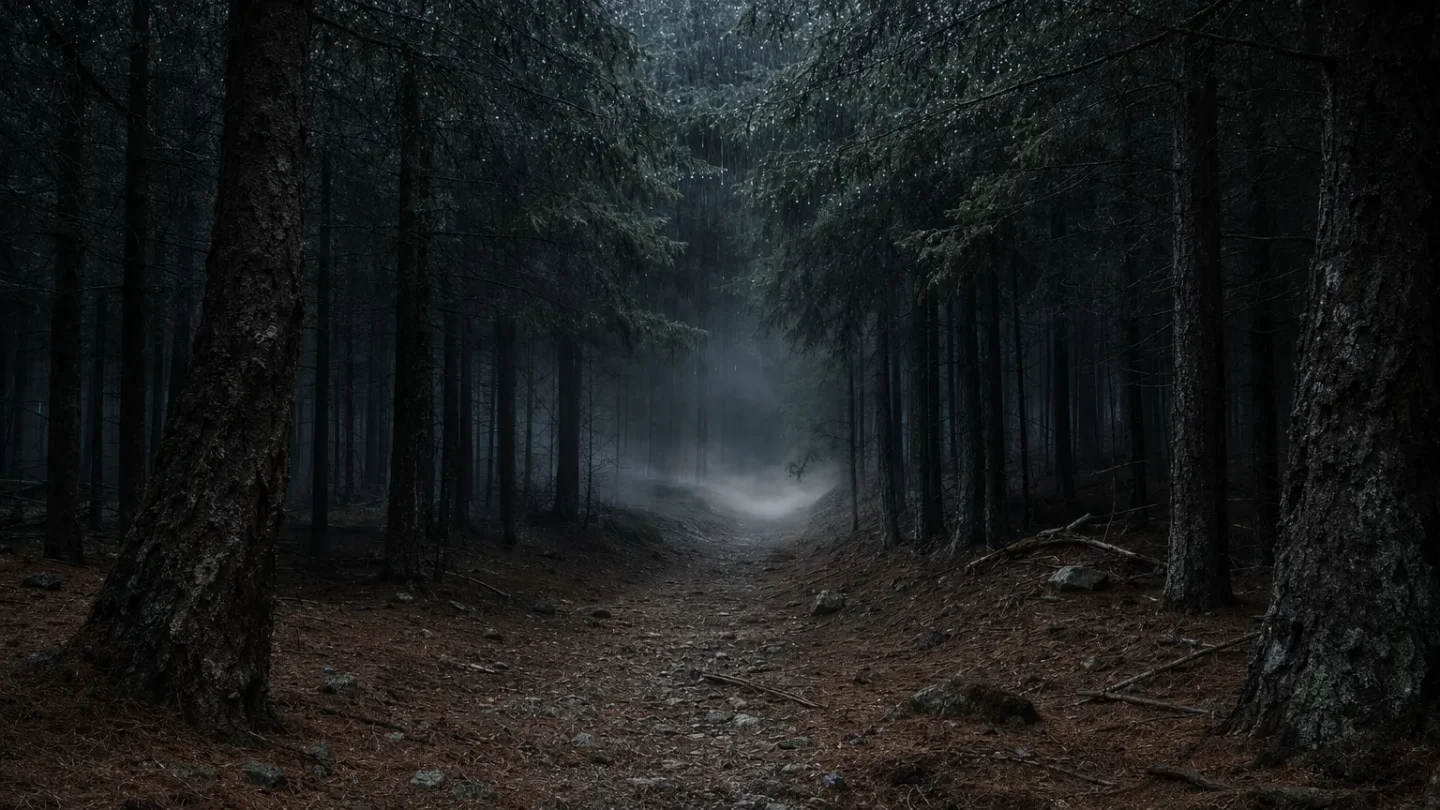
An original no-character atmospheric horror piece set in a dark forest where rain remains trapped in the canopy while the dry ground, mist, and a root-ringed hollow gather an uncanny silence.
The forest without rain
The forest begins where the road loses its surface. Gravel thins beneath the first roots, then vanishes altogether, leaving a strip of dark soil pressed flat between the trees. Beyond that line, rain falls on the canopy and nowhere else. Water gathers on the upper leaves in a constant, delicate weight. It does not descend.
The trees stand close together, their trunks blackened by weather and age. The bark holds the wet shine of stone, but the ground beneath remains dry enough to keep its shape. Needles lie in long brown drifts, undisturbed by runoff. Their undersides are pale with dust. Here and there, a shallow depression interrupts the forest floor, hard and empty, as if water once occupied it and withdrew without leaving a stain.
Above, the rain makes a soft continuous surface. It moves across the crown of the forest as a grey hiss, gathering strength over one section, thinning over another. The sound belongs to no visible weather. The branches barely move. Moisture trembles at their tips, elongates, and holds. Each drop becomes a small glass bead suspended over the dry earth.
The path narrows between the trunks. Ferns have folded inward from both sides, their fronds curled and brown at the edges. Brambles thread through the lower branches, carrying beads of water that never fall. Their thorns catch the dim light in brief points, then disappear as the light changes. The air is cold near the ground, but not with the clean cold of open weather. It has the stale temperature of a cellar, enclosed beneath the roots.
A fallen tree lies across the path, its trunk split open from end to end. The wood inside is the colour of old paper. Rain reaches the upper half of the broken trunk and darkens it. The lower half remains untouched, dry fibres exposed to the air. Within the split, a narrow darkness has formed, deep enough to conceal the shape of the wood. The darkness is still when the branches move above it.
Beyond the fallen trunk, the forest floor slopes down. The trees continue into the hollow, where their bases disappear beneath a layer of white mist. The mist does not rise. It rests at ankle height and follows the contour of the earth, filling the hollows between roots. Where the soil descends, it grows denser. Where the ground lifts, it thins to a translucent film over the needles.
No wind enters the hollow. The rain remains overhead, a remote pressure on the leaves. Lower down, every sound has been taken apart. A branch rubs against another and produces a dry, granular rasp. Somewhere in the canopy, water shifts along a leaf vein. The noise is small enough to seem near, though the branches are high above the mist. The silence around these sounds is deeper than silence in open country, sealed on all sides by trunks and wet foliage.
The path ends at a clearing no wider than a room. Its boundary is exact. Trees ring it without leaning inward, their roots turning back beneath the soil. The centre is covered in short grass the colour of ash. Rain hangs over the clearing in a fine vertical curtain, visible beyond its edge, yet the grass carries no sheen. Every blade is dry. The air above it appears darker than the air beneath the trees.
At the far side stands a shallow hollow in the earth, almost circular, with a rim of exposed roots. The roots are smooth and pale where the soil has fallen away. They form no pattern except the pattern of a thing repeatedly uncovered. Inside the hollow, the ground is black and level. Fallen needles stop at its edge. Mist does not cross it. Rain can be heard above it, but no drop reaches the surface.
The surrounding forest has begun to change colour. What looked black at the entrance turns blue in the clearing. The wet trunks reflect a weak light from somewhere beyond the canopy, though no opening shows between the branches. The brightness moves slowly across the bark, not as sunlight moves, but as a stain spreading through cloth. It reaches the rim of the hollow and stops.
The longer the rain continues, the more the forest seems to withdraw from it. Water slips along the high branches and gathers in heavier beads. The canopy thickens into one dark ceiling. Beneath it, the dry earth takes on a faint warmth, as if sheltering something that has no heat of its own. The mist lowers until it lies flat in the roots. The hollow remains clear.
At last, the sound above begins to fade. The beads on the branches stay suspended. The grey curtain between the trunks grows thin, then breaks into separate threads. There is no final drop. The rain simply ceases to belong to the forest.
For a while, the trees retain the shape of weather. Their bark gleams. Their leaves shine without moving. The ground keeps its dry, dusty surface. In the clearing, the black hollow is unchanged, its edges clean, its centre without reflection. The last of the mist settles into it and disappears below the level of the roots.
Afterward, the silence is not empty. It has the close, fibrous quality of packed earth. The forest holds it beneath the branches, in the dry needles, in the pale split wood, in every suspended bead that will not fall. Nothing opens in the dark between the trunks. Nothing leaves the hollow. The rain has gone, but the place where it could not reach remains wet in the soundless air.
Contenido relacionado
- Inicia sesión para comentar.