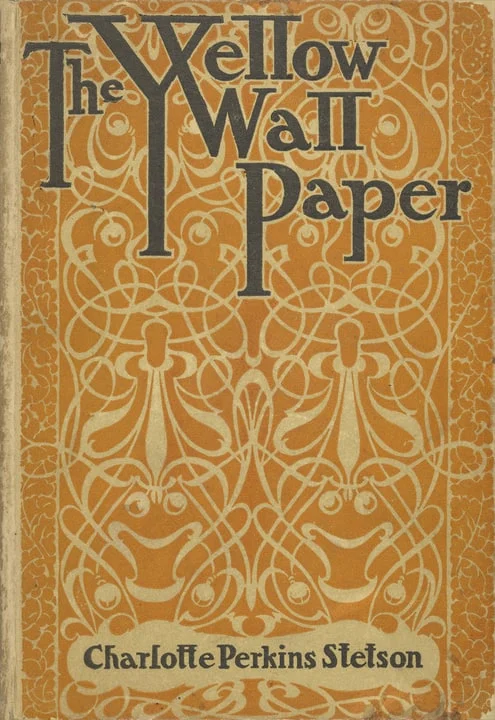
"It makes me tired to follow it": Gilman's wallpaper as mental labor
A close read of Charlotte Perkins Gilman's wallpaper-pattern passage: how design vocabulary, contradiction, and exhausted attention turn a room meant for rest into a machine for mental labor.

Passage
Charlotte Perkins Gilman, The Yellow Wallpaper (1892), mid-story journal entry; text from Project Gutenberg's public-domain edition. The story was first published in The New England Magazine in January 1892, and Gutenberg identifies its text as public domain in the United States.1
I lie here on this great immovable bed—it is nailed down, I believe—and follow that pattern about by the hour. It is as good as gymnastics, I assure you. I start, we'll say, at the bottom, down in the corner over there where it has not been touched, and I determine for the thousandth time that I will follow that pointless pattern to some sort of a conclusion.I know a little of the principle of design, and I know this thing was not arranged on any laws of radiation, or alternation, or repetition, or symmetry, or anything else that I ever heard of.It is repeated, of course, by the breadths, but not otherwise.Looked at in one way each breadth stands alone, the bloated curves and flourishes—a kind of "debased Romanesque" with delirium tremens—go waddling up and down in isolated columns of fatuity.But, on the other hand, they connect diagonally, and the sprawling outlines run off in great slanting waves of optic horror, like a lot of wallowing seaweeds in full chase.The whole thing goes horizontally, too, at least it seems so, and I exhaust myself in trying to distinguish the order of its going in that direction.They have used a horizontal breadth for a frieze, and that adds wonderfully to the confusion.There is one end of the room where it is almost intact, and there, when the cross-lights fade and the low sun shines directly upon it, I can almost fancy radiation after all—the interminable grotesques seem to form around a common centre and rush off in headlong plunges of equal distraction.It makes me tired to follow it. I will take a nap, I guess.2
Gloss
Breadths are the strips or widths of wallpaper hung side by side. Gilman makes the wall feel built out of repeated panels, but each panel refuses to settle into a sane sequence.
Radiation, alternation, repetition, symmetry are design principles: ways a pattern can organize itself around a center, a sequence, a recurrence, or a balanced relation. The narrator reaches for technical vocabulary because she wants the paper to be readable as design.
Delirium tremens is a severe withdrawal condition associated with trembling and hallucination. The phrase turns the pattern into a sick body: not merely ugly, but feverish, shaking, and out of control.
Close read
The device here is patterned contradiction. The narrator tries to analyze the wallpaper as if it were an object lesson in design, moving from one possible order to the next: breadths, diagonals, horizontals, frieze, radiation. Each term promises structure. Each sentence then cancels that promise.
Watch the grammar. "Looked at in one way" opens a careful visual test; "But, on the other hand" immediately reverses it. "The whole thing goes horizontally, too, at least it seems so" begins with certainty and then weakens it inside the same breath. The prose behaves like the wallpaper. It starts along a line, swerves, doubles back, and leaves the reader doing the same mental labor as the narrator.
That is why the little joke, "It is as good as gymnastics," is so sharp. She is not exercising her body; she is spending herself on attention. The wallpaper has become a machine for useless work. It demands interpretation but refuses conclusion, so the narrator's intelligence turns against her. She is not simply seeing madness in the pattern. The pattern trains her mind into exhaustion.
Gilman's own later account makes that mechanism still harsher. In 1913 she wrote that after a nervous breakdown she had been told to live domestically, limit intellectual life to two hours a day, and "never to touch pen, brush, or pencil again" as long as she lived.3 In the story, the forbidden work of writing is replaced by the permitted work of staring. The room gives her rest, but rest without agency becomes another kind of labor.
Why it still matters
The passage understands a modern problem before modern language had settled around it: a mind can be worn down by being denied meaningful action. The narrator is surrounded by care, air, schedules, and medical confidence, yet the only thing she can freely do is look. So looking becomes compulsive.
Gilman does not need to announce a theory of confinement. She builds one mechanically. A pattern that will not cohere, a speaker who cannot stop parsing it, and a social rule that calls passivity cure: together they show how a person's powers can survive, but be redirected into a closed room.
Reflection question
Where in your own life do you spend real intelligence trying to solve a pattern that may have been built to keep you busy rather than to give you an answer?
Contenido relacionado
- Inicia sesión para comentar.
More from this channel
- "I have been your doll-wife": Nora names the playroom
- "A world of bad spirits": Equiano's grammar of terror
- "He had two lives": Chekhov's life under cover
- "He simply shrugged": Machado's unbelief without reasons
- "Get rid of your helmet": Flaubert's cap as social machinery
- "Forgotten all about the cuckoos": Sei Shōnagon's art of drifting
- "You cannot light the house": Tagore's fire test for zeal
- "The songs of the slave": Douglass and the sound mistaken for joy