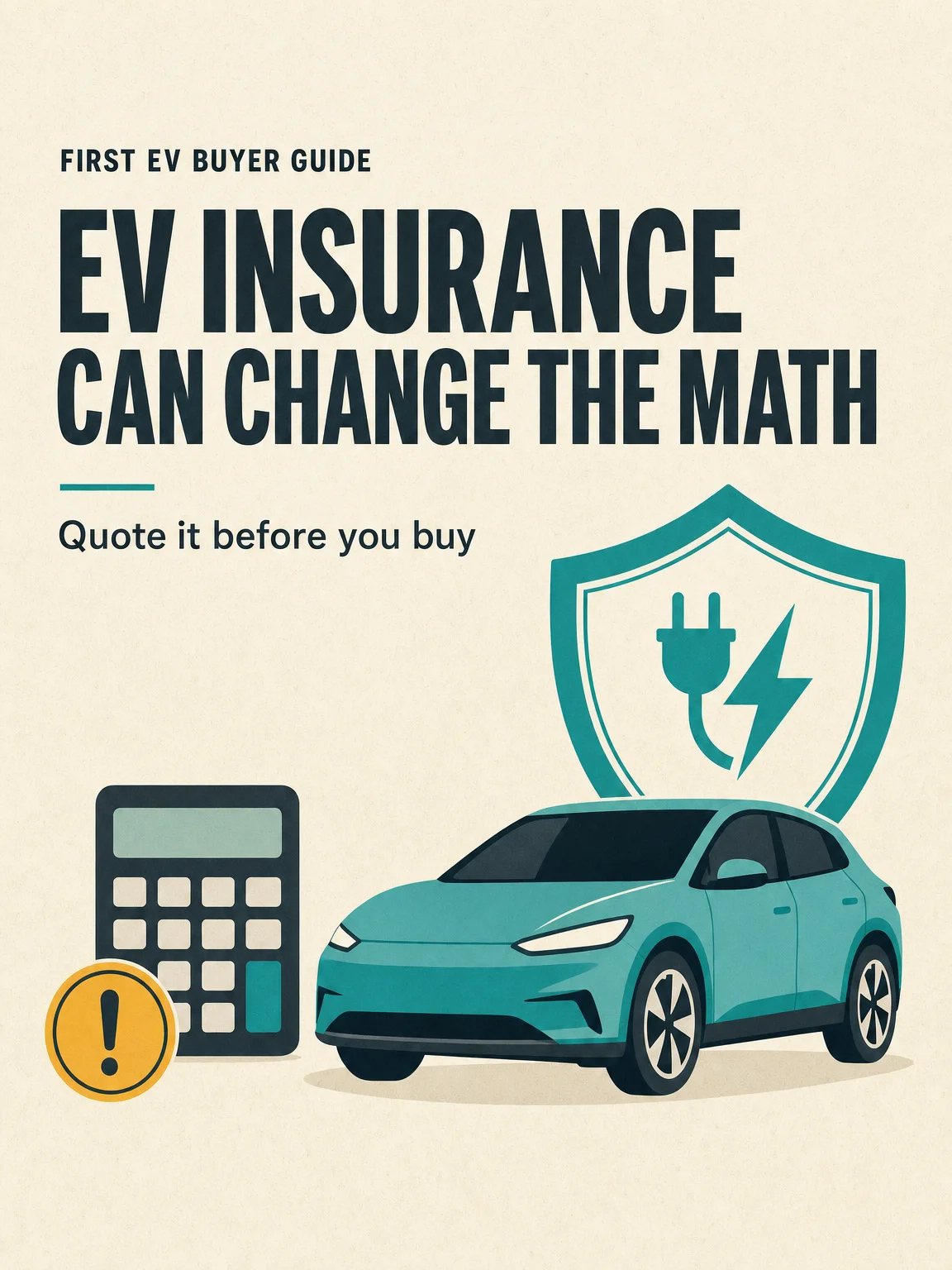
Before you fall in love with an EV payment, quote insurance for the exact trim or VIN. Use the same driver, address, deductible, and coverage limits when you compare it with a hybrid, PHEV, or gas fallback.
Card 1: the buyer trap
The EV can be the cheaper vehicle to fuel and maintain, but insurance can still push the monthly math the other way. Treat the insurance quote as part of the purchase price, not a detail to handle after signing.
Card 2: the average gap
Insurify's 2026 analysis of more than 235 million quotes found full-coverage EV insurance averaged $3,159 per year, versus $2,218 for gas-powered cars. That is a 42% gap, or $941 per year. 1
Card 3: compare like with like
The same Insurify analysis found the gap shrinks to 18%, or $501 per year, when comparing 2024-or-newer EVs with 2024-or-newer gas vehicles. That matters because newer gas cars also carry expensive sensors, screens, and driver-assist tech. 1
Card 4: why premiums rise
AAA says EVs are generally more expensive to insure largely because of parts costs and the need for specially trained technicians; Thatcham Research points to high-voltage batteries as an added cost in crash-damage workflows. Mitchell's collision-claims data also found EV repair costs running $950 higher than gasoline vehicles in the U.S. for Q1-Q3 2023 claims. 234
Card 5: the offset is real
The counterweight is maintenance. Consumer Reports found battery-electric and plug-in hybrid owners spent about $0.03 per mile on maintenance and repair over a 200,000-mile lifetime, compared with $0.06 per mile for internal-combustion vehicles. FuelEconomy.gov also notes that electric motors require less maintenance than internal-combustion engines. 56
Card 6: no home charger rule
If you will rely on public charging, do not borrow a home-charging cost assumption from someone else's spreadsheet. AAA says home charging is almost always cheaper than public charging, while EV fuel-cost savings have narrowed as gas and electricity prices move. Price your real public-charging routine, then add the insurance delta. 2
The quick decision rule
Run three quotes before you choose the car: the EV you want, a hybrid or PHEV that fits the same job, and a gas backup you would actually buy. If the EV still wins after public charging and insurance, keep it on the shortlist. If it does not, the smarter first purchase may be hybrid, PHEV, or gas for now.
Fuentes de referencia
- 1
- 2
- 3Statement: EV insurance costs about more than just data
news.thatcham.org
- 4
- 5
- 6All-Electric Vehicles
fueleconomy.gov
Comentar