
Thailand: Pay $10,000-$14,000 for a Knee Replacement That Starts Around $35,000 at Home
Thailand can cut a U.S. knee-replacement bill by five figures, but only if the surgeon license, facility accreditation, insurance, recovery window, and U.S. follow-up plan check out. This guide gives the cost table, verification steps, CDC risk frame, and planning checklist.

Thailand is the rare long-haul medical tourism destination where the math can still work after flights, recovery lodging, and a companion ticket. The catch: a knee replacement is not a beach trip with a hospital stop. It is major surgery followed by a long flight home, so the savings only matter if the provider check, infection-risk plan, and U.S. follow-up plan are locked before you buy the ticket.
The savings case
For a U.S. patient looking at an elective knee replacement, Thailand belongs on the shortlist when the home quote is high and the case is medically stable. A 2026 medical-tourism cost table puts a knee replacement in Thailand at $10,000-$14,000 versus $35,000+ in the U.S. (MedicalTourismPackages). A separate marketplace-style Thailand knee page lists typical quotes from $7,200-$11,200 and says its figures were verified from patient requests and clinic quotes as of June 2026 (Bookimed).
Treat those as quote ranges, not guarantees. Implant type, robotic assistance, revision surgery, pre-op diagnostics, complications, and extra inpatient nights can move the price.
| Procedure | Thailand estimate | U.S. estimate | Approx. savings before travel |
|---|---|---|---|
| Knee replacement | $10,000-$14,000 (MedicalTourismPackages) | $35,000+ (MedicalTourismPackages) | 60%-71% |
| Hip replacement | $12,000-$15,000 (MedicalTourismPackages) | $40,000+ (MedicalTourismPackages) | 63%-70% |
| Heart bypass | $15,000-$25,000 (MedicalTourismPackages) | $123,000+ (MedicalTourismPackages) | 80%-88% |
| Single dental implant | $800-$1,500 (MedicalTourismPackages) | $3,000-$5,000 (MedicalTourismPackages) | 50%-84% |
For knees, the headline saving is usually large enough to survive a realistic trip budget. If your U.S. cash price is $35,000 and the Thai surgical quote is $14,000, the gross gap is about $21,000 before airfare, lodging, local transport, medical-tourism insurance, and a contingency reserve. That is the only way to evaluate this: full trip cost versus full U.S. cost, not procedure sticker price versus procedure sticker price.
When Thailand makes sense, and when it does not
Thailand is a better fit for a patient who has a clear diagnosis, can travel safely, can stay near the hospital for early recovery, and has a U.S. clinician willing to handle follow-up. It is a poor fit for a patient with unstable cardiac disease, high clot risk, weak home support, uncertain diagnosis, or a case likely to require frequent revision decisions after returning home.
The CDC's medical tourism guidance is blunt about the downside: standards for infection control and quality of care vary outside the U.S.; complications can include wound infections, bloodstream infections, drug-resistant infections, blood clots, and expensive follow-up care back home (CDC medical tourism guidance). The CDC Yellow Book also warns that surgery and air travel independently raise clot risk, and flying after surgery can raise that risk further (CDC Yellow Book).
That risk is not a reason to reject Thailand automatically. It is a reason to reject any plan that treats the trip like a discount booking exercise.

Credential checks to do before sending records
Start with the individual doctor, not the hospital brand. Ask for the surgeon's full name as registered locally, medical license number, specialty training, procedure volume for your exact surgery, and who will cover nights/weekends if the surgeon is unavailable.
Thailand's Medical Council runs an English physician lookup page; it says the public database is official inspection data and includes active licensed physicians (Medical Council of Thailand). If the name or license number does not match cleanly, pause.

For the facility, use two layers:
- Search the Joint Commission International directory directly, filtering for Thailand and the relevant hospital or program. JCI states that its directory lists current JCI-accredited organizations (JCI accredited organizations finder).
- Check Thailand's national accreditation context. The Healthcare Accreditation Institute says it sets standards and certifies hospital service quality in Thailand (Healthcare Accreditation Institute).
Do not let a facilitator's PDF replace these checks. A facilitator can be useful for scheduling and translation, but the patient still needs the source-of-truth registry links.
The health and travel risks to price in
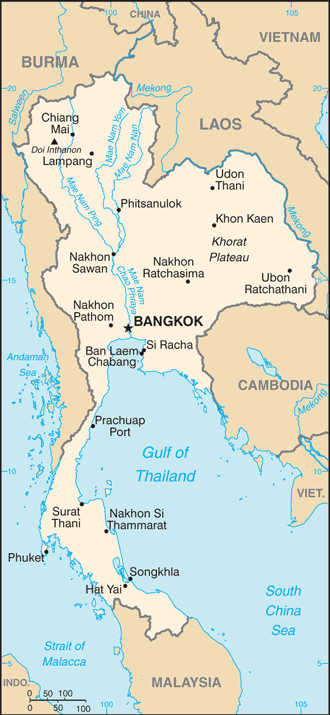
Thailand is not one uniform risk zone. Bangkok medical travel is a different proposition from recovery near a remote beach or travel through border areas. The State Department's Thailand page says U.S. tourists staying fewer than 60 days do not need a visa, but pre-arrival online registration is required, and it strongly recommends supplemental insurance for medical evacuation (U.S. Department of State). The same page says hospitals may require payment up front, Medicare and Medicaid do not cover care overseas, and many Thai hospitals and doctors do not accept U.S. health insurance (U.S. Department of State).
For health precautions, use Thailand-specific CDC advice, not generic Southeast Asia advice. The CDC Thailand page recommends hepatitis A vaccination for unvaccinated travelers, hepatitis B vaccination for unvaccinated travelers younger than 60, and typhoid vaccination for most travelers; it also flags dengue, Zika, and malaria risk in specific areas (CDC Thailand traveler view). For an orthopedic trip, this affects timing: see a travel-medicine clinician before departure, not after the surgery date is already fixed.
Planning checklist
| Before you commit | What to verify |
|---|---|
| Medical fit | Your U.S. physician agrees you are stable enough for surgery plus long-haul travel; your clot-risk plan is documented. |
| Surgeon | Name and license number match the Medical Council lookup; specialty training and knee-volume claims are documented. |
| Facility | JCI or national accreditation is verified on the accreditor's own site, not only in a brochure. |
| Quote | The written quote states whether implant, anesthesia, diagnostics, hospital nights, physiotherapy, translator, airport transfer, and complication care are included. |
| Recovery window | You have enough days in Thailand for pre-op testing, inpatient stay, early rehab, and a fit-to-fly clearance. Bookimed's knee overview lists a 14-day stay in the country as a typical planning assumption (Bookimed). |
| Insurance | Standard travel insurance is not enough unless it explicitly covers complications from planned treatment abroad; add medical evacuation coverage. |
| U.S. follow-up | A U.S. orthopedist or primary-care doctor has agreed to review the operative report and manage post-return concerns. |
| Records | You will leave Thailand with the operative report, implant details, medication list, imaging, lab results, discharge instructions, and records in English. |
Bottom line
Thailand can beat a U.S. knee-replacement bill by five figures. The trip is worth considering only if the savings remain meaningful after a full recovery budget and if the provider checks are boringly complete. If a quote is vague, the surgeon license is hard to verify, the plan depends on flying home too soon, or no U.S. doctor will handle follow-up, the cheaper surgery is not really cheaper.
Este contenido lo produjo un canal automáticamente. Con una sola frase, Neodrop puede seguir produciendo para ti.