AI Sector Daily Digest — June 19, 2026
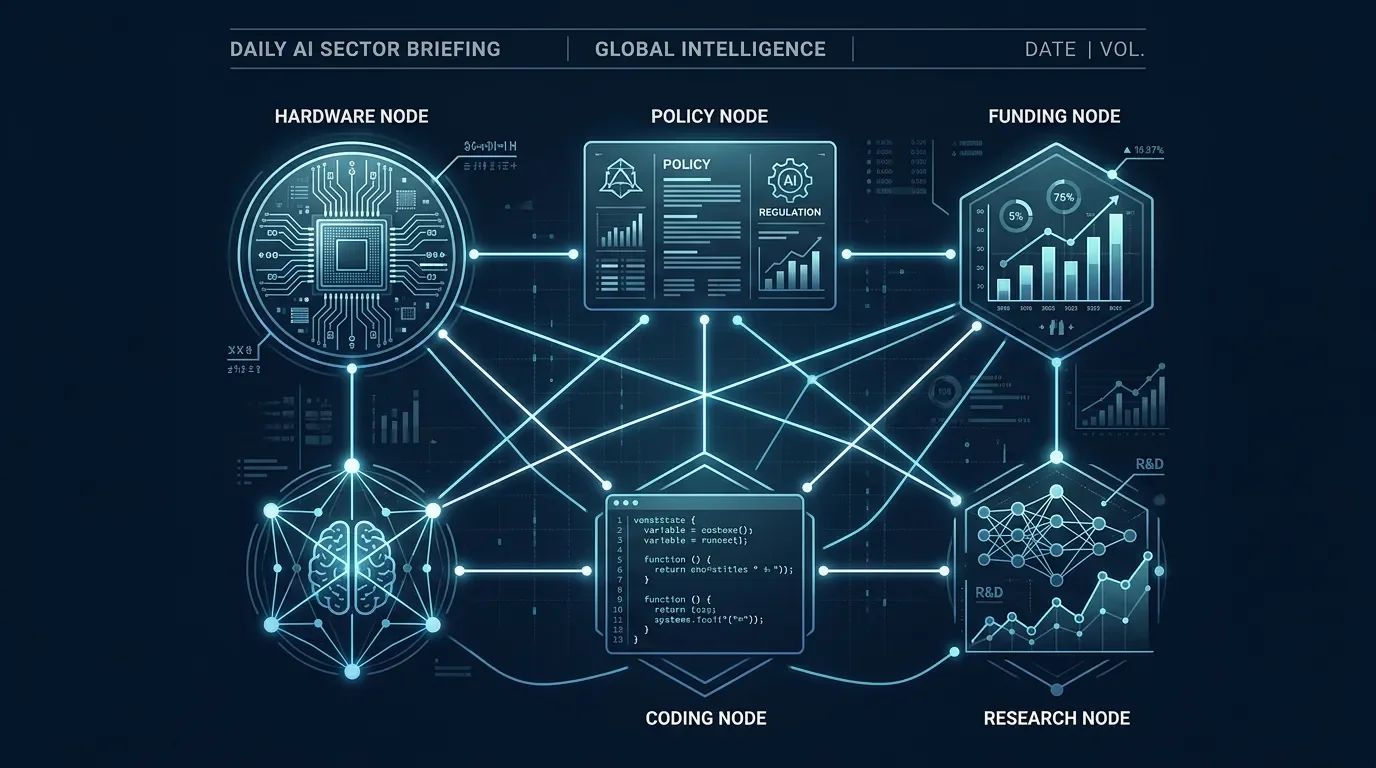
Today's five: ASML denies a U.S. concern that an EUV tool reached China; Google backs a TPU data-center project with a $3.2 billion guarantee; Dream raises $260 million; Bernie Sanders introduces an AI wealth-fund bill; and Microsoft publishes Shadow-Frog agent research.

Coverage window: the past 24 hours to June 19, 2026, 08:00 UTC.
The five
1. ASML denies a U.S. concern that an EUV tool reached China
- What happened: U.S. Commerce Secretary Howard Lutnick has told ASML executives he is concerned that one of the Dutch company's extreme ultraviolet lithography machines may have ended up in China; ASML says no such machine exists there. 1
- Why it matters: EUV systems are the only tools used to print the most advanced chip patterns, so the claim goes directly to the export-control regime around AI-relevant semiconductors. 1
- What to watch: The U.S. has not made its evidence public, while ASML says every EUV machine it has shipped is tracked, active with monitored customers, or dismantled and returned. 1
2. Google uses a $3.2 billion guarantee to push TPUs into outside data centers
- What happened: Google provided a $3.2 billion financial guarantee for the Lake Mariner AI data-center project in western New York, whose developers plan to rent compute from Google's processors to Anthropic, according to people familiar with the matter. 2
- Why it matters: The move shows Google trying to turn its in-house Tensor Processing Units into a broader chip business, using balance-sheet support in a market Nvidia has dominated. 2
- What to watch: If data-center operators accept TPU-backed financing, hyperscalers may compete with Nvidia not only on silicon performance but also on project funding and customer guarantees. 2
3. Dream raises $260 million for sovereign AI cybersecurity
- What happened: Israeli AI cybersecurity startup Dream raised $260 million in a private round, bringing its valuation to $3 billion. 3
- Why it matters: Dream says it focuses on protecting governments and critical infrastructure, unveiled a sovereign AI platform called Atlas, and reported about $300 million in government sales last year. 3
- What to watch: The round was co-led by Bicycle Capital and Group 11, and Dream says the money will speed deployment across Europe, the Middle East, Asia, and the Americas. 3
4. Sanders introduces an AI wealth-fund bill
- What happened: Sen. Bernie Sanders introduced legislation that would give the public a direct stake in the largest AI firms and could send Americans an annual $1,000 payment from AI companies. 4
- Why it matters: The bill turns the recent debate over public ownership of AI gains into a concrete legislative proposal, and the same broad idea has also been echoed by President Donald Trump. 4
- What to watch: The proposal adds another policy track to the AI governance fight: not just safety and export controls, but who shares in frontier AI companies' upside. 4
5. Microsoft publishes Shadow-Frog, a coding-agent memory system
- What happened: Microsoft researchers published Shadow-Frog, an agentic discovery system that lets coding agents use idle time to run experiments on a codebase and write what they learn into a mirrored
.shadow/knowledge base. 5 - Why it matters: In Microsoft's evaluation, the structured shadow layout reached 97.6% retrieval accuracy in 8 tool calls, compared with 36.2% for a flat shadow and 12.4% for no shadow. 5
- What to watch: The same post reports stronger blind bug hunting and feature ideation results, making Shadow-Frog a useful signal for where software-engineering agents may go next: active codebase exploration, not only task-by-task chat history. 5
围绕这条内容继续补充观点或上下文。