2026/6/24 · 21:03
The rooms below the weather
An original atmospheric horror piece set inside a damp, abandoned coastal building where the rooms, corridors, and weather carry the dread on their own.
The air begins in the lobby, low and wet, with the weight of rain held inside it long after the roof has stopped answering the sky. Nothing moves openly. The building keeps its weather in layers: salt on the glass, damp in the plaster, a cold shine along the tiles where the dark has gathered into shallow pools.
The hall below the tide
The entrance doors no longer close cleanly. Their frames have swollen into warped ovals, and the narrow seam between them shows a strip of fog pressed flat against the outside. It glows without brightness, the color of cloth left too long in water.
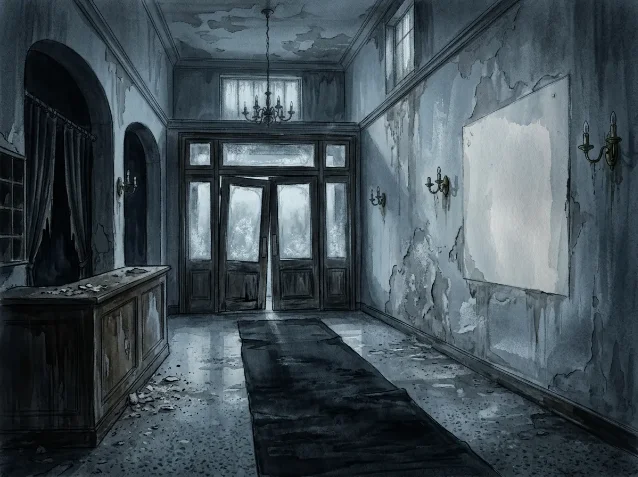
Inside, the floor runs away in a black line. A runner carpet stretches from the doors to the staircase, not torn enough to be ruined, not whole enough to be useful. It has taken on the texture of wet fur. At its edges, the tiles show through in dull squares, each one filmed with grit and the powdered white of dried salt.
The ceiling is high but feels lowered by stains. Brown blooms spread from the corners of old light fittings, feathering outward in rings. The fixtures themselves hang unlit, brass gone green at the seams. In their glass cups, dead insects have settled into a fine sediment that shifts when the building cools, making the faintest dry sound.
A reception desk waits against the far wall. Its varnish has lifted into blisters, and the drawers have swollen shut around whatever dark space remains inside them. Behind it, the wall is paler where a mirror once hung. The exposed rectangle looks cleaner than everything around it, which makes it worse: a bright absence with soft edges, as if the room has been staring at that missing shape for years.
The rooms above the lobby
The staircase rises in three damp turns. Each tread is furred with grit. The banister is smooth only where the varnish has peeled away, leaving the wood raw and dark. Along the wall, wallpaper folds downward in slow strips. The pattern beneath the mildew is almost floral, though the flowers have blurred into dark knots and leaning stems.
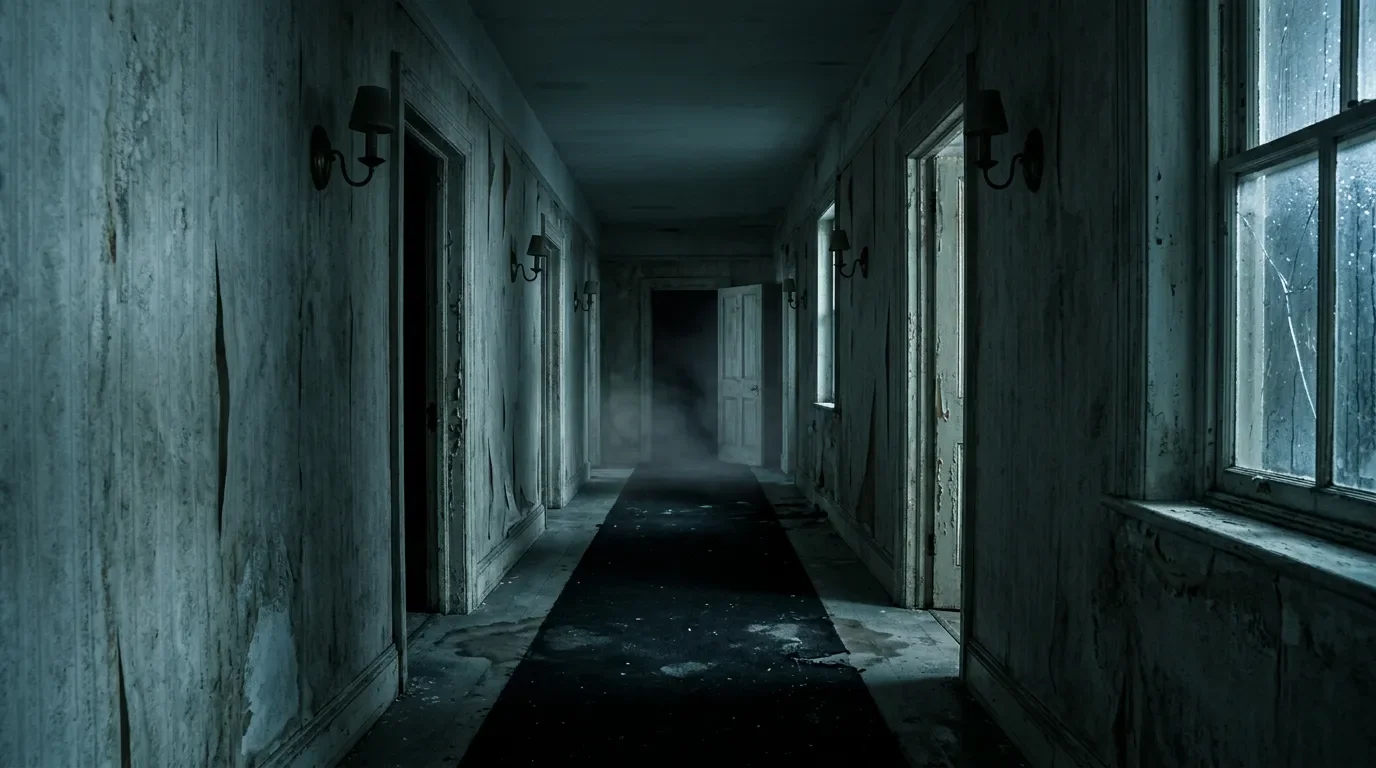
At the first landing, the corridor narrows. Door after door sits along it, each one numbered by a patch of lighter paint where metal once was. The air changes here. It loses the brine of the lobby and becomes close, linen-sour, packed with the smell of closed rooms and damp dust. The silence is not empty. It has grain in it, a soft pressure against the ears.
Under one door, a line of pale fog lies perfectly straight. It does not drift. It holds to the gap as if poured there and left to set. The carpet around it is darker, soaked in a long tongue stretching from the threshold toward the middle of the hall. No other door has this mark. No other part of the corridor is wet.
Farther along, a ceiling panel has sagged open. Black space shows above it, thick and close. A length of insulation hangs down in a grey rope, beaded with water at the tip. Each drop gathers slowly, growing heavy before it falls into a chipped bowl placed beneath the leak. The bowl is full to the rim. Its surface is unbroken.
The sea-facing wing
Past the last bend, the building gives way to the sea without admitting it. The windows look outward through panes filmed white at the corners, and beyond them there is only fog, rain, and the suggestion of a railing eaten thin by rust. The rooms on this side are colder. Their doors stand a fraction open, as if pressure from outside has pushed through the locks and left them tired.
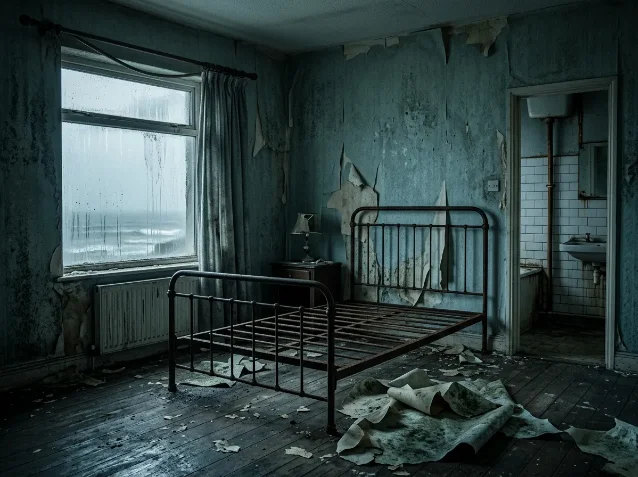
In the first room, the wallpaper has peeled from the outer wall in one broad sheet. It curls on the floor like shed skin, patterned side down. The plaster behind it is mottled green and black, with a vertical crack running from ceiling to skirting board. Near the crack, the wall sweats. Water gathers there without falling, fattening the stain grain by grain.
The bed frame is bare. Springs show beneath a mattress gone concave in the middle, its fabric darkened into a shape that has no clear edge. The curtain rod has bowed from damp, pulling the curtains into a shallow sag. They are stiff with salt. When the wind presses at the glass, the fabric does not move, but the shadows inside its folds deepen and loosen.
The bathroom door has no handle. Tiles inside gleam in a cold strip under the gap. A thin rust line trails from the overflow of the sink and disappears into the drain, where the porcelain has darkened in a perfect circle. The room smells faintly of metal. It is the only room where the air seems recently disturbed, though nothing in it has shifted.
Where the corridor ends
At the far end of the wing, the hallway stops at a set of service stairs descending into a lower dark. The door to them hangs open. Beyond it, the walls change from wallpaper to poured concrete, and the air cools sharply. Moisture beads on the first three steps. Below that, the stairwell disappears.
The sound from underneath is not loud. It is barely sound at all. A slow settling, perhaps. Water moving through a pipe that should be dry. The building gives it up reluctantly, one hollow pulse at a time.
The lobby lights remain dead behind the walls. The sea keeps pressing its weather against the windows. In every room, the damp works deeper into wood, cloth, paper, plaster. The place does not wait. Waiting would require an end to arrive. It only continues: swelling, cooling, darkening, keeping each closed door sealed around the air it has saved.
Editorial note: This is original fiction with no external factual source material. Its genre context is atmospheric horror fiction.
围绕这条内容继续补充观点或上下文。