The book that fits in your palm: a Roman poet's love songs, copied by a student of Rome's most dangerous teacher
Vatican manuscript Ott.lat.2857, digitized June 10, 2026 as part of DigiVatLib's Week 23 batch, is a tiny parchment-and-paper codex (123 × 110 mm, roughly smartphone-sized) containing the complete Tibullus elegies, made around 1475–1500 by a student of the controversial humanist Pomponio Leto — whose semi-secret Roman Academy was once raided by papal order. The manuscript's most striking feature is folio 65v: the poet's epitaph rewritten in capital letters inside a drawn rectangular frame, designed to look like a Roman gravestone. Provenance runs from Fabio Farnese (Knight of Malta) to Fulvio Orsini to Philipp von Stosch before entering the Vatican in 1748.

Hold the Vatican manuscript Ott.lat.2857 and you are holding something roughly the size of a modern smartphone: 123 × 110 mm, a codex small enough to slip into a jacket pocket or tuck inside a student's robe. Inside its 66 folios — a mix of parchment and paper, sewn together and carried through five centuries — are the complete love elegies of Albius Tibullus (c. 55–19 BCE), one of the three canonical Roman love poets, along with a curious addition at the end: a tombstone that never left the page. 1 2
The manuscript was digitized in June 2026 as part of the Vatican Apostolic Library's Week 23 batch, going live on DigiVatLib on June 10. It is now freely viewable online for the first time. 3
A pocket book for a poet's private world
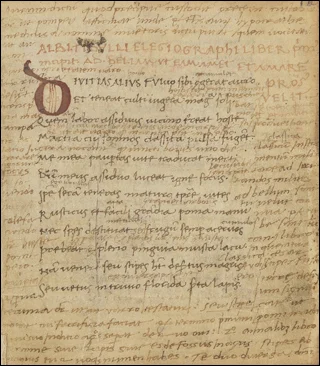
The first page of the main text, folio 2r, opens with a line any Roman student would have recognized immediately: "Divitias alivs fvluo sibi [con]gerat" — "Let others pile up wealth of tawny gold." 3 It is the opening of Tibullus I.1, the poem where the poet declares he wants none of empire or riches, only a small farm and the girl called Delia.
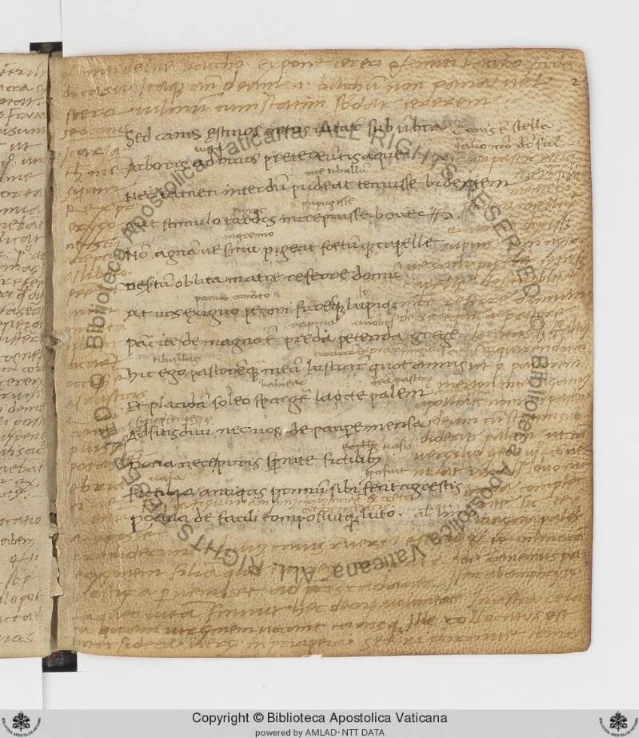
The margins of these early folios are dense with annotations — multiple hands responding to the text, adding glosses, cross-references, corrections. Whoever owned or used this book read it hard. The glosses thin out as the book progresses, a familiar sign: the reader's engagement dropped off, or the annotations were made in stages by different people at different times. 2
The manuscript carries all four books of the Corpus Tibullianum — Books 1 and 2, which are accepted as genuinely Tibullus's own (16 elegies total), plus Books 3 and 4, a later collection that includes six elegies by Sulpicia, the only surviving female voice from the entire classical Roman elegiac tradition. Whether Tibullus's ancient readers drew a sharp line between the two sets of poems is doubtful. This scribe did not.
The teacher behind the hand
The scholar who catalogued this manuscript for the IRHT (Institut de Recherche et d'Histoire des Textes) in 1975 identified something distinctive in the handwriting of folios 13r–14v, 19, and 19v–20v: a particular form of the letter g, written in an uncial style that was a signature of Pomponio Leto and his circle. 2
Julius Pomponius Laetus (1428–1497/98), known in Italian as Pomponio Leto, was the dominant Latin humanist in Rome during the second half of the fifteenth century. Around 1457, he founded the Accademia Romana — a semi-secret intellectual club whose members took Latin names, celebrated pagan Roman festivals (including the birthday of Romulus), and treated Leto as their pontifex maximus. 5 Pope Paul II was not amused. In 1468 he arrested twenty of the Academy's members on charges of paganism, heresy, and plotting against the Church. Leto himself was detained in Venice and extradited to Rome for interrogation. He was eventually released for lack of evidence.
Pope Sixtus IV reinstated him in 1471. The Academy kept meeting until the Sack of Rome in 1527. Among Leto's students was a young man named Alessandro Farnese, who would later become Pope Paul III. 6
The Encyclopaedia Britannica is frank about Leto's scholarly limitations: "Laetus is not regarded highly as a humanist: despite his erudition, the lack of rigour and absence of critical spirit in his method cause his philological achievements to be treated with reserve by modern scholars." As a teacher, though, his impact was considerable — his classroom drew students from across Italy, and the uncial g scattered through their manuscripts is something like a watermark of his influence.
The scribe of Ott.lat.2857 is not named. Among dozens of Leto's students, handwriting attribution is rarely possible without exhaustive comparison. What survives is the letter-form, the anonymous gesture of a trained hand.
The tombstone on the last page
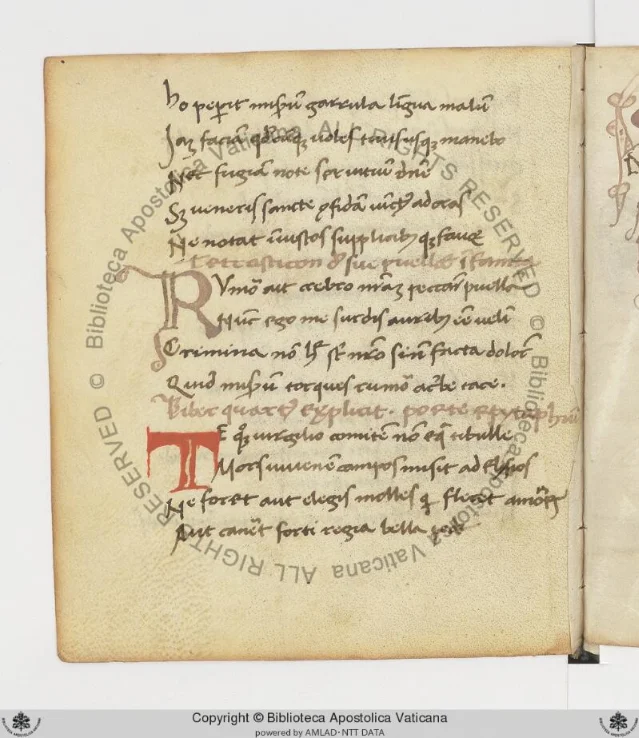
Tibullus died young — around 19 BCE — and the ancient tradition felt the need to mark the fact in writing. After the elegies end at folio 63v with a short prose epitaph by the poet Domitius Marsus, the manuscript goes a step further. 2
Folio 65v is the most striking page in the book. The same two-line text — "Sub teneris annis tenerorum rector amorum / Decedens dura hac ecce Tibullus humo" ("In his tender years, master of tender loves, / Tibullus, dying — here he lies in this hard earth") — has been recopied a second time, but now entirely in capital letters, preceded by the letters D. M. (Dis Manibus, the standard invocation of the Roman dead), and enclosed inside a rectangular drawn frame that mimics the shape of a carved stone monument. 2
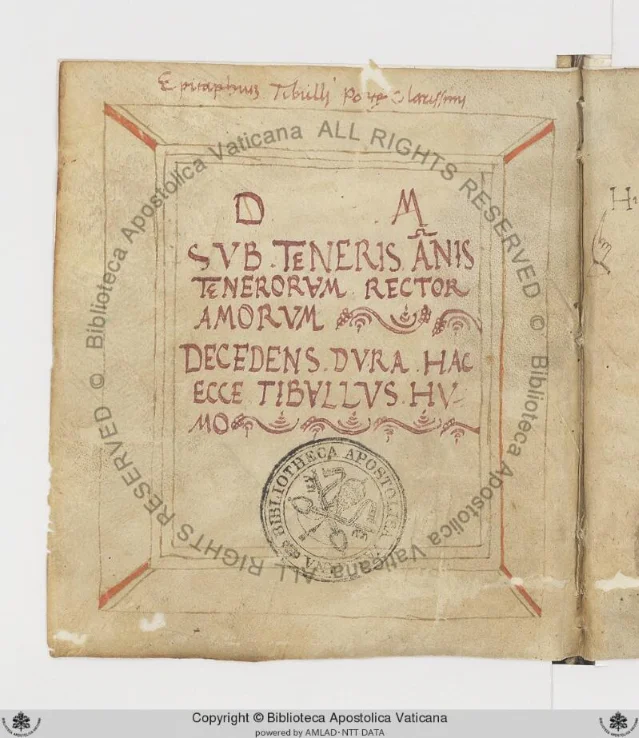
It is an unusual gesture for a manuscript of Latin poetry. The scribe is not just copying a text — they are staging a memorial, translating the conventions of Roman funerary epigraphy onto a page smaller than a postcard. Scholars L. L. Luisides (1954) and F. W. Lenz (1962) both examined this feature in the context of the manuscript's textual tradition, noting the D. M. abbreviation and the tomb-frame as distinctive to this copy among the Tibullus manuscripts they surveyed. 2
Three owners and a library
The manuscript's front flyleaf (f. IIv) carries a partially erased inscription in Greek capital letters: φαβίου τοῦ φαρνεσιου κτῆμα — "property of Fabio Farnese." 2 Fabio Farnese (1547–1579) was a Knight of Malta, a collector with the family instinct for fine objects that the Farnese name carried. He apparently erased his own ex-libris at some point — or someone else did — but not completely enough.
From Farnese, the manuscript passed to Fulvio Orsini (1529–1600), the most important collector of classical Latin manuscripts in sixteenth-century Rome. Orsini's inventory number, "39," is still legible on the same flyleaf. After Orsini's death his collection was dispersed, and Ott.lat.2857 eventually reached Philipp von Stosch (1691–1757), the Prussian antiquarian whose engraved bookplate and shelfmark "C. XXIV" appear on folio 66. In 1748, Pope Benedict XIV purchased the library of the Ottoboni heirs and folded it — along with Stosch's books — into the Vatican collections, where this tiny codex has stayed ever since. 2
Now open on DigiVatLib
The full digital surrogate comprises 148 IIIF canvases — every folio, the spine, all three cut edges, a colorchecker card, and a millimeter scale — made available by the Biblioteca Apostolica Vaticana as part of its Week 23 2026 digitization run. 4 7
The tombstone page is at folio 65v. It is about the same size as a business card.
Cover image: folio 1r of Vatican manuscript Ott.lat.2857, © Biblioteca Apostolica Vaticana — all rights reserved.
参考来源
- 1DigiVatLib — Manuscript Ott.lat.2857
- 2Vatican. Biblioteca apostolica vaticana, Ott.lat.2857 — Biblissima
- 3Vatican Manuscripts Added Week 23 of 2026 — wiglaf.org
- 4IIIF Manifest — MSS_Ott.lat.2857
- 5Julius Pomponius Laetus — Wikipedia
- 6Julius Pomponius Laetus — Britannica
- 7DigiVatLib IIIF Viewer — Ott.lat.2857
围绕这条内容继续补充观点或上下文。