
Pulisic progress, Australia trap: final USMNT checklist before Seattle
A day-before USA vs. Australia briefing: Pulisic has progressed to ball work but still is not fully training, the Group D clinching math is clear, and Australia's low-block counterpunch makes Pochettino's left-side decision the match hinge.

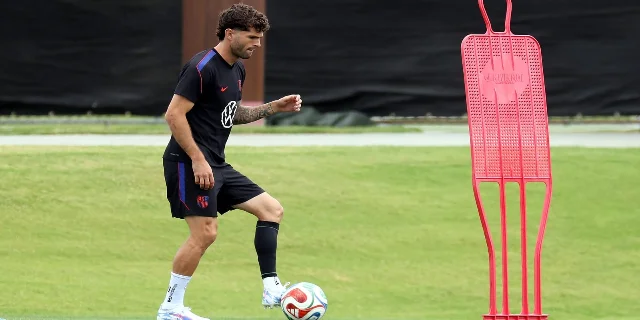
One day out, the USA-Australia preview has finally moved beyond the same old calf-watch loop. Christian Pulisic was seen Wednesday in Irvine kicking a ball with both feet during the media viewing window, but USA TODAY also reported that he remained day-to-day and had not fully trained with the group. 1 ESPN's Thursday match preview still projected him into the USA lineup on the left wing. 2
That is the tension for Friday in Seattle: the Americans can almost close the group early, but the smartest version of that plan may still involve managing their most important attacker.
The match state in one screen
| Question | Current answer |
|---|---|
| When and where? | Friday, June 19, 3 p.m. ET at Lumen Field in Seattle; ESPN lists Felix Zwayer of Germany as referee. 2 |
| What's at stake? | ESPN frames it as a top-of-the-table Group D match after both teams won their openers; it says a win would seal knockout qualification. 2 |
| How can USA win the group early? | MLSsoccer's scenario piece, syndicated by OneFootball, says the USA win Group D with a game to spare if they beat Australia and Türkiye lose or draw against Paraguay. 3 |
| What if the USA draw or lose? | The same scenario piece says a draw pushes final positioning to the June 25 match against Türkiye, while a loss would prevent the USA from winning Group D because of the head-to-head tiebreaker. 3 |
The cleanest U.S. path is obvious. Beat Australia, then hope Paraguay take at least a point off Türkiye. The harder question is how much risk Pochettino should accept to get there.
What actually changed on Pulisic
The new information is not that Pulisic is fully clear. It is that his progression became visible. USA TODAY's Nancy Armour reported that he did ball work Wednesday, wore a sleeve on his left calf, did gym work that included lunges, hopping from one leg to the other and resistance work, and remained on modified workouts. 1
Antonee Robinson put the risk plainly before that session: "He's not been training fully with the group yet, but we still got a couple of days to see where he's at." He added that if Pulisic is not available against Australia, the priority is having him back for the rest of the tournament. 1
That sounds like a minutes decision, not a binary healthy-or-out call. ESPN's projected XI has Pulisic starting, Balogun central and Sergiño Dest on the right wing in a 4-1-2-3. 2 If that projection holds, the first substitution plan matters almost as much as the first whistle.
The tactical hinge is the U.S. left side
The Guardian's Australia-focused preview identifies Pulisic's inverted left-wing role and Robinson's overlapping runs as a linked problem for the Socceroos' right side. 4 That is where the match could tilt if Pulisic starts: Alessandro Circati, Jacob Italiano and Aiden O'Neill may all have to share the job of protecting the same lane.
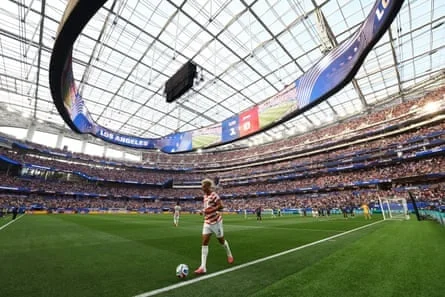
If Pulisic is limited, the U.S. should not simply ask a replacement to mimic him. Tim Weah changes the lane by staying wider and running behind. Gio Reyna changes it by receiving between lines. Brenden Aaronson or Alejandro Zendejas would press and carry, but with a different final-third rhythm. The bench gives Pochettino options, yet none of them recreate the exact Pulisic-Robinson gravity on that side.
That is why Australia's shape matters. ESPN projects Tony Popovic's team in a 5-4-1, with Harry Souttar central, Jordan Bos on the left and Nestory Irankunda wide in midfield. 2 The U.S. may have possession. Australia will try to decide where that possession becomes harmless.
Australia's bet: absorb volume, attack the mistake
Australia's opener explains the plan. ESPN says the Socceroos faced 30 shots against Türkiye, allowed only 1.36 expected goals from those attempts and still won 2-0, with Patrick Beach making eight saves. 2 That is not a model built on open control. It is a model built on forcing bad shots, surviving pressure and waiting for counterattacks.
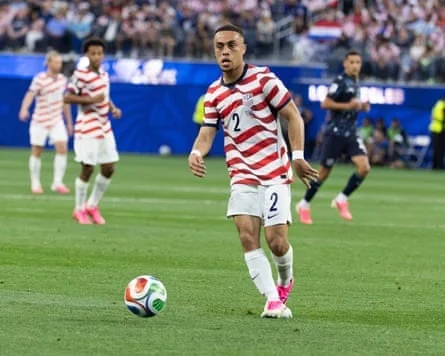
For the U.S., the danger is impatience. The Paraguay win rewarded early speed, high energy and aggressive pressure. Australia will welcome some of that if it creates stretched rest-defense moments behind Dest or Robinson. The Guardian singled out the Dest-Bos duel as one of the game's most compelling matchups, because both can turn a flank into a transition runway. 4
Pochettino's team can still press. It just has to press with an exit plan. If Tyler Adams is left covering too much grass alone, Australia's counter threat becomes more than a scouting note.
Pochettino's decision tree
Three reasonable plans are on the table.
- Start Pulisic, cap the load. This keeps the best left-side pattern intact early, when Australia are most likely to be organized. The tradeoff is that the U.S. needs a pre-planned second-half change before fatigue turns a calf issue into a tactical problem.
- Hold Pulisic for a bench role. This gives the U.S. a late game-breaker if Australia's block survives the first hour. The cost is that the starting XI must create enough left-side threat without its main connector.
- Sit him entirely if the medical staff are not convinced. A draw would not be a disaster because final positioning would still run through Türkiye, but a loss would hand Australia the group-control edge through head-to-head. 3
The first option feels likeliest if Thursday's final internal assessments match ESPN's projected XI. It is also the narrowest path to manage well: aggressive enough to chase the group, cautious enough not to turn June 19 into a medical mistake.
What to watch in the first 20 minutes
- Is Pulisic sprinting or managing? Touches alone will not tell the story. Watch whether he drives at the right side repeatedly or picks moments.
- Does Robinson overlap early? If he stays conservative, that may be a clue that the staff are protecting the left side against counters.
- Where does Dest receive? High and wide pins Bos back. Too high too often gives Australia a release point.
- How soon does Reyna appear if the block holds? His role may be the clearest sign of whether Pochettino sees Australia as a lock to pick or a transition game to control.
The U.S. do not need a perfect game to leave Seattle in control. They need a mature one: enough pressure to make qualification feel close, enough restraint to keep the tournament bigger than one calf and one afternoon.
围绕这条内容继续补充观点或上下文。