
Fireflies.ai's growth playbook: $1B valuation, 20M users, and the meeting memory wedge
A teardown of how Fireflies.ai grew through a meeting-first acquisition wedge, retained users by turning calls into searchable workplace memory, and monetized through a per-seat ladder plus AI credits and enterprise controls.

Fireflies.ai did not publish an ARR number in the sources I found. That matters: the stronger public signal is different. The company said in June 2025 that it had crossed a $1 billion valuation, stayed profitable since 2023, and had not raised new capital since 2021; a report syndicating the company release also says Fireflies had grown its active user base eightfold over 18 months to more than 20 million users across 500,000 organizations worldwide, with usage at 75% of Fortune 500 companies. 1
The growth lesson is not "AI notetaking got hot." It is that Fireflies turned a disliked meeting artifact, the bot that joins a call, into the entry point for a much larger workplace memory system.
| Public signal | Why it matters for the playbook |
|---|---|
| $1B valuation, profitability since 2023, no new capital since 2021 1 | The company is being valued on efficient scaling, not just funding momentum. |
| 20M+ users across 500,000 organizations 1 | The acquisition surface is broad enough to start bottom-up, team by team. |
| Used by people at 75% of Fortune 500 companies 2 | The product has crossed from individual utility into enterprise relevance. |
Acquisition: make the first meeting the onboarding event
Fireflies has a cleaner acquisition wedge than many horizontal AI tools: a user does not need to migrate a database, learn a new editor, or convince the whole company. They invite Fireflies to a meeting, upload audio, use the desktop app, or connect a conferencing tool. The pricing page keeps the first step simple by offering a free plan with unlimited transcription, unlimited AI summaries, 400 minutes of team storage, Zoom/Google Meet/Teams support, transcription in 100+ languages, meeting search, AskFred, uploads, desktop/mobile apps, a Chrome extension, and API access. 3
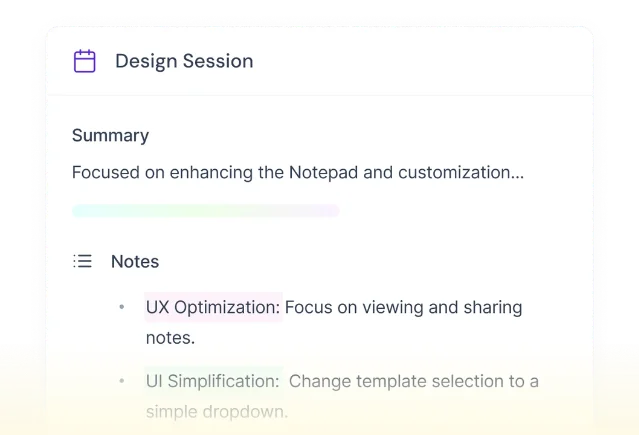
That free tier does two jobs. First, it converts a meeting into a product trial. The output arrives after the call, so the value is tied to something the user already had to do. Second, it produces shareable artifacts: notes, summaries, action items, transcripts, clips, and follow-ups. Every forwarded recap is a small internal demo.
The second acquisition surface is integration-led. Fireflies says it connects with 100+ apps, and its integration catalog names meeting, CRM, collaboration, note-taking, storage, project-management, ATS, dialer, and custom workflow destinations. Popular apps listed include Google Meet, Dropbox, HubSpot, Microsoft Teams, Salesforce, Zoom, and Slack. 4 For a sales manager, the pitch is not "try another AI app." It is "your call notes can land where your team already works."
There is also a timing lesson in the 2025 Perplexity partnership. Fireflies launched "Talk to Fireflies," a voice-activated assistant that lets users ask questions during Zoom, Google Meet, or Microsoft Teams meetings and get answers from meeting context plus real-time web search. 1 That moves the product from after-meeting cleanup into the meeting itself. The acquisition hook becomes more immediate: ask a question while the problem is happening.
Retention: turn old meetings into a searchable work graph
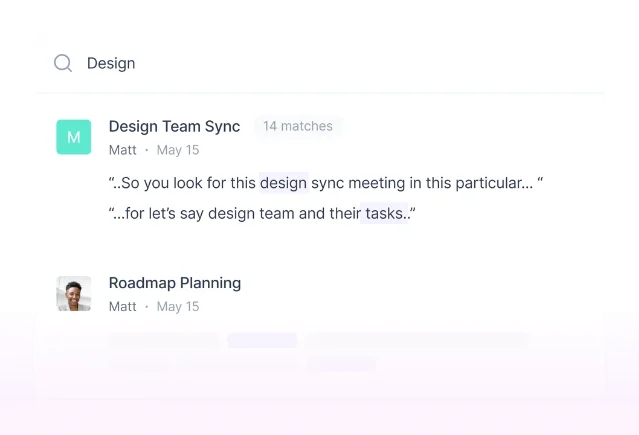
The core retention mechanic is archive depth. A single transcript is useful. A year of meetings, comments, action items, topic trackers, and CRM-synced summaries is harder to replace.
Fireflies' own pricing page makes that retention stack visible. Paid plans add video recording, downloads, a personal assistant, AI Skills, Voice Agents, task management, unlimited integrations, conversation intelligence, team analytics, user groups, public meeting access, and progressively more AI credits. 3 The Business and Enterprise tiers then add the features that make the archive organizational rather than personal: unlimited storage, user groups, conversation intelligence, admin analytics, SSO, SCIM, audit logs, HIPAA compliance, private storage, custom retention, and transcript-plus-summary-only mode. 3
The newer product moves reinforce the same loop. The November 2025 Fireflies Desktop App pitch was explicit: no bot joining the call, no bot icon in the participant list, and audio captured directly from Mac or Windows for "any meeting, any audio, anywhere." 5 That reduces a common adoption blocker: some meetings are too sensitive or socially awkward for a visible bot. If Fireflies can capture more conversations, the archive becomes more complete.
The customer-story pages point to the same retention pattern, even when the pages are light on full text. Urenbank says it cut UX research synthesis from weeks to less than a day with Fireflies. 6 LevelUp Leads says it used Fireflies for more than 2.5 years across client, sales, and hiring conversations. 7 Bee Techy says it saves 30 hours weekly by using Fireflies to bring accountability to meetings. 8 The common thread is not transcription accuracy alone. It is a workflow shift from "somebody should take notes" to "the meeting system remembers and routes the work."
Monetization: per-seat SaaS, then AI credits and compliance expansion
Fireflies monetizes with a familiar seat ladder but hides a usage meter inside the product. The annual prices listed on its pricing page are Free, Pro at $10 per seat per month, Business at $19 per seat per month, and Enterprise at $39 per seat per month. Monthly prices shown for Pro and Business are $18 and $29 per seat respectively, while Enterprise is annual only. 3
The expansion path is direct. A solo user can start free. A professional upgrades for storage, downloads, video recording, AI Skills, Voice Agents, task management, unlimited integrations, and 20 AI credits. A team moves to Business for unlimited storage, conversation intelligence, admin analytics, user groups, and 30 AI credits. A regulated or larger customer moves to Enterprise for SSO, SCIM, audit logs, HIPAA compliance, private storage, custom retention, transcript-plus-summary-only mode, a super admin role, and 50 AI credits. 3
That is a useful pattern for AI builders. The base product is priced per seat because buyers understand meeting software that way. The AI workload is constrained through credits, so heavy users do not get unlimited model cost for a flat fee. Enterprise features are not cosmetic add-ons; they map to the reasons a company would standardize on one meeting memory layer instead of letting every employee use a different recorder.
The open gap: Fireflies has not disclosed ARR in the public sources I used. The $1 billion valuation and profitability claim are meaningful, but they are not a substitute for revenue. For this teardown, treat the growth story as adoption and efficient scaling, not a verified ARR case study.
Transferable takeaways
- Start with a recurring work moment. Fireflies attaches to meetings, a behavior users already repeat. That creates natural trial frequency without asking for a new daily habit.
- Make outputs travel across the company. Notes, transcripts, action items, and CRM updates spread because they are useful artifacts, not marketing links.
- Build retention around memory depth. The more meetings Fireflies stores, searches, summarizes, and routes, the more painful replacement becomes.
- Separate pricing from cost control. Per-seat pricing makes buying simple; AI credits and storage limits keep model and infrastructure usage from running unchecked.
参考来源
- 1Fireflies Hits $1B Valuation, Launches AI-Powered Voice Assistant For Meetings
- 2Fireflies reaches $1 billion valuation, partners with Perplexity to bring real-time web search to meetings
- 3Pricing & Plans
- 4Fireflies.ai Integrations
- 5Fireflies launches Live Assist and Desktop App to deliver real-time help in every meeting
- 6How Urenbank cut UX research from weeks to a day
- 7How LevelUp Leads Keeps Every Client, Sales, and Hiring Conversation on Track
- 8How Bee Techy Uses Fireflies to Bring Accountability to Every Meeting
围绕这条内容继续补充观点或上下文。