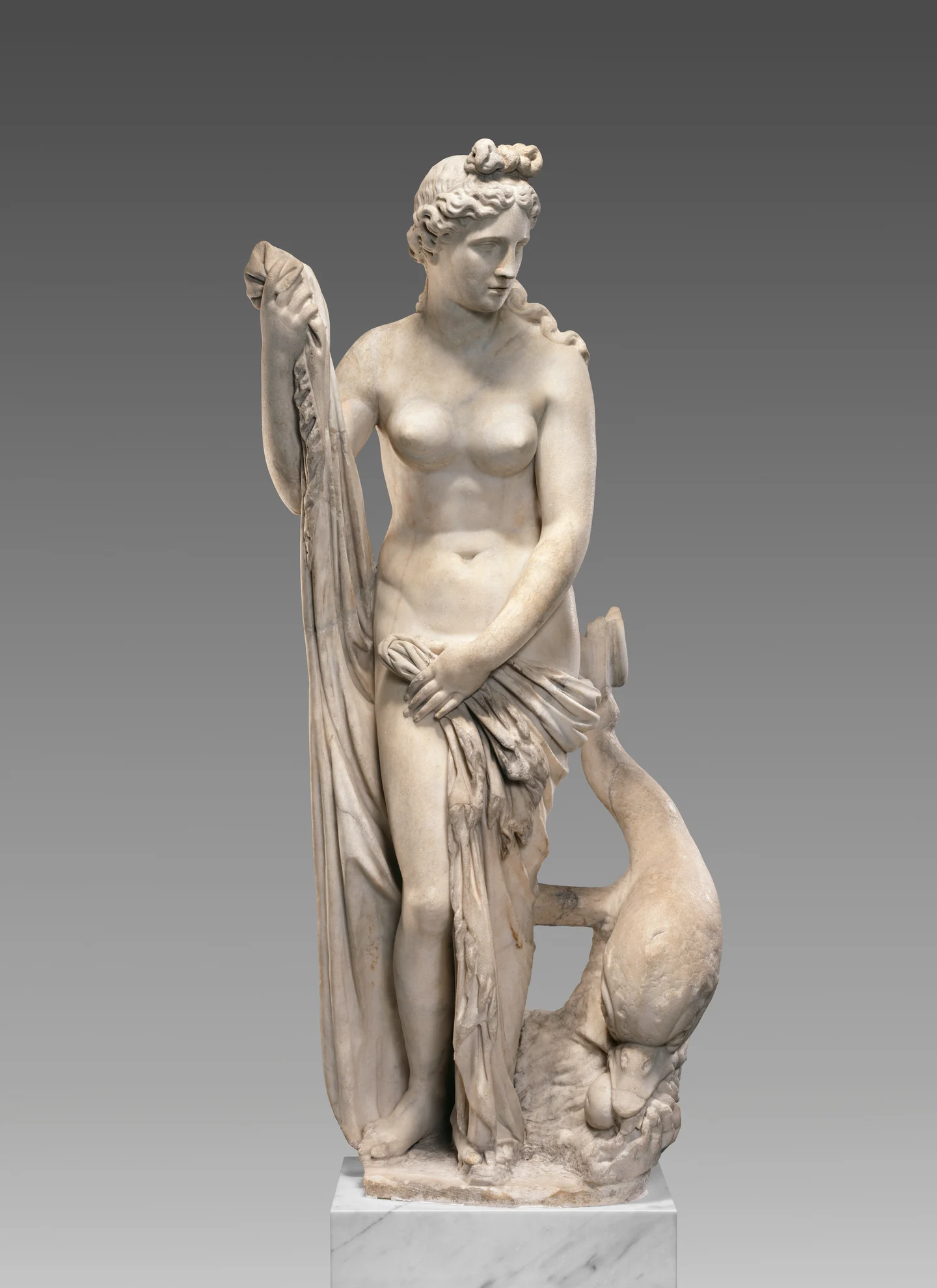
The Name Wasn't Mazarin's: How Rome's Most Traveled Venus Became Getty's First Antiquity
A richly narrative deep-dive tracing the Mazarin Venus (Getty Villa acc. 54.AA.11) from Praxiteles' scandalous fourth-century BC bronze at Knidos through its rediscovery in Raphael's Rome, its 250-year provenance void, documented passage through Beaujon's Paris estate and Sir Francis Cook's Doughty House, to J. Paul Getty's first antiquity purchase in 1954. The article decodes the pudica iconography, the dolphin's structural and symbolic double role, and why the 'Mazarin' name is almost certainly wrong but will not go away.

In the spring of 1954, a California oil billionaire named J. Paul Getty made a purchase that his accountants probably recorded as a routine line item. He paid an undisclosed sum to a Paris-and-Geneva dealer named Nicolas Koutoulakis for a Roman marble statue of Venus. The sculpture was 184 centimeters tall — just over life-size — and had been photographed, auctioned, catalogued, and passed between English country houses and Parisian townhouses for at least a century. It carried a grand name: the Mazarin Venus, so called in honor of Cardinal Jules Mazarin, the French statesman who had served as chief minister to Louis XIV. 1
There was only one problem with that name. Cardinal Mazarin almost certainly never owned it. 2
That gap between the sculpture's fame and its actual history is where its real story lives. The Mazarin Venus — accession number 54.AA.11 at the Getty Villa, Malibu — is a work built on layers of misdirection: a name that is almost certainly wrong, a provenance chain with a 250-year void, a body that may include at least one head borrowed from an entirely different ancient statue, and a myth about gunshot wounds that the Getty's own curators now call more romance than fact. Yet it also has a documented story of genuine weight — a story stretching back to second-century Rome, resurfacing in the Rome of Raphael, and arriving at last in Malibu as the founding purchase of what would become one of the world's great antiquities collections.
Before the marble: Praxiteles and the scandal at Knidos
The Mazarin Venus is a Roman marble copy, produced roughly in the second century AD, of a sculptural type that had been sending shock waves across the Mediterranean for five hundred years before any Roman workshop touched a chisel to it. 3
The source of all the trouble was an Athenian sculptor named Praxiteles (active c. 375–330 BC). Around 350 BC, working on a commission for a cult statue for the island city of Knidos, he did something that had no precedent in Greek monumental art: he rendered the goddess Aphrodite entirely nude, life-size, in marble. 4 Carolyn M. Laferrière, curator at the Princeton University Art Museum, describes the moment succinctly: "Praxiteles, an Athenian sculptor active in the mid-fourth century BCE, inadvertently caused a scandal across the Mediterranean when he created a life-size statue of the goddess Aphrodite for her temple on the island of Knidos." 4
The Knidians displayed the statue in an open colonnade — a monopteros — so that visitors could walk all the way around it, an arrangement unprecedented for a cult image. The effect was immediate and not entirely decorous. Pliny the Elder, writing in the first century AD, preserved an account in his Natural History of a young man so overwhelmed by the statue that he broke into the sanctuary at night; the stain he left on the marble was still visible in Pliny's time. 3 Ancient epigrams competed to capture the statue's hold on the imagination. Antipater of Sidon wrote: "Paris, Adonis, and Anchises saw me naked. Those are all I know of, but how did Praxiteles contrive it?" 3
The Knidia's fame grew to the point where Nicomedes I of Bithynia offered to cancel the city's entire national debt in exchange for the statue. The Knidians refused. 3 The original bronze was taken to Constantinople sometime in the fourth century AD and destroyed in the fire of the Palace of Lausos in 476 AD. 3 It survives today only through copies — art historian Kristen Seaman catalogued 192 surviving ancient versions in 2004.
The Mazarin Venus is one of them. It does not copy the Knidia directly; the Getty's curators describe it as "a Roman reproduction of one of those Hellenistic variants" — an adaptation several generations removed from Praxiteles, not a mechanically faithful replica but a creative reworking of the theme. 1 The Getty itself notes: "Indeed Praxiteles's statue was so popular that, beginning around 100 B.C., many artists created variations on his theme of the naked Venus." 1
Reading the marble: what the sculpture actually looks like
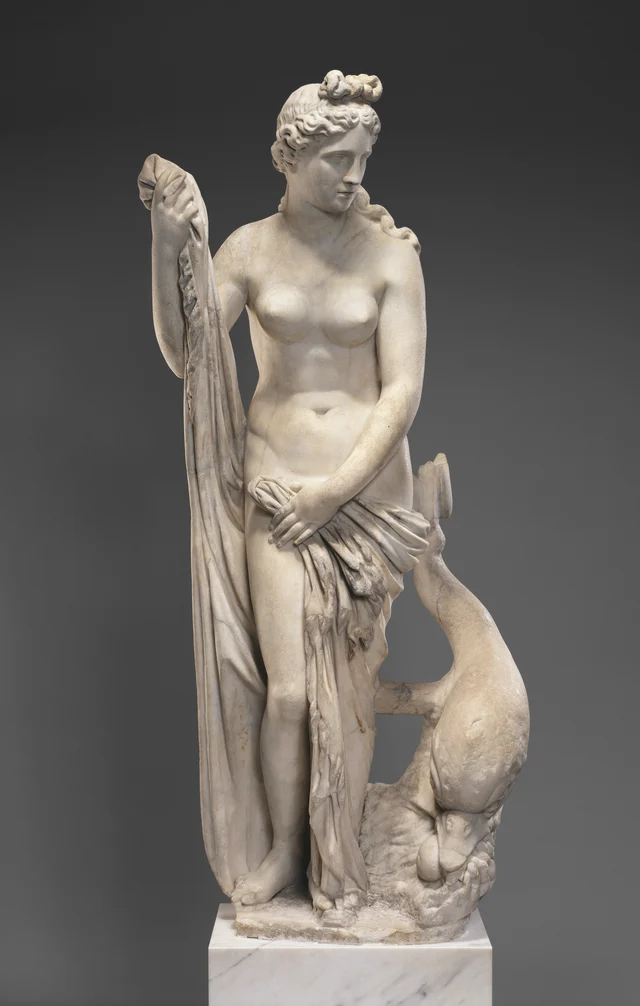
Stand before the Mazarin Venus in Gallery 106 of the Getty Villa and you are looking at a figure just slightly taller than a tall modern woman. The marble is fine and white, its grain tight enough to render the cloth against the hips as nearly translucent — the so-called wet drapery technique, in which the sculptor carves fabric as though it has been soaked through, clinging to the forms beneath. The figure's weight rests on the right leg; the left knee is bent and relaxed, creating the S-curve contrapposto that Praxiteles appears to have invented and that every sculptor after him borrowed. 5
The pudica gesture — Venus pudica, "modest Venus" — organizes the whole composition. The left hand drops toward the groin, partially covering it; the right hand holds the gathered drapery at hip level. The art historian Christine Mitchell Havelock argued that this gesture established "a canon for the proportions of the female nude" that Western art never fully escaped. It also carries a built-in paradox that scholars since have noted: the act of concealment draws the eye directly to what is being concealed, creating a tension between modesty and display that is the real subject of the type. This ambiguity — is the goddess reaching for her garment or putting it down, arriving at her bath or leaving? — was present in the original Knidia and persists here.
At the figure's right ankle, a dolphin curves upward, its body pressing against the leg. The dolphin carries two simultaneous meanings. As iconographic attribute, it refers to Venus Marina — the sea-born goddess who rose from the foam off Cyprus — and to the aquatic creatures that conventionally escort her. 1 As structural engineering, it solves a problem Praxiteles never had: bronze is self-supporting, but marble is not, and the unsupported weight of a marble leg and hip needs something to brace against. Roman workshops solved this consistently by elaborating the strut into a symbolic object — a tree trunk, a hydria (water jar), a Cupid figure, or, here, a dolphin. As Laferrière observes: "Struts were often necessary in Greek and Roman marble sculptures to offset and hold up the weight of the heavy stone. While the strut frequently took the shape of a tree trunk or rectangular block, here it has been elaborated into a figural scene that thematically relates to the goddess." 4
The head tilts slightly, the gaze angled downward and to one side — an expression of composed interiority, neither inviting nor rejecting. The hair is caught in a loose bun with curling tendrils framing the face.
What the marble does not entirely show you is how much of it is restoration. The breasts, parts of the cloth, the arms, and the dolphin are all replaced — probably in the eighteenth or nineteenth century. The head, according to the Getty's own curatorial notes, "may belong to another ancient statue." 2 The back of the figure shows marks that nineteenth-century writers interpreted as gunshot wounds from the Revolution of 1793 — a romantic idea that the Getty now describes as "based more in romance than in fact." 2 The marks remain; their origin is unconfirmed.
A family portrait: where the Mazarin Venus fits among Venus types
To understand what kind of object the Mazarin Venus is, it helps to see it alongside its relatives.
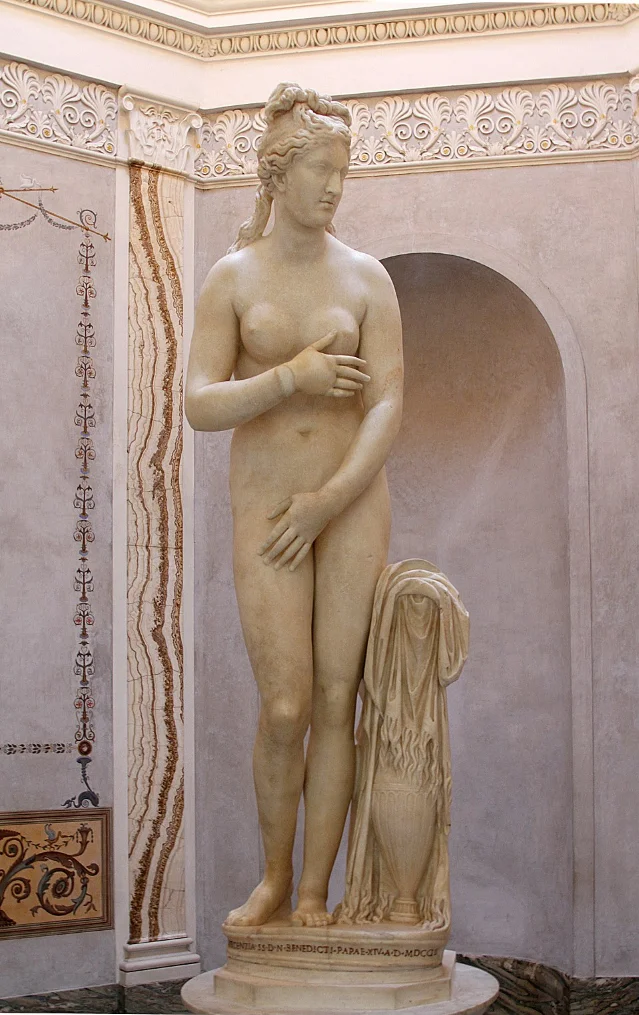
The Mazarin Venus belongs to what scholars classify as the Venus Pudica, Knidian one-hand variant: left hand at the groin, right hand holding drapery. This distinguishes it from the Capitoline Venus (both hands cover the body, no drapery) and from the Venus de' Medici (Uffizi, Florence), which also uses both hands but shares the dolphin attribute. 5 The Venus de Milo (Louvre, c. 150–125 BC) belongs to a wholly different typological lineage, possibly the Capuan Venus, and is not related to the Praxitelean tradition in any close sense. 6
What all these variants share is a debt to the Knidia's single conceptual invention: the goddess caught in a private moment, aware of being watched but unable to dismiss the audience. The closest surviving copy of the Praxitelean original is the Colonna Venus, now in the Vatican Museums.
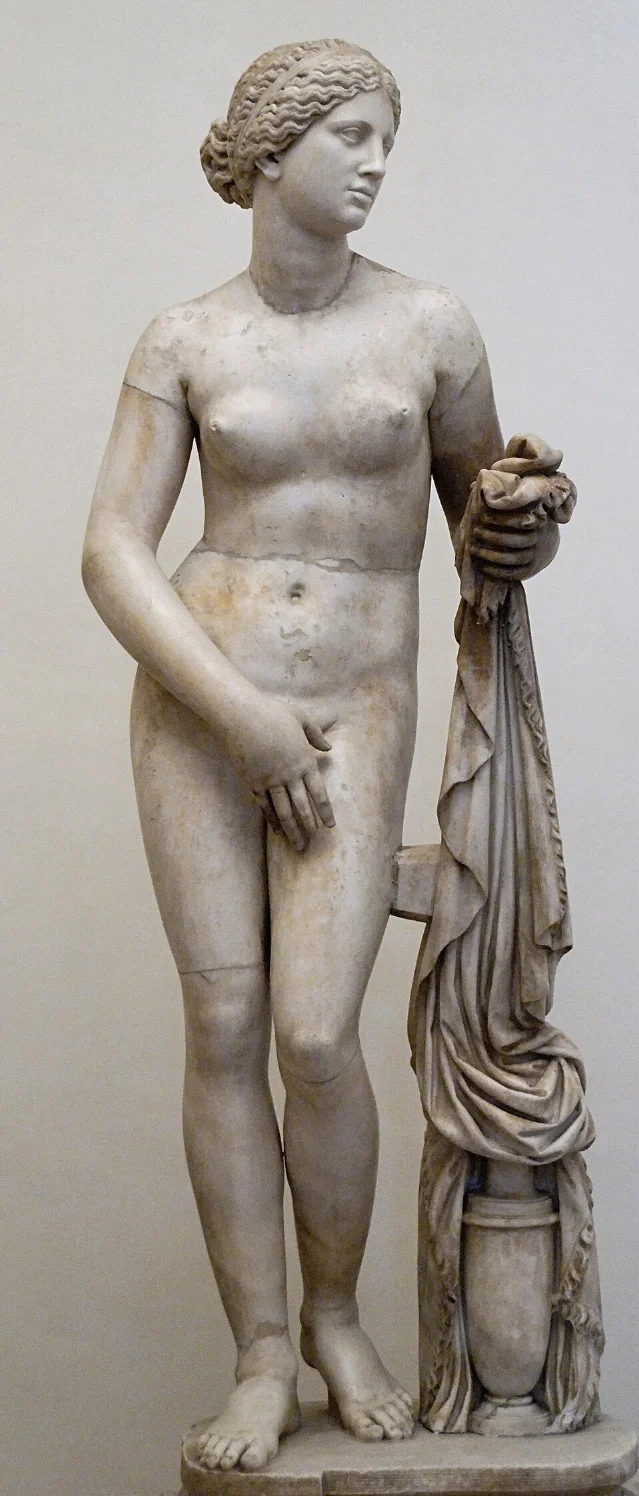
The second century AD — the Hadrianic-Antonine period (117–192 AD) — was the high-water mark of Roman marble copy production. Wealthy villa owners, bath patrons, and garden designers commissioned Greek-inspired sculptures in enormous quantities. The quality ranged from fine workshop productions for connoisseurs to mass-produced garden ornaments. The Mazarin Venus, despite its substantial restorations, falls at the upper end of that spectrum: at 184 cm it is slightly over life-size, implying a significant commission, and the unfinished state of the back suggests it was designed for niche or wall placement, not freestanding display. As Laferrière describes the broader phenomenon: "By the second century CE, when the Roman Empire had expanded to include the Greek world, such copies proliferated as artists creatively experimented with new compositions." 4 The sculptor was almost certainly a Greek artisan working in a Roman workshop — the signature "Menophantos" on a closely related variant confirms Greek craftsmen were active in this trade.
In that Roman setting, a Venus Pudica of this size would have served simultaneously as luxury display (advertising the owner's Hellenic taste), political reference (the Cupid-dolphin motif had become Augustan shorthand since the first emperor traced his lineage through Aeneas, son of Aphrodite, back to the goddess herself 4), and domestic cult image in a polytheistic household.
The first document: Rome, 1509 or 1510
The Mazarin Venus disappears from history for roughly fifteen hundred years — from the moment of its creation to its rediscovery — and then suddenly reappears in a print.
Around 1509 or 1510, a Brescian printmaker named Giovanni Antonio da Brescia made an engraving of a standing Venus with a dolphin, inscribed at the bottom: ROME NOVITER REPERTVM — "newly found in Rome." 1 This is the earliest known document of the sculpture's existence, and it places its rediscovery in one of the most intensely creative moments in Western art history.
Raphael (1483–1520) was in Rome from 1508 until his death. In 1508 he began the Vatican Stanze for Pope Julius II; by 1511 he was painting the Triumph of Galatea at the Villa Farnesina, the suburban pleasure palace of Agostino Chigi, the Sienese banker who was the wealthiest man in Rome. The Farnesina was saturated with Venus imagery — the Loggia of Cupid and Psyche (c. 1517), the bedroom frescoes — and Chigi's collection of antiquities was programmatic, assembled to create what one later scholar called a "Palace of Venus." 7
David Lung Clark's 2005 study "Raphael's Fornarina: Venus Pudica or Venus Aphrodisia?" (in Konsthistorisk Tidskrift) argues directly that the Mazarin Venus influenced Raphael's famous nude portrait La Fornarina (c. 1518–1519), identifying it among the antique sources Raphael would have known and drawn from. 8 Phyllis Pray Bober and Ruth Rubinstein's authoritative handbook Renaissance Artists and Antique Sculpture (1986) catalogued the sculpture as antique source no. 15 for Renaissance artists — confirmation that it was actively studied and drawn by Raphael's contemporaries. 8
Raphael died in 1520, leaving the Farnesina decorations unfinished. By then the Mazarin Venus had already entered the visual language of the High Renaissance. Where it went next is unknown.
The provenance void: 250 years of silence
The sculpture's documented history from c. 1510 to the mid-eighteenth century is a blank. No inventory among the great Roman collecting families — the Borghese, the Ludovisi, the Farnese, the Giustiniani — has been found that corroborates the sculpture's whereabouts. 1
The Cardinal Mazarin association — the name that has clung to the sculpture for a century and a half — appears to be a fabrication, or at least an unsubstantiated legend. Jules Mazarin (1602–1661), the Italian-born statesman who served as Louis XIV's chief minister and built one of the great collections of the seventeenth century, does have the kind of biography that would have led him to a fine Roman marble Venus: he was an obsessive collector, his collection eventually formed the core of the Bibliothèque Mazarine in Paris, and he was famously surrounded by art. But the Getty's own provenance research has found no corroboration: "Although historically associated with the collection of Cardinal Jules Mazarin (1602–1661), the earliest known publication of this provenance is in 1863, and it has not yet been corroborated by Mazarin's inventories." 1 A metal base inscribed "Venus de Mazarin" was added to the sculpture by the late nineteenth century, cementing the association in the public mind, but that base has since been removed. 8
The earliest reliable owner the Getty has been able to identify is Nicolas Beaujon (1718–1786), a Paris financier and tax farmer who built the estate known as La Chartreuse on the Rue du Faubourg Saint-Honoré, with elaborate gardens he called the Folie-Beaujon. Beaujon assembled a celebrated art collection; the sculpture was first published in 1853 under the name "Venus de Folie-Beaujon," suggesting a long association with his estate, though it has not been confirmed in his personal inventories. The Getty notes: "More probable is the acquisition of the Venus by Nicolas Beaujon, who built the Chartreuse and the Folie-Beaujon gardens in the mid-18th century." 1
The documented chain: from Gudin to Surrey to Malibu
From 1853 the provenance is clear. The sculpture was then in the collection of Jean Antoine Théodore Gudin (1802–1880), the French marine painter and a favorite of Louis-Philippe, at La Chartreuse in the Folie-Beaujon district. On March 22, 1866, Gudin sold it at auction in Paris. 8
The buyer was Sir Francis Cook, 1st Viscount of Monserrate (1817–1901), a British textile merchant who assembled one of the most important private collections of antiquities in Victorian England at Doughty House in Surrey — a house that also held Velázquez's The Toilet of Venus and Giorgione's The Adoration of the Magi. The German archaeologist Adolf Michaelis catalogued the Venus there in his Ancient Marbles in Great Britain (1882), giving the sculpture its first systematic scholarly treatment. 9 Eugenie Strong published it again in the Journal of Hellenic Studies in 1908. The Cook collection remained at Doughty House through the early twentieth century, one of the last great private antiquity holdings in England.
In 1947, the Cook family sold the Venus to Spink & Son, Ltd., the London dealers who also handled other antiquities transactions for Getty. The sculpture passed briefly to a French private collection around 1948 before being acquired by Nicolas Koutoulakis, a dealer with offices in Paris and Geneva who was among the most significant figures in the mid-century antiquities trade. The RIHA Journal's 2023 study on antiquities networks during and after the Nazi era, by scholar Irene Bald Romano, notes that "J. Paul Getty also bought the Roman Mazarin Venus (54.AA.11) directly from Koutoulakis in 1954." 10
Getty's first purchase: 1954
J. Paul Getty (1892–1976) had spent the first decades of his collecting life focused on seventeenth- and eighteenth-century French decorative arts — Sèvres porcelain, Beauvais tapestries, Louis XIV and Louis XV furniture. He bought the Mazarin Venus in 1954 as his first antiquity acquisition, a pivot that would eventually reshape both his collecting identity and the institution that bears his name. Ron Reznick, who documented the Getty Villa's ancient sculptures in detail, writes: "It was bought by J. Paul Getty in 1954 as the first antiquity acquired specifically for his museum." 11
The accession number encodes the date: 54.AA.11. The "54" prefix records the year of acquisition in the Getty system.
Getty would go on to purchase the Crouching Venus (55.AA.10) through Spink & Son the following year, and eventually the Lansdowne Herakles, the Getty Kouros, and hundreds of other Greco-Roman works. The Mazarin Venus preceded all of them. When the Getty Villa opened on the Pacific Coast Highway in Malibu in 1974 — a full-scale recreation of the Villa dei Papiri, the ancient Roman villa buried by Vesuvius near Herculaneum — it had been designed partly as a house for sculptures like this one. Getty died in 1976, two years after the Villa opened, and never lived to see the institution fully take shape.
Where it stands now: Gallery 106, the Basilica
The Mazarin Venus has occupied several positions within the Getty Villa since 1974. It currently stands in Gallery 106, the room the museum calls the Basilica, on the north side of the Inner Peristyle. The architectural setting is deliberate: the Basilica reproduces a room from the Villa dei Papiri, with eight white marble columns dividing the space into a wide nave and two side aisles, a vaulted apse at the far end. It is designed to evoke a private Roman reception hall — which is to say, the approximate kind of setting in which a Venus Pudica like this one might have originally stood. 12
The statue's current placement in Gallery 106 dates to around 2011, when a far more famous sculpture — the Cult Statue of a Goddess (the so-called Morgantina Venus, a cult image in terracotta) — was repatriated to Italy following a legal agreement between the Getty and the Italian government. After that departure, the Mazarin Venus was moved to a more prominent position in the room. A blogger who covered the transition at the time noted, with something like candor: "In her place the Getty has placed the Mazarin Venus, a smaller and less-clothed sculpture. While she is pretty, she doesn't anchor the room quite like Cult Statue of a Goddess did." 13 The observation is honest, and it captures something real about the difference between a cult statue — an object made to be worshipped — and a luxury copy made to be admired.
170 years of scholarship: what the Mazarin Venus means to the field
The sculpture's scholarly life has been long and consistent. It received a catalogue entry in the Lexicon Iconographicum Mythologiae Classicae (1984) as Aphrodite no. 756. It appears in Francis Haskell and Nicholas Penny's Taste and the Antique: The Lure of Classical Sculpture 1500–1900 (Yale, 1981), still the standard work on the reception history of classical sculpture. Michaelis catalogued it in 1882; Eugenie Strong in 1908; Getty's own bibliography now runs to more than fifty entries spanning from 1853 to 2023. 1
The most recent major appearance was in the Getty's 2021–2022 exhibition Rubens: Picturing Antiquity, which documented Peter Paul Rubens's engagement with classical sculpture and confirmed that the Mazarin Venus's influence extended well beyond the immediate moment of its Renaissance rediscovery into the Baroque. Rubens drew from sculptures like this one; those drawings fed his monumental paintings of Venus and mythological nudes. The sculpture that slid into Roman mud in the second century AD and was pulled back out around 1510 was still shaping European art's visual vocabulary four hundred years after its rediscovery.
The "Mazarin" name, despite its inaccuracy, has proven unmovable. Getty curators acknowledge it directly: "Scholars once believed that this statue was owned by Cardinal Mazarin, advisor to Louis XIV, king of France. Although this is unlikely, the statue is still known to many as the Mazarin Venus." 2 The name is a palimpsest of a reputation — the real history written over by a false one, the false one too well established to erase.
Judith Barr's 2019 study of the sculpture as a "provenance palimpsest" noted that the very persistence of the Mazarin name illustrates how appellations shape perceived value: linking a work to a famous historical figure inflates its mystique regardless of whether the connection is real. The sculpture's true name — "Venus de Beaujon" or "Venus de Folie-Beaujon," from the first reliable owner — was never glamorous enough to stick. Cardinal Mazarin's name was.
An open question in white marble
What the Mazarin Venus carries, beyond its beauty and its restorations and its name problems, is the accumulated evidence of a particular kind of ancient desire — the Roman passion for owning the Greek world's aesthetic accomplishments in durable white stone, translated, adapted, and made permanent for the next generation's garden or bath or reception hall.
The dolphin at its feet is both the goddess's sea-creature and the engineer's solution to a physics problem. The gesture that pretends to modesty creates desire instead. The head may belong to a different body entirely. Two hundred and fifty years of its life are unaccounted for. Its name belongs to a man who probably never saw it.
None of that makes it less than what it is: the first object J. Paul Getty bought when he decided to stop collecting French furniture and start collecting ancient Rome. Whether he knew the name was wrong, we cannot say. The purchase price was never disclosed. The accession number says 1954. The marble says second century.
The marble has been saying the same thing for nearly two thousand years.
Cover image: J. Paul Getty Museum, Statue of Venus (the Mazarin Venus), accession 54.AA.11, 2nd century AD Roman marble, 184 cm. Getty Open Content Program.
参考来源
- 1The J. Paul Getty Museum: Statue of Venus (the Mazarin Venus)
- 2Google Arts & Culture: Statue of Venus (the Mazarin Venus)
- 3Wikipedia: Aphrodite of Knidos
- 4Princeton University Art Museum: The Museum Acquires a Notable Roman Sculpture of Venus (2025)
- 5Wikipedia: Capitoline Venus
- 6Wikipedia: Venus de Milo
- 7Wikipedia: Villa Farnesina
- 8Wikipedia: Mazarin Venus
- 9Grokipedia: Mazarin Venus
- 10RIHA Journal 0282 (2023): Antiquities in the Nazi Era — Irene Bald Romano
- 11Digital Images: Ancient Sculptures of the J. Paul Getty Museum
- 12Nile Scribes (2020): A Roman Villa in California: the Getty
- 13Exhibition Inquisition (2011): Mazarin Venus tag
围绕这条内容继续补充观点或上下文。