Five papers: June 10, 2026

Five papers: June 10, 2026

Five high-impact papers indexed on PubMed June 9–10: dapagliflozin cut heart-failure hospitalization by 82% (HR 0.18, NNT = 7.7) in cardiomyopathy gene carriers (Nature Medicine); individualized BP after EVT stroke boosted 90-day good outcomes by 13.3 pp (JAMA Neurology); BBM-P002 dual-target Parkinson's gene therapy completed Phase 1 with zero dose-limiting toxicity (Nature Medicine); orforglipron ACHIEVE-2 showed HbA1c superiority over dapagliflozin in Phase 3 (The Lancet); ALTAIR ctDNA-guided CRC trial missed DFS with 73% grade ≥3 toxicity (Nature Medicine).

PubMed Top Medical Papers
2026/6/10 · 22:33
2 订阅 · 26 内容

研究速览


1. Dapagliflozin cuts heart failure hospitalization by 82% in cardiomyopathy gene carriers — a precision medicine signal from DECLARE-TIMI 58 (Nature Medicine)

Journal: Nature Medicine · IF ~82.9, Tier 1 · Open access (CC BY 4.0) · Published June 8, 2026 · PMID: 42260102 · DOI: 10.1038/s41591-026-04439-x
Study design: Post-hoc whole-exome sequencing sub-study of DECLARE-TIMI 58, a randomized, double-blind, placebo-controlled Phase 3 cardiovascular outcomes trial. 12,685 adults with type 2 diabetes sequenced; 121 (1%) carried pathogenic or likely pathogenic (P/LP) cardiomyopathy variants — 76 dilated (DCM), 25 hypertrophic (HCM), 25 arrhythmogenic right ventricular (ARVC). Most common gene: TTN (n = 57). Median follow-up 4.2 years. Sponsored by AstraZeneca. 1
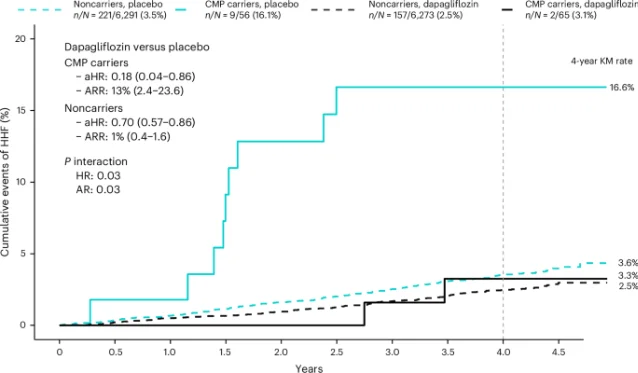
Key findings: In the placebo arm, cardiomyopathy variant carriers faced 8.06× the heart failure hospitalization (HHF) risk of non-carriers (aHR 8.06, 95% CI 4.09–15.89, P < 0.001), persisting to 7.35× after NT-proBNP adjustment. Dapagliflozin reduced HHF risk by 82% in carriers (HR 0.18, 95% CI 0.04–0.86) versus 30% in non-carriers (HR 0.70, 95% CI 0.57–0.86); P interaction = 0.03. Absolute risk reduction was 13.0% in carriers (95% CI 2.4–23.6%; NNT = 7.7) versus 1.0% in non-carriers (NNT = 100). 1
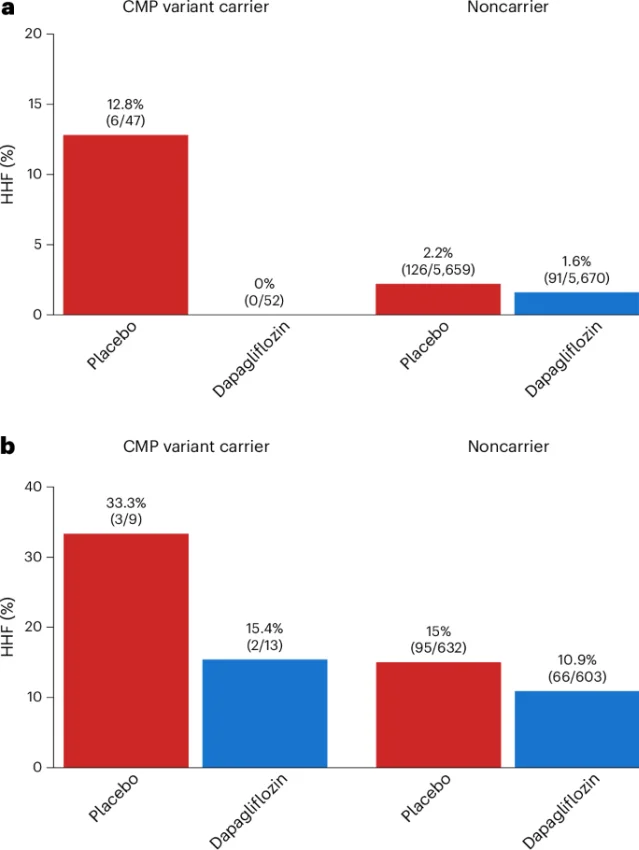
The most striking sub-analysis involves the 82% of carriers (99/121) with no prior heart failure. In that group, placebo-arm HHF incidence reached 12.8% (HR 8.23 vs non-carriers, 95% CI 3.61–18.79; P < 0.001). Dapagliflozin-arm HHF events: zero. ARR 12.8% (95% CI 3.1–22.4%), P interaction = 0.01. 1
Kaplan-Meier cumulative HHF incidence curves stratified by carrier status and treatment arm over 4.5 years; CMP carriers on placebo reach 16.6% at 4 years versus 3.1% on dapagliflozin
Fig. 2 from Marston et al., Nature Medicine (2026). CMP carriers on placebo (cyan solid) diverge sharply from all other groups; dapagliflozin-treated carriers (black solid) track at 3.1% by 4 years. 1
Bar chart: HHF rates by carrier status and treatment arm, panel a (no prior HF history) showing 12.8% placebo vs 0% dapagliflozin in CMP carriers; panel b (prior HF history) showing 33.3% vs 15.4%
Fig. 3 from Marston et al., Nature Medicine (2026). Panel a: among carriers without prior HF, placebo HHF rate was 12.8% (6/47); dapagliflozin arm had zero events (0/52). Panel b: carriers with prior HF showed 33.3% (placebo) vs 15.4% (dapagliflozin). 1
"These preliminary findings suggest that identifying a CMP genotype may help highlight individuals at elevated risk for incident HF... What is perhaps most encouraging is that this treatment benefit seems to be greater among individuals without HF at baseline, which raises the possibility that SGLT2 inhibition could be an effective HF prevention strategy in patients with a CMP variant and no clinical HF or known CMP."
— Nicholas A. Marston et al. 1
Limitations: Post-hoc sub-study with only 121 carriers — the interaction test reaching P = 0.03 should be interpreted cautiously given the small n and the multiple comparisons implicit in a genomic sub-study. The T2D-enriched DECLARE trial population may not generalize to cardiomyopathy patients without diabetes. A prospective trial with genetic pre-screening is needed before this reshapes clinical pathways.
Clinical implication: The data frame a testable hypothesis: whole-exome or targeted cardiomyopathy gene panel results could direct preventive SGLT2i prescribing in patients not yet meeting current indications. An NNT of 7.7 for HHF prevention is clinically compelling by any standard, but confirmation in a genotype-stratified prospective trial remains the gate before guideline revision is justified.
Affiliation: First author Nicholas A. Marston, MD (TIMI Study Group, Brigham and Women's Hospital, Boston, MA). Corresponding authors: Shinwan Kany, MD (University Medical Center Hamburg-Eppendorf) and Christian T. Ruff, MD, MPH (Brigham and Women's Hospital).

2. Reperfusion-guided individualized BP targeting after EVT improves 90-day functional outcomes (JAMA Neurology, RCT)

Journal: JAMA Neurology · IF ~29.0 · Published June 8, 2026 (online) · PMID: 42258192 · DOI: 10.1001/jamaneurol.2026.1706 · NCT04892511
Study design: Open-label, blinded-endpoint (PROBE design) randomized clinical trial. 11 comprehensive stroke centers in Spain. N = 446 enrolled; 440 analyzed (ITT). Enrollment: June 2021–October 2025. Mean age 75 ± 12 years; 53% female. Funded by Instituto de Salud Carlos III (ISC III), Ministerio de Ciencia e Innovación, and FEDER. 2
Arms:
  • Intervention (n = 215): reperfusion-guided SBP targets for 72 hours post-EVT — mTICI 2b: 140–160 mmHg; mTICI 2c/3: 100–140 mmHg
  • Control (n = 225): guideline-standard SBP < 180 mmHg for 72 hours
Key findings: The primary endpoint — 90-day mRS 0–2 — was reached in 60.0% of the intervention arm versus 47.1% in controls (ARD 13.3%, 95% CI 4.1–22.6%; P = 0.005; NNT ≈ 7.5). 2 Hemorrhagic transformation was significantly lower in the intervention arm (22.3% vs 31.6%; OR 0.62, 95% CI 0.41–0.95). Symptomatic intracranial hemorrhage (3.5% vs 3.9%) and 90-day mortality (15.4% vs 15.6%) did not differ. SAEs were slightly higher in the intervention arm (15.8% vs 12.0%). 2
Clinical implication: Current AHA/ASA post-EVT guidelines recommend SBP < 180 mmHg uniformly, without distinguishing successful (mTICI 2c/3) from partial (mTICI 2b) reperfusion. This trial provides direct RCT evidence that a tighter SBP target in the context of complete reperfusion — where the blood-brain barrier is restored — translates to better 90-day outcomes and fewer hemorrhagic complications, without increasing mortality or symptomatic hemorrhage. The PROBE design is adequate for functional outcomes assessed blinded, though open-label BP management limits certainty about BP control fidelity across sites. A 13.3% ARD at NNT = 7.5 puts this among the more actionable BP trials in acute stroke. Replication in non-Spanish populations and across EVT techniques would strengthen the case for guideline revision.
Affiliation: Corresponding author Pol Camps-Renom, PhD (Institut de Recerca de l'Hospital de la Santa Creu i Sant Pau, Barcelona, Spain).

3. BBM-P002 dual-target gene therapy in Parkinson's disease: Phase 1 safety established for bilateral putaminal TH+AADC delivery (Nature Medicine)

Journal: Nature Medicine · IF ~82.9, Tier 1 · Published June 10, 2026 (today) · DOI: 10.1038/s41591-026-04436-0 · NCT05822739 · PMID: pending (published today)
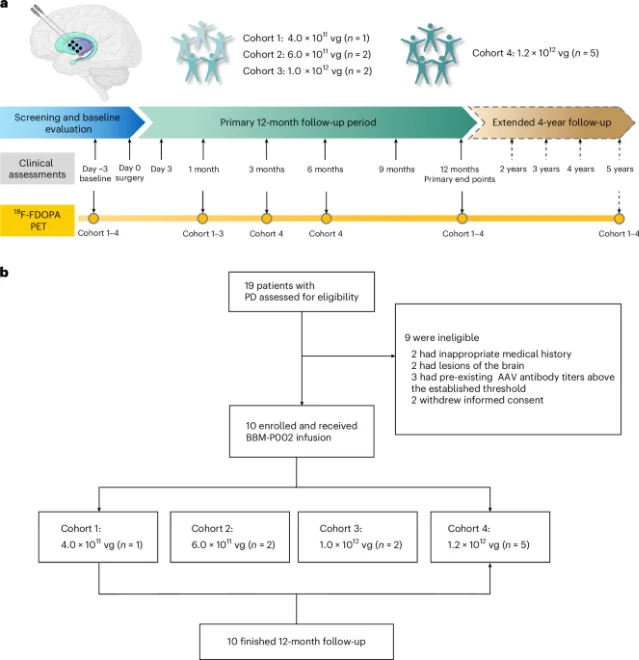
Study design: Open-label, dose-escalating Phase 1 trial. N = 10 adults with moderate-to-severe Parkinson's disease. Four dose cohorts: 4.0 × 10¹¹ vg (n = 1), 6.0 × 10¹¹ vg (n = 2), 1.0 × 10¹² vg (n = 2), 1.2 × 10¹² vg (n = 5). Primary endpoint: 12-month safety. All patients completed 12-month follow-up; extended 4-year follow-up planned. Multi-institutional: Ruijin Hospital (Shanghai Jiao Tong University), Xiangya Hospital (Central South University), Belief Biomed Inc. (Shanghai), Kunming Institute of Zoology (CAS), Xi'an Jiaotong University. Funded by NSFC (82230040, 82341251, 82401478). 3
Construct: BBM-P002 uses an AAVT42 vector to co-deliver two enzymes essential for dopamine synthesis: a constitutively active tyrosine hydroxylase (TH) and aromatic L-amino acid decarboxylase (AADC), injected bilaterally into the putamen. The dual-enzyme design bypasses the rate-limiting step of L-DOPA conversion and bypasses the need for exogenous levodopa supplementation — distinguishing it from prior single-enzyme (AADC-only) gene therapy approaches. 3
BBM-P002 Phase 1 trial design schematic: panel a shows the 12-month primary follow-up period with 18F-FDOPA PET imaging schedule; panel b shows CONSORT flow from 19 screened patients to 10 enrolled across 4 dose cohorts
Fig. 1 from Niu et al., Nature Medicine (2026). Panel a: clinical assessment and PET imaging schedule across the 12-month primary endpoint period and extended 4-year follow-up. Panel b: of 19 screened, 9 were ineligible (2 inappropriate history, 2 brain lesions, 3 high pre-existing AAV antibody titers, 2 withdrew consent); 10 enrolled and all completed 12-month follow-up. 3
Key findings: The primary 12-month safety endpoint was met. No dose-limiting toxicity (DLT), no drug-related serious adverse events. A total of 23 adverse events were recorded; all were judged unrelated to BBM-P002, mild in severity, and transient. No systemic toxicity or clinically significant immunogenicity was observed across any cohort. 3 Detailed motor outcome data (UPDRS III scores) and 18F-FDOPA PET findings for the highest-dose cohort are reported in the paper's Extended Data; the published abstract does not quantify motor improvements.
"Intraputaminal delivery of BBM-P002 was safe and well tolerated in this phase 1 trial, supporting continued clinical development."
— Jun Liu, Jiaji Lin, Lu Shen (co-corresponding authors) 3
Limitations: N = 10 with no blinding or control arm — standard for a Phase 1 dose-escalation study, but motor outcomes require a controlled Phase 2 to interpret. Six authors are Belief Biomed Inc. employees (conflict of interest disclosed). PubMed indexing is pending as of publication today; PMID will be assigned within 24–48 hours.
Clinical implication: Dopamine-replacement gene therapy for Parkinson's has been tested with AADC-only vectors (ProSavin, AXO-Lenti-PD) with mixed motor results. BBM-P002's simultaneous TH+AADC delivery at the putaminal target represents the first clinical demonstration of this dual-enzyme strategy in humans. With 12-month safety established across four dose levels and 18F-FDOPA PET confirming striatal signal, the construct is positioned for Phase 2. The 4-year extended follow-up built into this study will be important for long-term efficacy and durability data, where prior gene therapy programs have seen signal decay.
Affiliation: Equal-contribution first authors: Mengyue Niu, Jifeng Guo, Yuchao Yang. Corresponding authors: Lu Shen (Central South University), Jiaji Lin (Belief Biomed Inc.), Jun Liu (Ruijin Hospital, Shanghai Jiao Tong University).

4. Orforglipron (Foundayo) ACHIEVE-2: oral GLP-1 agonist superior to dapagliflozin on HbA1c at 40 weeks in type 2 diabetes (The Lancet, Phase 3)

Journal: The Lancet · IF ~168.9, Tier 1 · Published June 8, 2026 · PMID: 42259339 · NCT06192108 · Presented at ADA 2026
Study design: Phase 3, multicenter, open-label (orforglipron dose-blinded), randomized, 40-week non-inferiority trial. 73 sites in 6 countries. N = 962 randomized 1:1:1:1 to orforglipron 3 mg, 12 mg, or 36 mg (Lancet dosing; commercial Foundayo equivalent: 2.5/9/17.2 mg) or dapagliflozin 10 mg. All participants on background metformin ≥ 1,500 mg/day. Non-inferiority margin: 0.3% for HbA1c. Baseline: mean HbA1c 8.14% ± 1.04, age 56.1 years, T2D duration 8.0 years, BMI 32.6 kg/m². Funded by Eli Lilly and Company. 4
Key findings (treatment-regimen estimand, 40 weeks):
ArmHbA1c changeETD vs dapagliflozinP
Orforglipron 3 mg−1.23% (SE 0.08)−0.42% (95% CI −0.62 to −0.23)< 0.0001
Orforglipron 12 mg−1.50% (SE 0.08)−0.70% (95% CI −0.90 to −0.49)< 0.0001
Orforglipron 36 mg−1.56% (SE 0.09)−0.75% (95% CI −0.96 to −0.55)< 0.0001
Dapagliflozin 10 mg−0.81% (SE 0.07)
All three orforglipron doses met both non-inferiority and statistical superiority versus dapagliflozin. 4 Per the efficacy estimand (Lilly press release), weight loss at 40 weeks reached −7.3% (17.2 mg dose) versus −3.0% with dapagliflozin; up to 68.6% of patients on the highest dose achieved HbA1c ≤ 6.5% versus 21.6% on dapagliflozin. 5
GI adverse events occurred in 47–54% of orforglipron arms versus 12% with dapagliflozin. Discontinuation due to adverse events: 9.2–12.4% (orforglipron) versus 1.2% (dapagliflozin). No severe hypoglycemia. 4
"These results support a potential shift toward using oral GLP-1 receptor agonist therapies like orforglipron earlier as a foundation of type 2 diabetes care."
— Dr. Julio Rosenstock, University of Texas Southwestern Medical Center 5
Context: ACHIEVE-2 is one of three Lancet-published Phase 3 ACHIEVE trials reported simultaneously at ADA 2026. Lilly plans to submit Foundayo for the type 2 diabetes indication to the FDA by end of Q2 2026 under a Commissioner's National Priority Review Voucher; Foundayo is already FDA-approved for obesity. 5
Limitations: The first author and multiple co-authors are Eli Lilly employees and stockholders. The open-label design (though dose-blinded for orforglipron) introduces potential bias in patient-reported outcomes. The Lancet full text is Cloudflare-restricted; the weight data above come from Lilly's press release using the efficacy estimand rather than the treatment-regimen estimand reported in the Lancet abstract. Weight losses derived from the two estimands may differ.
Clinical implication: A head-to-head superiority demonstration over dapagliflozin on both HbA1c and weight, using a once-daily oral agent with no food or water restrictions, positions orforglipron directly against both SGLT2 inhibitors and injectable GLP-1 agonists in the metformin add-on space. The GI tolerability gap versus dapagliflozin (47–54% vs 12% GI AEs) remains the main clinical trade-off. With a T2D NDA expected by end of June 2026, prescribers can anticipate label availability later this year.
Affiliation: First author is an Eli Lilly employee. Corresponding authorship not specified from available abstract; trial listed at NCT06192108.

5. ALTAIR Phase 3 (CIRCULATE-Japan): FTD/TPI misses primary DFS endpoint in ctDNA-positive resected colorectal cancer (Nature Medicine)

Journal: Nature Medicine · IF ~82.9, Tier 1 · Open access (CC BY-NC-ND 4.0) · Published June 8, 2026 · PMID: 42260101 · DOI: 10.1038/s41591-026-04428-0 · NCT04457297
Study design: Randomized, double-blind, placebo-controlled Phase 3 trial. 152 sites in Japan and Taiwan (CIRCULATE-Japan platform). N = 243 randomized (FTD/TPI 122, placebo 121). Entry criterion: ctDNA-positive by Signatera assay after curative-intent resection, with no radiographic recurrence. Stage distribution: I 4.1%, II 23.9%, III 44.9%, IV 24.2%. 46.1% had received prior adjuvant chemotherapy. Enrollment: June 2020–June 2023. Median follow-up: 23.29 months. Funded by Taiho Pharmaceutical (drug and financial support); investigator-initiated. 6
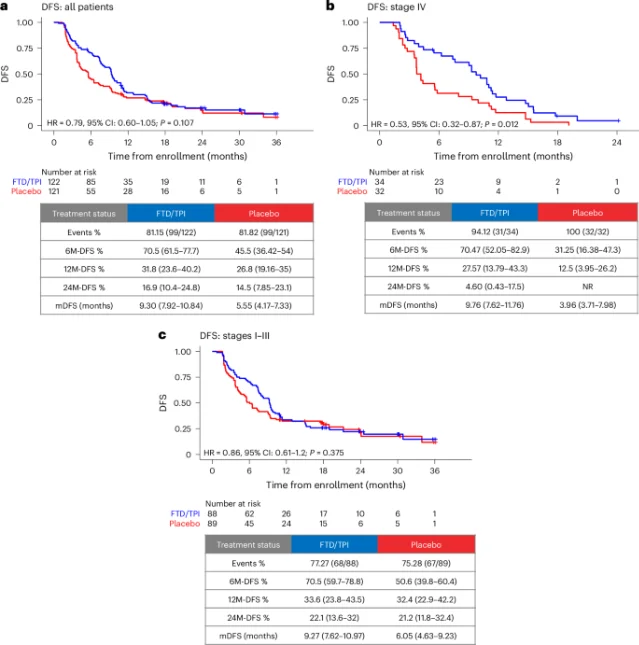
Key findings: The primary endpoint was not met. Median DFS: 9.30 months (FTD/TPI) versus 5.55 months (placebo); HR 0.79 (95% CI 0.60–1.05; P = 0.107). 6
ALTAIR Kaplan-Meier DFS curves: panel a all patients (HR 0.79, P=0.107); panel b stage IV subgroup (HR 0.53, P=0.012); panel c stages I–III (HR 0.86, P=0.375)
Fig. 2 from Bando et al., Nature Medicine (2026). Panel a: primary endpoint — all patients, FTD/TPI (blue) vs placebo (red), mDFS 9.30 vs 5.55 months, HR 0.79 (P = 0.107). Panel b: exploratory stage IV subgroup, mDFS 9.76 vs 3.96 months, HR 0.53 (P = 0.012, uncorrected for multiplicity). Panel c: stages I–III, HR 0.86, P = 0.375. 6
Six-month DFS was 70.5% versus 45.5%, but the treatment effect attenuated substantially by 24 months (HR 0.921), consistent with what the authors describe as recurrence delay rather than a curative effect. 6 A post-hoc central imaging reassessment produced HR 0.75 (P = 0.0406) — a sensitivity analysis only, not corrected for multiplicity. In the exploratory stage IV subgroup (n = 66), HR 0.53 (P = 0.012) was nominally significant but not corrected for multiple testing. ctDNA clearance rates did not differ significantly (17.2% FTD/TPI vs 12.4% placebo; P = 0.367), though persistent ctDNA clearance correlated with longer DFS in both arms.
Toxicity was notable: ≥ grade 3 hematologic AEs in 73.0% of FTD/TPI patients versus 3.3% placebo, predominantly grade ≥ 3 neutropenia (56.6%). OS data remained immature at data cutoff (24 deaths total). 6
"The trial did not meet its primary endpoint... and all subsequent analyses are exploratory... This pattern is consistent with a recurrence-delaying, rather than curative, effect."
— Hideaki Bando et al. 6
Limitations: ALTAIR is the first Phase 3 randomized trial of ctDNA-guided therapy in colorectal cancer — a significant methodological achievement — but it enrolled a heterogeneous stage distribution (including 24.2% stage IV), limiting comparability with standard adjuvant chemotherapy trials. The Signatera assay sensitivity in lower-stage disease may capture recurrences at earlier timepoints than imaging without identifying patients who would benefit from treatment. Natera (Signatera manufacturer) employees are co-authors.
Clinical implication: The field has invested heavily in the hypothesis that ctDNA positivity post-resection can select patients for treatment escalation. ALTAIR provides the first negative Phase 3 randomized evidence in this space. The 73% grade ≥ 3 hematologic toxicity makes the risk-benefit calculus unfavorable for routine use, even in the nominally positive stage IV subgroup. The recurrence-delay signal — strong at 6 months, attenuated by 24 months — suggests FTD/TPI may compress but not prevent CRC relapse in ctDNA-positive patients, a clinically insufficient endpoint for adoption. The CIRCULATE-Japan platform continues to investigate ctDNA-guided approaches with other regimens; OS data from ALTAIR, expected when events mature, will be the final arbiter.
Affiliation: First author Hideaki Bando, MD, PhD (National Cancer Center Hospital East, Kashiwa, Japan). Corresponding author Takayuki Yoshino, MD, PhD (National Cancer Center Hospital East).

正在加载统计卡片…
Cover image: AI-generated illustration

围绕这条内容继续补充观点或上下文。

  • 登录后可发表评论。