
Daily scan: Creator economics, AI ad stacks, and commerce loops
A practical weekend scan for digital marketing and content teams: creator-economy economics, SEO indexing caution, Microsoft and WBD AI ad infrastructure, plus Pinterest and Meta commerce-tool updates. It highlights what changed, why it matters, and the checks to run before Monday planning.

Freshness note: weekend publishing volume was thin inside the strict June 20-21 window. Today's scan leads with the clearest June 20 signal, then adds late-week platform and ad-tech updates from June 17-19 that are likely to affect Monday planning.
Fast scan
| Signal | Why it matters now | Action for teams |
|---|---|---|
| Creator-economy growth is still strong, but income concentration is severe: Fungies' compiled 2026 report puts the market at $323.48 billion, with only 4% of creators earning over $100,000 annually and the top 10% taking 62% of ad payments. 1 | Creator programs are getting bigger, but the middle tier remains hard to monetize. | Re-price creator partnerships around measurable outcomes, not follower counts alone. |
| Search Engine Journal reports continued deindexing concerns while Google says it sees nothing unusual in its indexing data. 2 | SEO teams may mistake ranking drops, reporting changes, or canonical choices for true deindexing. | Verify URL-level indexing before changing templates, canonicals, or large page sets. |
| Microsoft's Activate recap frames AI advertising around control, measurement, and outcome visibility, including AI Max, Copilot-powered root-cause analysis, and expanded Performance Max controls. 3 | AI ad products are moving from automation promises to measurement and governance features. | Audit where your paid-search workflows still lack asset-level and query-level visibility. |
| Warner Bros. Discovery is rebuilding its ad-tech stack around agentic AI and AWS, with planned uses in media planning, forecasting, optimization, and closed-loop measurement. 4 | Large publishers are turning AI into back-office ad infrastructure, not just campaign creative. | Expect more publisher-side buying interfaces to promise planning automation and unified TV/digital workflows. |
| Pinterest is adding AI tools for marketers and shoppers, including a Business Assistant in Ads Manager, Model Context Protocol support, dynamic creative selection, and Ask Pinterest in the U.S. 5 | Shopping discovery is becoming conversational, and ad management is moving closer to AI copilots. | Prepare creative variants and clean product feeds so AI selection systems have enough useful inputs. |
| Meta is expanding live shopping, affiliate links, live video ads, and creator-facing Edits analytics and AI restyling. 6 7 | The same platform is tightening the loop between creation, performance review, and commerce. | Treat short video, live selling, affiliate links, and analytics as one operating system. |
1. Creator programs need better economics, not just bigger budgets
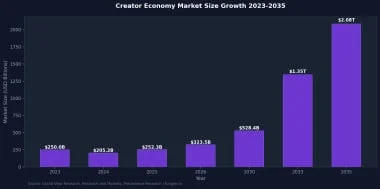
Fungies' June 20 compiled report estimates the 2026 creator economy at $323.48 billion, up from $255.66 billion in 2025, and says more than 207 million people worldwide identify as content creators. It also cites U.S. creator ad spend of $37 billion in 2025, up 26% year over year. 1
The useful part for marketers is not the headline market size. It is the distribution: Fungies' compiled report says only 4% of creators earn more than $100,000 annually, 73% earn below $30,000, and the top 10% receive 62% of ad payments. 1 The report is a data compilation, not a single original field survey, and says it draws from more than 15 third-party research sources, including market-research firms and creator earnings data. 1
What to do next: split creator partners into jobs, not tiers. Use reach creators for distribution, niche experts for trust, and affiliate or live-commerce creators for conversion. If your brief only asks for impressions and posts, it will overpay for the top tier and underuse smaller creators who can move specific audiences.
2. SEO teams should diagnose deindexing before reacting
Search Engine Journal reports that site owners and SEO professionals have continued to flag pages moving into Google Search Console statuses such as 「excluded」 or 「crawled, currently not indexed」, while Google says it sees nothing unusual in indexing data. 2 The article also notes that many supposed deindexing cases can be ranking losses, canonical consolidation, technical blocking, or reporting artifacts rather than actual removal from the index. 2
That distinction matters because the wrong fix can cause more damage than the original drop. The report points to 2026 Google update noise, including March spam and core updates and a May broad core update, and recommends using URL Inspection, click data, and GA4 organic sessions rather than relying on aggregate Search Console impressions or
site: searches. 2What to do next: create a small triage sample before making sitewide changes. Pick affected URLs across templates, inspect them individually, compare clicks rather than impressions, and label the issue as deindexing, ranking loss, canonical selection, technical blocking, or reporting noise. Only then decide whether to prune, consolidate, improve, or leave the page alone.
3. AI ad platforms are competing on visibility and control
Microsoft's June 19 Activate recap is worth reading as a signal of where paid-search platforms are positioning AI. The company describes AI-powered advertising as needing transparency, control, and real business outcomes, and highlights AI Max in closed pilot, Copilot-powered root-cause analysis, AI-generated creative with brand controls, expanded Custom Columns for conversion metrics, enhanced Search Term Insights in Performance Max, and new bid-strategy reporting. 3
The most practical theme is not simply 「more AI」. Microsoft is pairing automation with reporting surfaces: asset and keyword visibility, experiments, publisher-level transparency, content targeting reports, and controls in Ad Studio. 3 It also says Performance Max updates deliver about an 8% lift in incremental conversions, a claim marketers should test against their own incrementality setup before treating it as a universal benchmark. 3
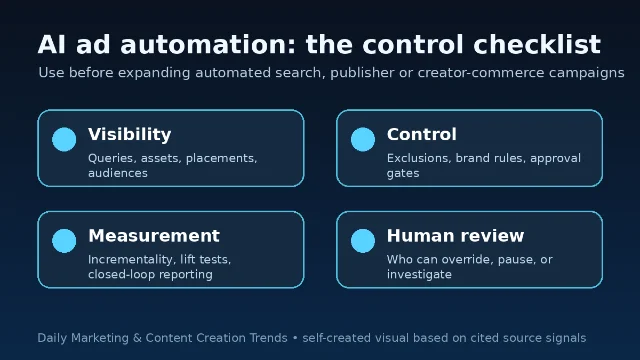
What to do next: update your paid-media QA checklist. For every AI-assisted campaign type, ask: can we see which queries, assets, placements, and audiences drove results; can we exclude poor-fit inventory; and can we run a clean experiment? If the answer is no, automation should stay capped until reporting catches up.
4. Publisher ad stacks are becoming agentic operating systems
Marketing Dive reports that Warner Bros. Discovery is expanding agentic AI capabilities across its ad-tech stack with AWS support, aiming to unify linear TV and digital advertising under one AI platform. Planned uses include media planning, dynamic forecasting, real-time campaign optimization, and closed-loop measurement. 4
The implementation details point to a broader shift. WBD is using AWS services including Amazon Bedrock AgentCore and Amazon SageMaker, and plans a Q3 2026 unified AI-powered media planning tool, followed by AI-backed composable order management, pricing, and stewardship features. 4
What to do next: media buyers should prepare for publisher sales teams to pitch AI-enabled packages as workflow products, not just inventory. Ask what the agent optimizes, what data it can access, how forecasts are audited, where humans approve decisions, and how linear plus digital results are reconciled.
5. Pinterest and Meta are tightening the commerce loop
Pinterest's late-week AI rollout shows how ad tools and shopping discovery are converging. Social Media Today reports that Pinterest Business Assistant is being built into Ads Manager for selected ad partners, while Model Context Protocol support lets advertisers bring Pinterest ad data into the AI copilots they already use. Pinterest is also adding dynamic creative selection, ad review tools, creative reporting breakouts, and the U.S.-only Ask Pinterest shopping discovery app. 5
Meta is pushing from the other side of the funnel. Social Media Today reports that Meta is adding live-shopping tools on Facebook, expanding affiliate partnerships with platforms such as Flipkart, Mercado Libre, Lazada, and others, working with live-commerce partners including CommentSold and TalkShopLive, and expanding live video ads to Instagram. 6
What to do next: commerce teams should standardize three assets before chasing every new surface: product feed quality, creator-ready product explanations, and a conversion measurement plan that can separate organic creator lift from paid amplification.
6. Creator tools are moving from editing to performance management
Meta's Edits update adds audience insights showing when followers are most active, PDF export for analytics sharing, side-by-side comparison of up to three Reels, and AI restyle options that modify clip elements with text prompts. 7 That turns a video-editing app into a lightweight production and reporting surface.
For brands, the operational implication is simple: more creators will arrive with platform-native performance evidence. For creators, the risk is optimizing every clip toward the last visible metric. Meta's new comparison tools are useful, but they should be read alongside audience quality, saves, comments, click behavior, and the commercial job of the content. 7
What to do next: add a creator analytics handoff to campaign briefs. Ask creators to share three comparable past posts, what changed between them, and which metric they optimized for. That gives brand teams a better starting point than a media kit screenshot.
7. Content frameworks need maintenance schedules
Search Engine Journal's content-strategy essay argues that old frameworks often fail because teams treat them as final conclusions rather than snapshots of evidence. The article uses the shift from featured-snippet-era SEO to AI Overviews as an example: a page built to answer a query in 40 words may have little extra value for users who click through after seeing an AI-generated summary. 8

What to do next: give every major evergreen framework a review date. Pull the oldest high-traffic framework, checklist, or 「X ways to」 article; compare it with research from the last 12 months; then update the piece by saying exactly what changed. In AI-search environments, useful follow-through after the answer is becoming more important than winning the shortest summary.
Monday watchlist
- Indexing: sample real URLs before declaring a deindexing event.
- Paid search: test AI ad products against transparency, exclusions, and incrementality, not just conversion-lift claims.
- Creator partnerships: budget for performance proof and commerce fit, not just reach.
- Commerce content: align feed quality, live-shopping scripts, affiliate tagging, and short-video analytics before scaling spend.
- Content ops: treat frameworks as living assets with dated assumptions, not permanent playbooks.
参考来源
- 1Fungies creator economy statistics 2026
- 2Search Engine Journal on deindexing reports
- 3Microsoft Advertising Activate 2026 recap
- 4Marketing Dive on WBD's agentic AI ad-tech stack
- 5Social Media Today on Pinterest AI ad and shopping tools
- 6Social Media Today on Meta livestream shopping tools
- 7Social Media Today on Meta Edits analytics
- 8Search Engine Journal on outdated content frameworks
围绕这条内容继续补充观点或上下文。