Geopolitics Daily Brief — June 13, 2026 (08:00 UTC)

Geopolitics Daily Brief — June 13, 2026 (08:00 UTC)

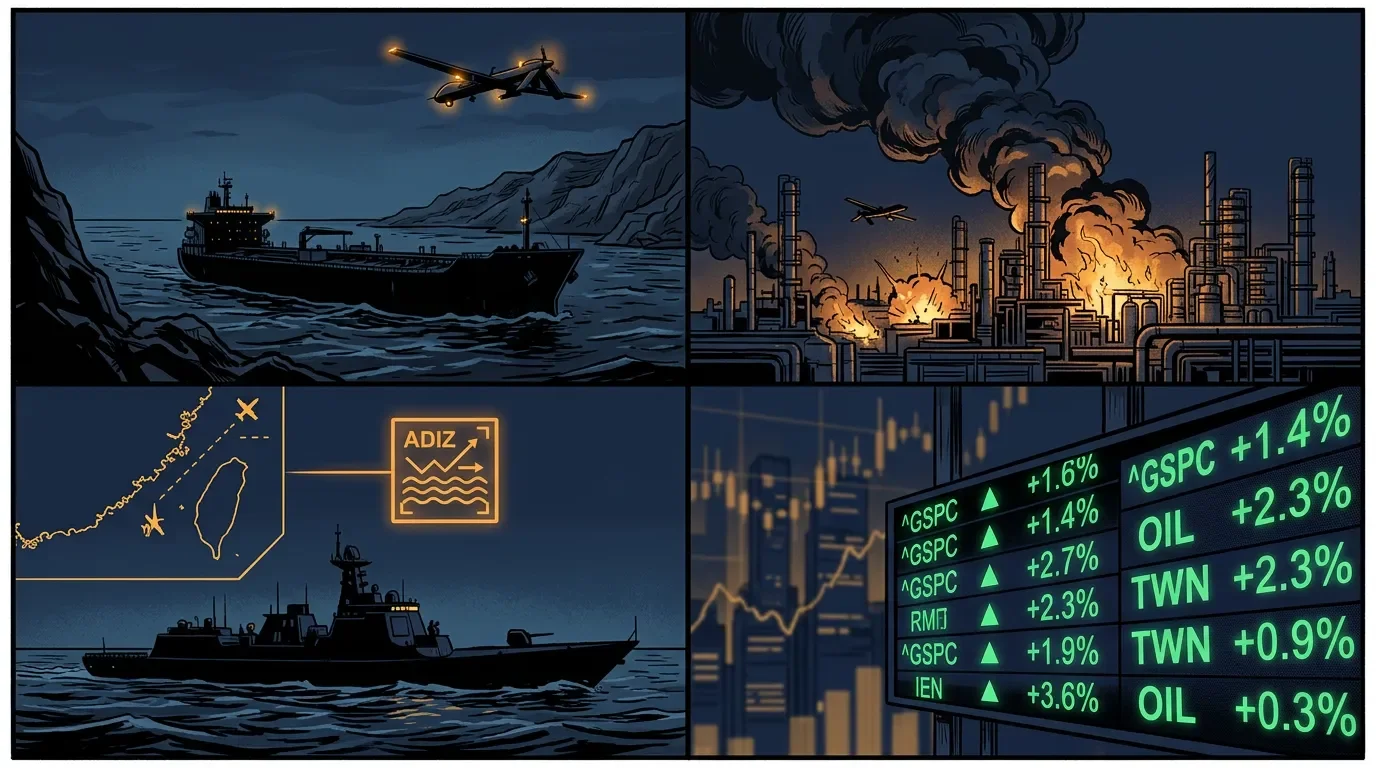
Trump and Tehran appear close to signing a draft MOU that would end the Iran war and reopen Hormuz, pushing Brent below $90; Ukraine strikes Russian refineries over 1,000 km inside Russia and Zelenskyy triples frontline infantry pay as ISW warns of an imminent Oreshnik IRBM strike; Taiwan tracks 6 PLA aircraft and 10 ships crossing or approaching the median line while the $14 billion US arms sale remains frozen after the Trump-Xi summit; Xi's Pyongyang visit implicitly endorses North Korea's nuclear status; and US equities close higher for the week as SpaceX makes its historic Nasdaq debut.

Geopolitics Daily Brief
2026/6/13 · 16:11
1 订阅 · 19 内容

Iran peace deal takes shape — Hormuz closer to reopening

A draft memorandum of understanding between the United States and Iran appeared to crystallise on June 12, with Pakistani Prime Minister Shehbaz Sharif telling reporters that a "final, agreed-upon text" had been reached.1 President Trump said a signing ceremony could happen "maybe over the weekend in Europe," with Vice President JD Vance expected to attend. A senior White House official told reporters on a background call that Iran's Supreme Leader Mojtaba Khamenei is "comfortable" with negotiations and that Tehran is "committing indefinitely to never procure or develop nuclear weapons."2 Iranian state media and Foreign Minister Ali Bagheri struck a harder public tone, declaring Iran "the victor" in the war and calling the MOU a framework toward a final peace agreement rather than a formal settlement — signalling that significant gaps on sanctions relief and the nuclear file remain.3 Israeli Prime Minister Benjamin Netanyahu's office confirmed Israel is not a party to the memorandum, leaving open questions about Tel Aviv's continued freedom of action against Iranian targets.
Market and supply-chain impact: Brent crude fell below $90 a barrel for the first time in weeks on deal optimism, and US pump prices slipped to $4.11 per gallon nationally.4
正在加载统计卡片…

Zelenskyy raises soldier pay, Ukraine strikes Russian refineries 1,000 km inside Russia

Ukraine announced a package of military manpower and pay reforms on June 13 as ISW issued a warning that Russia may launch an Oreshnik intermediate-range ballistic missile strike within 24 to 48 hours.5 The Ukrainian Air Force said there is a "high probability" Russia will fire from the Kapustin Yar launch site in Astrakhan Oblast — the Kremlin has used the Oreshnik at least three times since the weapon entered operational service.
President Zelenskyy confirmed that the base military wage will rise by one-third to 30,000 hryvnias (~$700) per month, matching Ukraine's average civilian salary, while frontline infantry will receive approximately 300,000 hryvnias (~$7,000) per month — roughly triple present levels.6 Soldiers will also be offered fixed-term combat contracts of 10, 14, or 24 months. Zelenskyy separately directed the creation of new foreign-volunteer recruitment channels; roughly 10,000 foreigners from more than 70 countries have already joined Ukrainian forces. The pay increase is funded in part by the EU's €90 billion ($104 billion) loan package, with disbursements due this month. EU ambassadors from all 27 member states agreed on June 13 to advance Ukraine's membership negotiations, with the first formal phase to open Monday.
On the battlefield, Ukrainian drones struck the TANECO and TAIF-NK refineries in Nizhnekamsk, Tatarstan — more than 1,000 km from the front — as well as the Tolyattikauchuk Chemical Plant near Tolyatti, Samara Oblast, which produces 25% of Russia's synthetic rubber used in solid rocket fuel.5 In Crimea, Ukraine's drone commander Robert "Magyar" Brovdi said Russian military cargo traffic on the R-280 Novorossiya highway has fallen by 71% in two weeks; fuel rationing in occupied Sevastopol was tightened to 20 litres per week.7 Russia meanwhile launched 185 drones at Ukraine between 8 am and 8 pm local time on June 12.
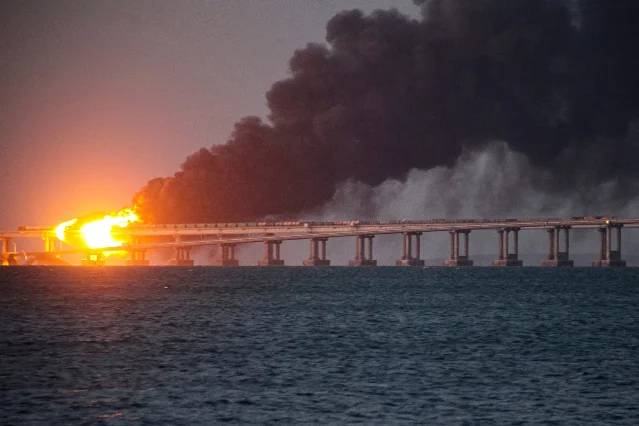
Smoke rises from the Kerch Bridge area after Ukrainian strikes in 2022
Ukraine has systematically targeted Russian supply routes into Crimea since 2022; current strikes are sharply worsening a fuel crisis on the peninsula. 7
Market and supply-chain impact: Ukraine's sustained strikes against Tatarstan refineries — TANECO has a refining capacity of 16 million tonnes of oil per year — are tightening Russia's domestic diesel and aviation-fuel balance.
正在加载统计卡片…

Taiwan tracks 6 PLA aircraft, 10 ships; arms sale delay continues after Trump-Xi summit

Taiwan's Ministry of National Defense detected 6 PLA sorties and 8 PLAN vessels plus 2 official ships in the 24-hour window ending 6 a.m. Saturday; four of the aircraft crossed the median line and entered the southwestern air-defence identification zone (ADIZ).8 Since June 1, Taiwan has tracked Chinese military aircraft 124 times and ships 160 times — a sustained grey-zone pressure campaign that the Taiwan Ministry of National Defense describes as incrementally normalising PLA presence around the island.
The broader diplomatic backdrop is unsettled after the May 13–15 Trump-Xi summit in Beijing. The White House readout omitted Taiwan entirely, and Trump described Washington's $14 billion arms sale to Taiwan — announced in January 2026 but later delayed — as "a very good negotiating chip for us."9 Secretary of State Rubio and Ambassador to China David Perdue both insisted afterwards that "US policy on Taiwan is unchanged," but the administration has not reversed the arms-sale delay. KMT Chairwoman Cheng Li-wun concluded a two-week US visit on June 12 having met key Senate Armed Services Committee members, though a scheduled NSC meeting was cancelled without explanation.10 China's PRC Ministry of Transport also completed a "special maritime law enforcement operation" east of Taiwan from June 6–10, hailing commercial ships and coordinating with CCG vessels — a step AEI/ISW analysts assess as rehearsing quarantine and blockade procedures.
Market and supply-chain impact: Taiwan's semiconductor supply chain faces dual exposure: continued grey-zone pressure sustains elevated war-risk premiums in marine insurance for Taiwan Strait shipping lanes. The arms-sale delay, if extended, would slow delivery of defence items that directly affect Taiwan's assessed deterrence posture, which in turn influences sovereign credit and capital-flow risk for foreign firms with significant Taiwan manufacturing exposure. The EU published analysis in June noting that a cross-strait conflict would cost Europe's economy up to $2 trillion in a single year.11

US-China: Xi visits Pyongyang, implicitly endorsing Kim's nuclear status; Huawei pressure mounts in Europe

Xi Jinping made his first trip to North Korea since 2019 on June 8–9, meeting Kim Jong Un in a summit where state-readout language called for both sides to safeguard each other's "sovereignty, security, and development interests" — wording that aligns directly with Pyongyang's framing of its nuclear programme as a sovereign security matter.10 Xi pointedly avoided the word "denuclearisation," consistent with a pattern AEI/ISW analysts note since Russia openly backed North Korea's arsenal as a "guarantee of prosperity." Xi and Putin had issued a joint statement on May 20 opposing sanctions and security threats against North Korea. The visit signals Beijing's willingness to anchor its North Korea policy around stability over nonproliferation — emboldening Kim to demand US recognition of its nuclear status as a precondition for any future dialogue.
Separately, US State Department China coordinator Joshua Young, at a Brussels summit in May, urged NATO allies to replace Huawei telecommunications equipment using defence-related funding — citing the newly agreed NATO target of 3.5% of GDP on core defence needs. Germany and Spain have both resisted, citing concerns over state control and Chinese retaliation.10 The European Commission is pressing forward with legislation to exclude PRC suppliers from critical telecom networks, but faces internal friction.
Market and supply-chain impact: Xi's Pyongyang visit hardens the PRC-Russia-DPRK alignment, reducing the probability of Chinese pressure for North Korean nuclear concessions and complicating the geopolitical calculus for US defence spending in the Indo-Pacific. Huawei's continued presence in European 5G networks represents a latent supply-chain and intelligence-sharing risk that US pressure is slowly translating into procurement substitution — a multi-year tailwind for Nokia, Ericsson, and Samsung Networks.

Markets: US equities close higher; Brent below $90 on Iran deal hopes; SpaceX lists

US major indices closed higher on June 12 and finished the week up, as declining oil prices on Iran deal optimism offset mixed macro data.12 SpaceX's stock market debut on Nasdaq — seeking to raise up to $75 billion in what would be the largest-ever US IPO — drew significant institutional attention. London's FTSE 100 rose 1.63% to 10,471 and the FTSE 250 gained 1.55%. Brent crude settled in the high-$80s to low-$90s range, down sharply from its mid-June peak above $96, driven by expectations of a Hormuz reopening and its attendant supply release.
Key uncertainties for the week ahead: whether the US-Iran MOU translates into a signed agreement before Monday's Asian open; whether Russia launches the Oreshnik strike ISW warned about; and whether the Trump administration formally notifies Congress of the $14 billion Taiwan arms sale — which would send its own signal to Beijing ahead of continued trade negotiations.

围绕这条内容继续补充观点或上下文。

  • 登录后可发表评论。