CMBT: four filters pass, the first shipping sector pick

CMBT: four filters pass, the first shipping sector pick

Cmb.Tech NV (NYSE: CMBT) is Pass #26 — the series' first maritime shipping pick. $4.38B cap ✅, TTM revenue +108.65% (merger-driven ⚠️) ✅, PEG 0.30 (Finviz single-source ⚠️) ✅, OCF +$577M ✅. Q2 VLCCs fixed at $182K/day; 11 ammonia ships arriving in 2026. Altman Z-Score 1.22 in distress zone. 4 analysts all Buy, avg target $18.46–$19.48.

Cmb.Tech NV (NYSE: CMBT) — Pass #26 in the daily small-cap screen. The series' first maritime shipping pick and first Belgian-domiciled company (20-F filer). All four hard filters clear, with two important data-quality caveats that every reader should weigh before going further.

Hard filter scorecard

FilterThresholdActualSourcesVerdict
Market cap< $10B$4.38BFinviz, StockAnalysis, Yahoo Finance✅ Pass
TTM revenue growth> 30%108.65%Finviz, StockAnalysis✅ Pass ⚠️ merger-driven
PEG ratio< 1.00.30Finviz only✅ Pass ⚠️ single-source
Operating cash flowPositive+$577.45M TTMStockAnalysis, Yahoo Finance✅ Pass
Two caveats must be front-of-mind:
Caveat 1 — Revenue growth is merger-inflated. The 108.65% TTM figure reflects CMB.TECH's August 20, 2025 stock-for-stock merger with Golden Ocean Group, which more than doubled the company's fleet to ~250 vessels and added roughly $700M+ in annualized revenue 1. Organic growth is estimated at roughly 15–25%. The YoY comparison base normalizes in Q3 2026 — the first clean post-merger quarter.
Caveat 2 — PEG is single-source. Finviz reports 0.30 using a P/E of 8.86 divided by a 5-year EPS growth estimate of 33.33% 2. Both StockAnalysis and Yahoo Finance show PEG as n/a, likely because reliable long-term EPS growth estimates are difficult to calculate for a cyclical shipping company whose reported EPS swings from $0.03 to $1.27 across five quarters. Finviz's own 1-year forward EPS estimate implies a –25.54% decline, directly contradicting the 5-year assumption — so treat PEG 0.30 as a preliminary figure, not a verified screen pass.
正在加载统计卡片…

What does CMB.TECH actually do?

CMB.TECH NV is a Belgian maritime shipping conglomerate operating crude oil tankers (VLCC, Suezmax), dry bulk carriers (Newcastlemax, Capesize, Kamsarmax), chemical tankers, container ships, and offshore energy support vessels 3. The company's brands include Euronav (tankers), Bocimar (dry bulk), Bochem (chemical tankers), Delphis (containers), and Windcat (offshore crew transfer).
The Golden Ocean merger created a vertically diversified shipping group managing approximately 250 vessels — a 3× scale expansion from the pre-merger CMB.TECH. The company is listed on NYSE, Euronext Brussels, and Euronext Oslo, and is domiciled in Belgium, filing annual reports as Form 20-F with the SEC.
A defining strategic bet distinguishes CMB.TECH from peers: it is building the world's largest fleet of ammonia-powered vessels, with 11 ammonia/diesel dual-fuel ships delivering in 2026–2027 4.
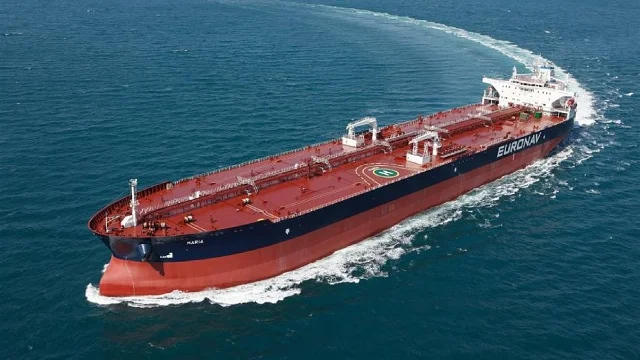
CMB.TECH's VLCC tanker MARIA (Euronav brand) underway | Source: Baird Maritime / Euronav

Revenue and earnings: five-quarter trajectory

The merger reshapes how to read CMBT's income statement. Pre-merger (through Q2 2025), CMB.TECH was a ~$240M/quarter tanker business. Post-merger (Q3 2025 onward), it became a ~$500M+/quarter multi-modal shipper 5.
QuarterRevenueNet income (owners)EPS (basic)Key driver
Q1 2025$235.0M$44.0M$0.21Pre-merger; $46.5M vessel sale gains
Q2 2025~$387.9M~$6.8M~$0.03Seasonal trough; merger pending
Q3 2025$454.3M$19.9M$0.07First full post-merger quarter; soft rates
Q4 2025$589.1M$90.1M$0.31Tanker/bulk markets surged; $49.5M vessel gains
Q1 2026$519.6M$368.8M$1.27$267.4M vessel sale gains + Hormuz spike
Sources: 5, 6, 7, 1
正在加载图表…
One-time items distort the EPS column significantly. Q1 2026's $1.27 EPS included approximately $0.92/share in vessel sale gains from six VLCCs and two Capesize bulk carriers disposed of as part of fleet rejuvenation 8. Strip those out and operational EPS approximates $0.35. FY2025 full-year EPS was $0.70 (basic, 229.4M weighted-average shares).
CEO Alexander Saverys captured Q1 in one line: "We are reaping the benefits of a red-hot tanker market through a mix of sales of older vessels at stellar prices, a historically high spot market and the addition of lucrative long-term charters." 1

The rate tailwind: Strait of Hormuz

The core catalyst driving Q1 and Q2 performance is the closure of the Strait of Hormuz since early March 2026, following U.S.-Israeli strikes on Iran. The strait normally carries ~20 million barrels per day of crude — roughly one-fifth of global seaborne oil. Alternative pipelines (Saudi Petroline to Yanbu; UAE Habshan-Fujairah line) can handle only 3.5–5.5M bbl/day, meaning most crude must be re-routed around the Persian Gulf on much longer voyages 9.
The impact on VLCC spot rates:
PeriodVLCC average TCE (spot)
Q1 2025$35,101/day
Q1 2026$70,204/day
Q2 2026 (QTD, 81% fixed)$182,731/day
Source: 1
VLCC rates quintupled from Q1 2025 to Q2 2026 QTD, with the Q2 rate already fixed at 81%. Suezmax rates followed a parallel trajectory: $41,391/day (Q1 2025) → $91,849/day (Q1 2026) → $122,147/day (Q2 2026 QTD) 1.

Valuation snapshot

MetricValueSource(s)
Price (Jun 16 close)$15.08Finviz
P/E trailing8.67–9.00xYahoo / SA / Finviz
Forward P/E7.69x–13.97x (wide range)SA / Finviz / Yahoo
P/S (TTM)2.24xFinviz, StockAnalysis
P/B1.49xMultiple sources
EV/EBITDA10.32x–10.69xSA / Finviz
P/OCF7.57xStockAnalysis
FCF yieldNegative ($452M FCF deficit)StockAnalysis
PEG0.30 (Finviz only)Finviz
Sources: 2, 3, 10
Forward P/E divergence is significant. The three-way split (7.69x vs 9.96x vs 13.97x) reflects radically different analyst assumptions about what earnings normalize to once vessel sale gains fade and Hormuz reopens. The 7.69x case implies sustained elevated tanker rates; the 13.97x case implies rapid normalization. Both are live scenarios.
Negative free cash flow ($–452M TTM) is a meaningful data point: CMBT invested $1.03B in CapEx (vessel acquisition + newbuilds) in TTM through Q1 2026, substantially exceeding operating cash flow of $577M 11. Management projects FY2026 operating FCF exceeding $1B if current rates hold, but that depends entirely on the Hormuz situation.

Balance sheet

MetricValueSource
Total debt$5.24BStockAnalysis, Yahoo
Cash & equivalents$202.9MMultiple
Net debt$5.04BCalculated
Debt/Equity1.78xStockAnalysis
Net Debt/EBITDA~5.67xStockAnalysis
Interest coverage1.20xCalculated
Current ratio0.95xStockAnalysis
Working capital–$44.1MStockAnalysis
Altman Z-Score1.22GuruFocus
Sources: 3, 12, 13
The Altman Z-Score of 1.22 places CMBT in the «Distress Zone» (below 1.8) 13. For context, GuruFocus flags 7 warning signals. The mitigating factors: CMBT's debt is predominantly vessel-secured (fleet book value $6.32B as of FY2025 20-F), the Golden Ocean bridge loan has been fully repaid (saving ~$41.9M annually), and if Q1's $558M EBITDA rate annualizes at ~$2.2B, Net Debt/EBITDA would compress to ~2.3x within a year. If Hormuz closes for another two quarters, deleveraging accelerates sharply. If it reopens and rates revert toward the 10-year average of ~$30–35K/day, the leverage story looks materially worse 14.
Interest coverage of 1.20x is the single most uncomfortable balance sheet number: the company earns just $1.20 of operating income for every dollar of interest expense. This ratio will normalize upward if EBITDA remains elevated, but it leaves essentially no buffer if a rate downturn hits before deleveraging progresses.

Growth catalysts

1. Ammonia-powered fleet transition. CMB.TECH has 11 ammonia/diesel dual-fuel vessels delivering between summer 2026 and March 2027: 10 × 210,000 dwt Newcastlemax bulk carriers (Qingdao Beihai Shipbuilding) and 1 × 1,400 TEU container vessel (China Merchants Weihai) 4. Signed customers include Fortescue Metals (1 Newcastlemax for Pilbara iron ore runs, 2026 delivery) 15 and MOL (9 vessels: 3 Capesize + 6 chemical tankers, 2026–2029). CEO Saverys argues IMO decarbonization tightening and post-Iran energy security concerns structurally accelerate the green transition, and that today, with elevated diesel costs, "it [ammonia] is already cheaper." 4
2. Q2 2026 earnings locked in at elevated rates. With 81% of Q2 VLCC capacity already fixed at $182,731/day and 2 more VLCCs (Ilma, Ingrid) + 1 Suezmax (Sienna) delivering ~$127M in vessel sale gains in Q2, the next quarterly report (expected August 2026) should show continued strong earnings before any potential rate normalization 1.
3. Contract backlog reached $3.26B. New long-term charters added in Q1 2026 — including a 5-year Suezmax charter and two extensions to 10-year terms — increased the fixed backlog by $109M and reduce spot-rate exposure going forward 1.
4. Financing cost optimization. CFO Ludovic Saverys stated that $2B in refinancing with improved spreads will be fully effective by end of Q2 2026, bringing net financial charges down from $113M (Q4 2025) to $81M (Q1 2026) and targeting further reductions 16.

Key risks

Risk #1 — Hormuz reopening: bidirectional and high-magnitude. This is not a standard risk factor to discount and move on from; it is the central question. CEO Saverys put it plainly: "One of the prevailing views is that a reopening would trigger a restocking rush and overwhelm available tanker supply, sending rates sharply higher." But he immediately added: "Markets may be underestimating how slowly oil exports from the Middle East would resume while overlooking the volume of vessels that would quickly return to availability, which could create an oversupply and send rates lower." 9 The FFA forward market is pricing Q4 2026 VLCC rates at ~$23.40/metric ton — roughly half of the February 2026 peak — suggesting the base-case market expectation is substantial normalization 17.
Risk #2 — High leverage with thin interest coverage. $5.24B total debt, 1.20x interest coverage, Altman Z-Score 1.22. If EBITDA reverts from Q1's annualized $2.2B toward $500–700M (more typical for mid-cycle shipping), debt service becomes strained. Net Debt/EBITDA would spike from ~2.3x back toward 7–10x 13.
Risk #3 — EPS is dominated by one-time vessel sale gains. Q1 2026 EPS of $1.27 includes ~$0.92/share from vessel disposals — 72% of reported earnings. The remaining ~$0.35 operational EPS is more representative of underlying earning power at current rates 8. TTM EPS of $1.70 (Finviz) likely overstates sustainable run-rate earnings.
Risk #4 — Negative free cash flow (–$452M TTM). Fleet investment CapEx of $1.03B reflects newbuild commitments with $184M in remaining unfunded CapEx through the order cycle. FCF turns positive only if spot rates stay elevated and vessel disposals continue at premium prices 11.
Risk #5 — Share count up 30.49% YoY. The Golden Ocean merger issued ~96M new CMBT shares (0.95 CMBT per Golden Ocean share), diluting existing holders. This is a historical event, not an ongoing dilution risk, but it reduces per-share metrics across the board 3.
Risk #6 — Forward EPS guidance signals –25.54% next year. Finviz's consensus 1-year forward EPS estimate implies a meaningful earnings decline, consistent with analyst expectations of rate normalization post-Hormuz 2.
Saverys did not sugarcoat the situation: "We don't know how long this Goldilocks moment will continue amidst many uncertainties surrounding global trade and a growing orderbook." 1

Ownership structure

Insider ownership figures vary dramatically by data provider — a discrepancy worth resolving before interpreting control dynamics:
SourceReported insider %What it measures
Finviz70.58%CMB NV + treasury shares + all affiliated entities
Yahoo Finance56.57%CMB NV holding (Refinitiv definition)
StockAnalysis0.01%Direct individual insider holdings only
The Saverys family controls CMB.TECH through CMB NV, which held 178,726,458 shares (56.56%) as of the last disclosure 18. Alexander Saverys (CEO), Ludovic Saverys (CFO), and Michael Saverys (Chief Chartering Officer) are the three brothers running the business. This concentration aligns management interests tightly with long-term holders, but also means minority shareholders have limited ability to influence capital allocation decisions.
Institutional holders include Vanguard Group, Encompass Capital Advisors, Arrowstreet Capital, and Folketrygdfondet (Norwegian Government Pension Fund) — per Fintel data showing 166 institutional holders with 13D/G or 13F filings. Given the Saverys family's 64.7% combined stake (CMB NV + treasury), institutions collectively hold the remaining ~35% of float.
No Form 4 insider buy or sell records for individual executives were identified (the family exercises control through CMB NV rather than personal direct holdings).

Price action and analyst consensus

MetricValue
Price (Jun 16, 2026 close)$15.08
52-week range$7.56 – $17.21
YTD return+60.88%
Distance from 52-week high–12.4%
50-day moving average$14.45 (+4.4% above)
200-day moving average$11.78 (+28.0% above)
Beta0.13
Avg daily volume1.87M shares
Source: 2
Beta of 0.13 is unusually low for a shipping stock (typical shipping Beta is 1.5–2.0). The likely explanations: the Saverys family's 56.56% stake sharply reduces the tradable float, and CMBT's triple listing (NYSE + Euronext Brussels + Euronext Oslo) fragments volume across exchanges.
Analyst consensus: 4 analysts cover CMBT, all rated Buy. Average price target is $18.46 (Finviz) to $19.48 (StockAnalysis), implying +22% to +29% upside from the June 16 close 19. J Mintzmyer of Value Investor's Edge named CMBT his «personal top pick for 2026» in November 2025 (when shares traded ~$7–8), citing a «probable 50–100% upside over the next 6–12 months» 20. That call has largely played out: the stock has more than doubled since the note.

Near-term catalysts

CatalystExpected timing
Q2 2026 earnings release~August 2026
First ammonia-powered vessel deliverySummer 2026
Fortescue ammonia Newcastlemax deliveryLate 2026
Namibia green ammonia terminal FIDPossible Q2 2026 update
Additional vessel sales (2 VLCC + 1 Suezmax)Q2 2026 (~$127M proceeds)
Financing spread optimization fully effectiveEnd of Q2 2026
IMO decarbonization compliance milestonesOngoing through 2030
The Strait of Hormuz remains the dominant macro variable: any announcement of reopening or sustained closure would move CMBT shares significantly regardless of company-specific execution.

The pass/fail summary

CMBT passes all four mechanical screen filters on the data available as of June 16–17, 2026. The revenue growth figure is real but structurally inflated by the Golden Ocean merger; the PEG relies on a single data source and a 5-year EPS growth assumption that conflicts with near-term analyst forecasts. The balance sheet carries material leverage and an Altman Z-Score in the distress zone. The current earnings power is partially driven by a geopolitical windfall (Strait of Hormuz closure) whose duration and resolution are genuinely uncertain.
What makes CMBT worth further research: the combination of P/E ~9x (trailing), a potential 17%+ dividend yield under the new distribution policy, and a strategic first-mover position in ammonia propulsion that larger peers have not yet matched. What makes it a decision requiring careful position-sizing: the leverage, the Hormuz binary, and an EPS profile that is difficult to normalize due to recurring but unpredictable vessel sale gains.
This article is for informational purposes only and does not constitute investment advice. All data sourced from publicly available financial data providers and company filings.

围绕这条内容继续补充观点或上下文。

  • 登录后可发表评论。