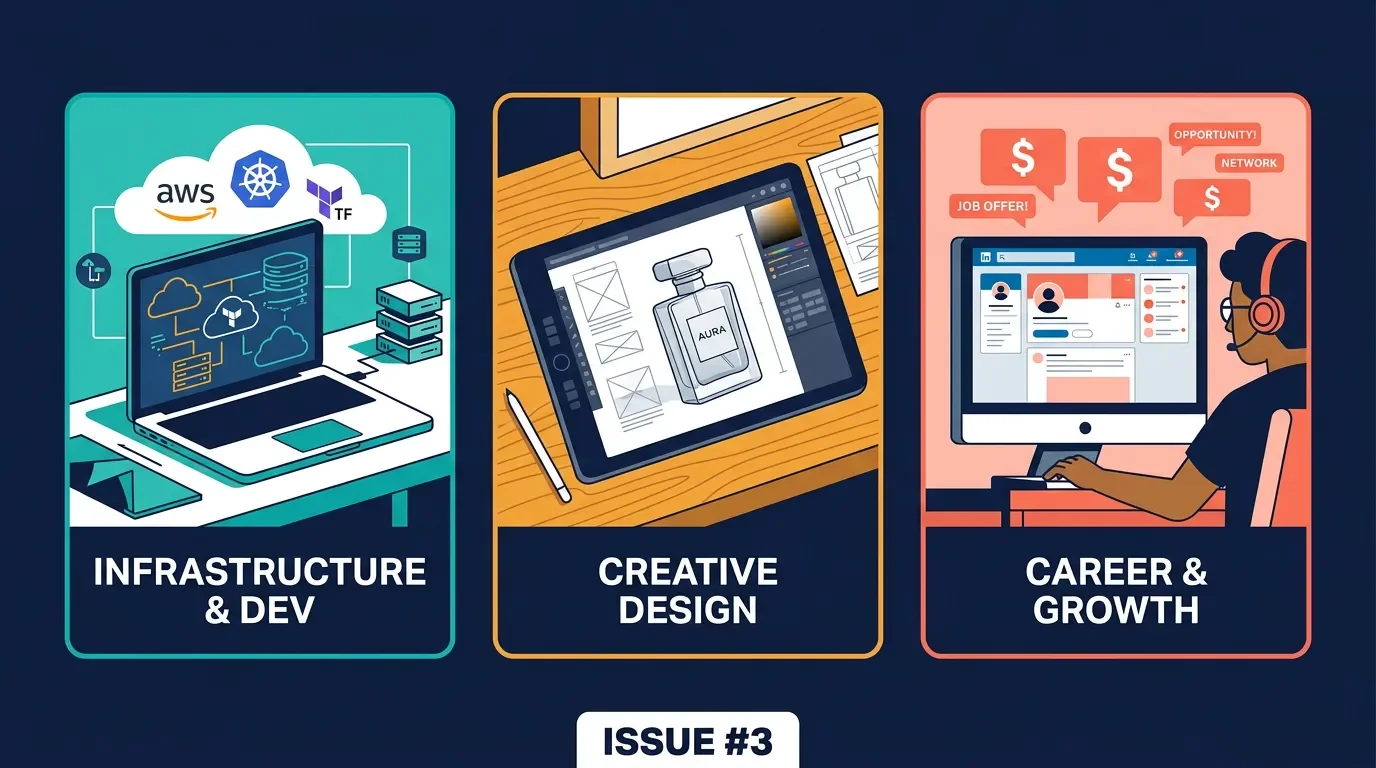
Issue #3: Eight Gigs That Sidestep the Overcrowded Corners of the Market
Eight scam-filtered side hustles and remote freelance gigs for developers, designers, and office workers — all new categories not covered in Issues #1 or #2. Cloud/DevOps consulting, Flutter/React Native mobile dev, WCAG accessibility auditing, 3D product visualization, Figma design systems, LinkedIn ghostwriting, freelance grant writing, and instructional design. Each gig tagged [DEV], [DESIGN], or [OFFICE] with verified 2026 rate data and three concrete first steps.

Eight gigs that sidestep the overcrowded corners of the market
The three usual suspects — frontend dev, content writing, and basic graphic design — dominate every "side hustle" roundup. What follows skips those. Eight gigs where rate compression hasn't caught up yet, clients aren't price-shopping on fiverr, and the entry bar is real but learnable.
| Gig | Audience | Rate range | Entry bar |
|---|---|---|---|
| Cloud/DevOps consulting | [DEV] | $50–$125/hr | AWS certs or Terraform portfolio |
| Mobile app dev (Flutter/RN) | [DEV] | $85–$145/hr | 2–4 shipped apps |
| WCAG/ADA accessibility auditing | [DEV] | $75–$150/hr | WCAG 2.1 AA knowledge + screen reader |
| 3D product visualization | [DESIGN] | $150–$1,000/image | Blender or Cinema 4D portfolio |
| Figma design systems | [DESIGN] | $75–$150/hr | Component library + auto-layout samples |
| LinkedIn ghostwriting | [OFFICE] | $2,000–$5,000/mo | Writing portfolio + LinkedIn results |
| Freelance grant writing | [OFFICE] | $50–$200/hr | 3–5 funded proposals |
| Instructional design / e-learning | [OFFICE] | $45–$100/hr | Articulate 360 or Rise sample course |
[DEV] Cloud/DevOps consulting (AWS, Terraform, Kubernetes)
Businesses that moved to the cloud during 2020–2022 are now dealing with messy infra: overprovisioned EC2 instances, no IaC, and bills they don't understand. Freelance DevOps and cloud consultants get hired to clean it up.
What clients actually pay for: Terraform modules that replace click-ops, Kubernetes cluster setup and hardening, CI/CD pipelines (GitHub Actions, GitLab CI), cost optimization reviews, and on-call runbook documentation.
Rates: Upwork's DevOps hiring page quotes $40–$100/hr as the typical range, skewing toward $60–$100 for mid-to-senior engineers.1 Arc.dev puts the average hourly rate for DevOps engineers at $81–$100.2 Senior consultants with AWS Solutions Architect or Terraform certifications and a track record of cutting cloud bills regularly clear $100–$150/hr.
Entry requirements: AWS Certified Solutions Architect (Associate level is enough to start), hands-on Terraform or Pulumi experience, and at least one reference project showing cost or reliability improvements. A GitHub portfolio with real IaC modules beats a certificate-only resume.
First steps:
- Build 2–3 public Terraform modules on GitHub (VPC setup, ECS task, RDS with backup policies) — this is your live portfolio.
- Search Upwork and We Work Remotely for "AWS infrastructure," "Terraform," and "cloud cost optimization." Proposals that include a one-paragraph cost audit observation from the job description close at higher rates.
- Price your first engagement at $60–$75/hr, complete it cleanly, then request a case study testimonial showing the before/after state.
Scam signal: Clients who want you to "just log in to our AWS console" without a formal access policy document or who promise equity in lieu of payment for infrastructure work. Both are common time-wasters.
[DEV] Flutter / React Native mobile development
Cross-platform now accounts for 64% of freelance mobile work on US platforms.3 Flutter is closing the gap with React Native, and both command better rates than they did two years ago — partly because many agencies that were developing in-house talent have shifted to freelance contracts.
What clients need: Mid-size startups building MVP cross-platform apps, e-commerce brands adding a mobile storefront, and SaaS companies building companion apps. Full builds, feature ownership, App Store/Play Store release, and CI/CD integration are all common scope items.
Rates: Senior Flutter or React Native freelancers in the US charge $125–$185/hr, with a median at around $145.3 Upwork confirms a $24–$45/hr range for entry-level cross-platform and $100–$145+ for senior.4 The supply math: there are more than 2.1 million active mobile developers worldwide, which keeps mobile rates 25–40% below AI engineering at the same seniority level — but that still puts a senior freelancer well above $100/hr.
Entry requirements: 2–4 shipped apps in the App Store or Play Store (findable, not test builds), clean state management patterns (Riverpod, Bloc for Flutter; Redux or Zustand for RN), and experience with at least one real-world API integration.
First steps:
- Audit your public portfolio — any app with under 50 reviews that was last updated more than a year ago signals abandonment. Update or remove it.
- Build a 15-minute Upwork profile walkthrough video showing one app's architecture decisions. Video-first profiles consistently outperform text-only ones in mobile dev hiring.
- Target Series A–B SaaS startups on Wellfound (formerly AngelList) who list "mobile app" as a product initiative — they often skip Upwork entirely and hire directly.
Scam signal: Fixed-price projects for full app builds under $5,000. A real senior mobile developer billing 150–250 hours for a clean MVP would price that at $15,000–$25,000 minimum. Low fixed prices almost always mean scope isn't defined yet.
[DEV] Web accessibility (WCAG/ADA) auditing
The DOJ finalized ADA web accessibility rules in April 2024, extending Title II requirements to state and local government websites. Since then, ADA-related website lawsuits have spread into e-commerce and healthcare. The practical consequence: companies that have never thought about accessibility now need someone to audit and prioritize their compliance gaps.
)
ADA website lawsuits have expanded significantly to smaller businesses since the 2024 DOJ rule. 5
What clients pay for: Manual WCAG 2.1 AA audits, remediation prioritization reports, developer handoff documentation, and ongoing monitoring setup. A small business audit (10–30 pages) runs $2,500–$7,000 as a project fee; a mid-market site (50–100 pages) runs $10,000–$25,000.6
Rates: Freelance accessibility auditors charge $75–$150/hr. Projects requiring federal compliance reporting (VPAT documentation) command the top of that range.
Entry requirements: Solid WCAG 2.1 AA knowledge, screen reader proficiency (VoiceOver on Mac/iOS and NVDA on Windows are the two standards), keyboard-only navigation testing, and color contrast tools. The Deque University courses (axe certification) are a recognized entry credential and take about 40 hours to complete.
First steps:
- Audit your own portfolio site or a friend's business site and write a 5-page report in VPAT format. This is your sample deliverable.
- Look for healthcare, legal, and e-commerce clients who have received demand letters or are under state regulatory review — these are motivated buyers, not tire-kickers.
- Price your first two audits at $1,500–$2,500 flat to build verified examples. After two funded reports, move to $75–$100/hr.
Scam signal: Clients who want a signed statement that their site is "fully ADA compliant" — that doesn't exist, and any freelancer who provides one is exposing themselves to liability. Real engagements produce audit reports with issue lists, not compliance certificates.
[DESIGN] 3D product visualization (Blender, CGI rendering)
Every DTC brand and Amazon seller needs product images. Photography requires the physical product, a studio, and a reshooting cycle for every colorway. CGI doesn't. A freelance 3D artist can produce a photorealistic render of a product variant that hasn't been manufactured yet, from a CAD file or a rough sketch.
What clients pay for: Static hero images ($150–$500 per image for simple products, $300–$1,000 for medium complexity like furniture or electronics), 360° product views ($500–$2,000 per product), and full e-commerce packages covering multiple angles and a lifestyle scene ($800–$3,500 per product).78

Rates by complexity: Simple packaging/bottles: $100–$300/image. Electronics, appliances, furniture: $300–$1,000/image. Jewelry, luxury goods, machinery: $1,000–$1,500+/image. Catalog-scale work (50+ SKUs) can be negotiated as monthly retainer or bulk pricing, which cuts per-image costs for clients and gives freelancers predictable income.
Entry requirements: Blender (free) or Cinema 4D/3ds Max proficiency, a portfolio showing at least 5–8 photorealistic renders across different product categories, and basic knowledge of HDRI lighting, material nodes (principled BSDF), and rendering engines (Cycles or Eevee in Blender, V-Ray elsewhere). AI-assisted texturing tools have compressed the learning curve significantly.
First steps:
- Build a 10-piece portfolio using CAD files from Grabcad (free library) — vary by category: cosmetics, tech, furniture, apparel accessories.
- Search for "Amazon product photography" and "3D rendering" on Upwork and Contra. Also check r/ecommerce and r/Blender for clients posting "looking for 3D artist."
- Offer your first 3–5 clients a package rate ($600–$900 for 3 hero images) rather than per-image pricing — it reduces price friction and gives you a richer portfolio piece.
Scam signal: "Test renders" that require you to complete several hours of work before any contract is signed. Serious clients approve a brief sample (one test render at maximum) before committing to a paid project.
[DESIGN] Figma design system / component library
Every SaaS product with more than one designer or a frontend team eventually breaks down without a design system. Building one from scratch — components, tokens, auto-layout, variables, and documentation — is a 4–8 week project that most in-house teams deprioritize until it becomes a crisis.
What clients pay for: Auditing and consolidating scattered components into a structured library, building atomic components with auto-layout and variable tokens, documenting handoff specs, and onboarding the design team. A full design system project runs $8,000–$20,000 depending on scope; component library builds tend to run 4–6 weeks at $75–$120/hr.910
Rates: Upwork data shows $75–$125/hr for mid-to-senior Figma designers working on design systems; specialized design systems consultants on Toptal charge $150+/hr.9 A Reddit thread from 2023 (still widely cited) pegged full design system builds at $120+/hr or $16k+ for the full engagement.11
Entry requirements: Deep Figma proficiency (auto-layout, components, variables, prototyping), a portfolio showing at least one production design system or component library you built (not just used), and familiarity with design tokens and how they map to CSS/Tailwind for developer handoff.
First steps:
- Rebuild a well-known open-source product's UI in Figma as a structured component library — Notion, Linear, or Vercel's dashboard work well as practice. Publish it on Figma Community.
- Target B2B SaaS startups with 10–50 employees on Wellfound and Contra. These companies have grown past one designer but rarely have a system.
- Lead with an audit offer ($500–$800 flat) instead of jumping straight to full build — audits convert to full system projects at high rates once clients see the gap documented.
Scam signal: Clients who ask you to "just clean up our Figma file" for a flat $200–$400. That scope is either a test to see how little you'll accept or a job that will expand without expanding the fee.
[OFFICE] LinkedIn ghostwriting
The economics are strange but real: a founder who posts consistently on LinkedIn generates pipeline. Most founders do not have time to post consistently. So they pay someone to post as them. This market has grown fast since 2023 and rates have moved up with it.
What clients pay for: 3–5 LinkedIn posts per week, written in the founder's voice, covering their industry take, recent wins, and lessons. Most retainers include a monthly interview call (30–60 min), a content calendar, one round of revisions per post, and basic performance tracking.
Rates: LinkedIn ghostwriters typically charge $500–$10,000/mo depending on experience and scope.12 The realistic range for a freelancer starting out is $1,500–$2,500/mo for 12–16 posts; experienced writers with case studies showing follower growth or lead attribution charge $2,000–$5,000/mo; top-tier operators with named client results charge $5,000–$10,000/mo.12 At 3 clients, $2,500/mo each, that's $7,500/mo for roughly 20–25 hours of work. The math works.
Entry requirements: Strong writing ability, the ability to extract someone's voice from a transcript and reproduce it in post form, and a genuine understanding of what performs on LinkedIn (hooks, post structure, when to use carousels). A writing portfolio with at least 2–3 samples in different executive voices is the minimum; actual LinkedIn engagement results close clients faster.
First steps:
- Write 3 spec posts for a founder you admire — pick someone whose content is sparse or formulaic. These are your cold outreach samples.
- Offer your first paying client a 4-week trial at $1,000–$1,500. Track post impressions and engagement. Document the results. This becomes your case study.
- Raise rates after 3–4 clients with documented results. Price to $2,500–$3,500/mo for new clients. Existing clients get grandfathered or renegotiated at 6-month marks.
Scam signal: Clients who want "ghostwriting" but also want you to respond to comments, DMs, and connection requests as them — that's a different scope (full LinkedIn management) and should cost significantly more. Scope creep in ghostwriting is common and worth addressing in the contract upfront.
[OFFICE] Freelance grant writing
Grant writing is one of the few writing specializations where being good is provably verifiable — a funded proposal is a public record. That makes it easier to build a portfolio and command premium rates quickly, relative to other writing gigs where results are harder to measure.
What clients pay for: Foundation grant proposals ($1,500–$4,000 flat per proposal), federal grant applications ($5,000–$25,000 depending on complexity), and monthly retainers for nonprofits submitting 3–6 grants per year ($2,000–$8,000/mo).
Rates: Freelance grant writers charge $50–$200/hr, with experienced writers at $75–$125/hr and federal grant specialists at $100–$200/hr.13 A realistic full-time freelance income estimate: billing 800–1,100 hours per year at $100/hr yields $80,000–$110,000 before self-employment taxes. Federal specialization (NIH, NSF, HRSA) pushes that range 20–35% higher according to Grantsights' editorial analysis based on grant professional compensation surveys.13
Entry requirements: Strong research and persuasive writing skills, familiarity with the grant application lifecycle (needs statement, logic model, budget justification, evaluation plan), and 3–5 funded proposals. The GPC (Grant Professional Certified) credential is recognized but not required to start; Grants.gov registration is required for federal work.
First steps:
- Volunteer to write one grant for a local nonprofit or community organization — this is standard practice for entry-level grant writers and your portfolio baseline.
- Search "grant writer" on Idealist, Chronicle of Philanthropy, and LinkedIn for contract roles. These often pay $45–$65/hr, below market but faster to land than direct consulting.
- After 3 funded proposals, move to direct outreach: email 10–15 nonprofits in your target sector with a brief note referencing your success rate and a relevant sample.
Ethics note: Percentage-based compensation (a cut of the grant award) is prohibited by the Grant Professionals Association, the Association of Fundraising Professionals, and most federal funders. Any client offering this arrangement should be declined — it's an ethics violation and a compliance risk.13
The r/nonprofit community has an active thread on rate-setting that's worth reading before you pitch your first client:
正在加载内容卡片…
[OFFICE] Instructional design and e-learning development
Remote work and AI upskilling have pushed corporate L&D budgets up, but internal instructional design headcount hasn't kept pace. Companies that need a new onboarding module, compliance training, or product certification course are hiring freelance IDs to build it in Articulate 360 or Rise, then hand it off to internal LMS admins.
What clients pay for: Standalone modules ($3,500–$18,000 per module depending on interactivity level), full curriculum builds ($33,000–$45,000 for 1.5–5 hours of content), and hourly consulting for scoping, storyboarding, and SME interviews. Basic compliance micro-courses (15–30 min) run $2,500–$5,000. Scenario-based sales simulations run $20,000–$23,000.14
Rates: Freelance instructional designers in the US charge $45–$100/hr, with the rate range running from $36 for junior to $57 for senior specialists (Glassdoor April 2026 data, cited by Blue Carrot).14 ZipRecruiter puts the average yearly pay for freelance remote instructional designers at $79,711 as of June 2026.15
Entry requirements: Articulate Storyline or Rise (the industry standard authoring tools), a sample course of 15–30 minutes demonstrating at least one branching scenario or knowledge check, and familiarity with ADDIE or SAM instructional design frameworks. AI avatar tools (Synthesia, HeyGen) are increasingly expected as a deliverable option.
First steps:
- Build one sample module on a subject you know well using Articulate Rise (free trial). Export as SCORM and host it on a free Articulate Review link to share with prospects.
- Search LinkedIn and Upwork for "instructional design," "e-learning development," and "Articulate Storyline." Filter by contract roles posted in the last 7 days.
- Target pharmaceutical, financial services, and technology companies — these industries have mandatory compliance training and ongoing L&D budgets that don't disappear in budget cuts the way discretionary training often does.
Scam signal: Clients who want you to "develop a 2-hour course in 2 weeks for $800." At $45/hr minimum, a 30-minute course requires 20–50 hours of development time. Anyone pricing a 2-hour course under $3,000 is either not accounting for your time or planning to argue scope after the fact.
Scam filter — patterns to skip this week
Three recurring patterns from the gig platforms this week that are worth naming:
"Commission on results" grant writing — still appearing on Upwork and LinkedIn. Any client offering to pay a percentage of the grant award is asking you to violate professional ethics standards and federal cost principles. Walk away.
$5–$15/hr "accessibility auditors" — appearing on job boards framed as "QA" or "testing" roles. These are typically outsourced screenshot review, not WCAG manual auditing. Not worth taking unless you're still building knowledge and treat it as learning time, not income.
Founder LinkedIn "management" at ghostwriting rates — a growing pattern where clients want post-writing plus responding to comments, accepting/declining connections, and managing DMs, all packaged as a ghostwriting retainer at $1,000–$1,500/mo. Engagement management is a distinct, higher-effort service. Price it separately or decline.
参考来源
- 1Upwork – Best Freelance DevOps Engineers for Hire (Jun 2026)
- 2Arc.dev – The Best Freelance DevOps Engineers for Hire
- 3Second Talent – Freelance Mobile App Developer Hourly Rate US 2026
- 4Upwork – Best Freelance App Developers for Hire (Jun 2026)
- 5AudioEye – ADA Website Lawsuits are Spreading: Why No Business is Too Small to be Sued
- 6AudioEye – Web Accessibility Audit Costs: Pricing Examples and Factors
- 7PIXREADY – 3D Product Rendering Cost in 2026: Complete Pricing Guide
- 8Transparent House – How Much Does 3D Product Rendering Cost in 2026?
- 9Upwork – Best Freelance Figma Designers for Hire (Jun 2026)
- 10Intuitia Tech – Best Freelance Figma Designers for Hire in 2026
- 11Reddit r/userexperience – Freelance gig to build design system
- 12Windmill Growth – How Much Does a LinkedIn Ghostwriter Cost in 2026?
- 13Grantsights – Grant Writer Salary: Pay Ranges and Career Paths (2026)
- 14Blue Carrot – E-Learning Development Costs in 2026: Full Pricing Guide
- 15ZipRecruiter – Freelance Remote Instructional Designer Jobs (Jun 2026)
围绕这条内容继续补充观点或上下文。