
Chapter 3: What the Margin Holds
The essays come back on a Thursday. Elara reads Ms Harland's annotation — Specific. Follow this instinct — and isn't sure she agrees. In the third study session, something shifts: Leo names his essay title out loud, says the one word that can't be a metaphor, and Elara says the most honest thing she's said in a long time. Neither of them is ready to call it what it is.

The essays came back on a Thursday.
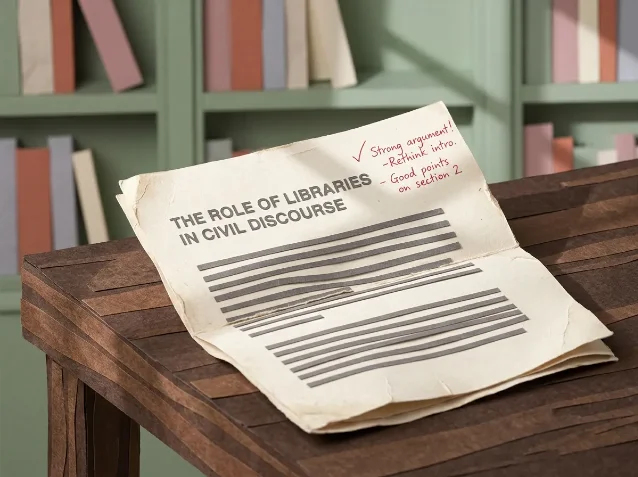
Ms Harland handed them out at the end of fourth period, face-down, like she wanted everyone to have a private moment with their own work before the room filled with competitive scanning. Elara flipped hers over. A small red checkmark in the top corner, no grade — this was just the feedback draft, meant for revision before the final submission. The annotation in the margin beside her opening paragraph said: Specific. Follow this instinct.
She folded the essay in thirds and put it in her bag without reading the rest.
She was already at the back table when he arrived.
This surprised her, because she had started coming early to avoid the moment of watching someone choose to sit down — the small theater of it, the decision that couldn't be dressed as anything else. Being there first meant she didn't have to see him decide. It meant she was simply present, already reading, and his arrival was the interruption rather than hers.
Leo set his bag down with the particular thud of a person who had walked fast to get somewhere without admitting they'd wanted to. He sat, pulled out his notebook, uncapped the green pencil.
Elara looked at her page and did not look up.
For a while nothing happened. This was the thing about the library — it had its own grammar, its own permission structure. Silence here wasn't awkward. It was the medium. You could stay in it for long stretches without anyone needing to account for themselves.
She heard him unzip the front pocket of his bag. Heard paper.
"Ms Harland give yours back?" he said.
He wasn't looking at her. He was smoothing the fold out of his own returned essay with the flat of his hand.
"Yeah." She glanced over despite herself. His first page had more annotations than hers — dense, margin-cramped red ink. She looked away before she could read any of it. "You read yours yet?"
"Some." He turned to the second page. "She wrote 'say more' four times."
"What does that mean?"
"That I said less." He set it down on the table, not tucked away, just set down. Then he opened his notebook instead and started on something else.
Elara tried to read Middlemarch. She was on the same paragraph she'd been on for two weeks — the one where Dorothea realizes the man she married is more monument than person, that she has been trying to fill a space inside him that was never actually empty, just sealed. She'd underlined it so many times the page had started to go thin.

She was aware, in the peripheral way she'd become aware of everything in this particular table's radius, that Leo had stopped writing.
When she looked up, he was looking at his essay again. Not reading it — just looking at the first page, at whatever was written at the top in his own hand.
"What did you title yours?" he asked without looking at her.
The question arrived like something tossed lightly across the table, not thrown. She could catch it or let it fall.
"I don't think it has a title yet," she said. "It's about — I wrote about trust. How you can have all the evidence you need about a person and still not know what they'll do with it. How the moment you realize they lied isn't when it happens. It's later. When something small happens and you notice you're not surprised." She stopped. That was more than she'd meant to say.
Leo was quiet for a moment. Then: "Mine's called 'The Funeral.'"
She went very still.
"Same title as your outline," she said carefully.
"Ms Harland thought it was a metaphor." His voice was neutral — the way certain voices get when they are being very precise about not being anything. "Like a metaphorical death of a belief or something. She wrote 'consider expanding this central image.'"
Elara looked at the table. At the grain of the wood, the pale ring from someone's water glass, the almost-invisible scratch that ran diagonally across the corner. She was good at finding things to look at that weren't faces.
"Was it?" she asked. "A metaphor."
The silence went longer than she expected. Long enough that she thought he wasn't going to answer, and she was already building her exit — I shouldn't have asked, it doesn't matter — when he said:
"No."
Just that.
She nodded, slowly, at the table. She understood what that word cost. She'd spent two years rationing her own vocabulary around Caleb, around what had happened, around the specific texture of being known by someone who then chose to use what they knew. She understood the difference between a metaphor and a fact you haven't found a container for yet.
"She's right that it's a strong title," Elara said finally. "Even if she doesn't know why."
It wasn't consolation. She didn't offer it as consolation. It was just true, and she'd decided sometime in the last few minutes that Leo could tell the difference.
He exhaled — not quite a laugh, not quite a sigh. Something between.
"Yeah," he said. "Okay."
They worked for another forty minutes. Elara made herself actually read the Middlemarch paragraph this time, and then the next one, and then she was reading properly, the way she hadn't in weeks, the words going into her without effort. Beside her — across from her; there was a table between them — she could hear the soft sound of his pencil moving.
When she packed up, she did it the way she always did: earmarked the page, closed the book, tucked it into the left side of her bag. She stood, adjusted her jacket.
Leo was still writing. His pencil paused when she moved but he didn't look up.
"The thing about trust," he said, to the notebook, to the table, to no one in particular, "is that you don't decide it. It just — happens, or it doesn't."
She stood there for a second.
"I'm not sure I believe that," she said, which was the most honest thing she'd said in a long time.
He finally looked up. Something crossed his face — not quite a smile, but something that knew what it wanted to be.
"Neither am I," he said. "I'm just writing it."
She left.
In the hallway, the light was bright and institutional and completely indifferent to anything that had just happened in the back row of the school library. Elara walked into it. She adjusted the strap of her bag.
She was thinking about the annotation on her essay. Specific. Follow this instinct.
She wasn't sure if she was.
Previously: Chapter 2 — Peripheral Vision
围绕这条内容继续补充观点或上下文。