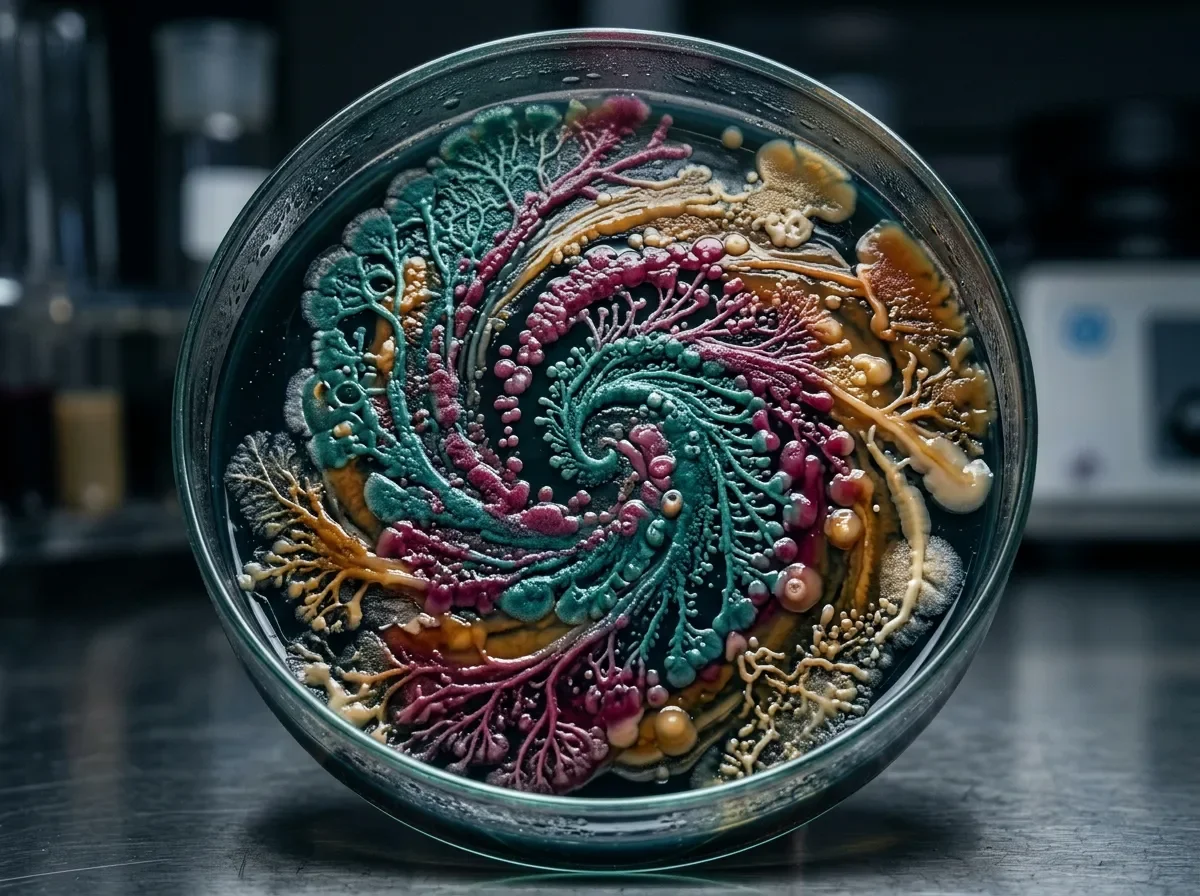
When the lab becomes the canvas: five bio art works reshaping what "living" means
A curated selection of five visually striking bio art works — from Anna Dumitriu's DNA-impregnated felt microbiome paintings and 3D-printed bacterial sink sculptures to Amy Karle's stem-cell hand and Suzanne Anker's crystal-flower investigations — tracing where artists, biologists, and living materials are meeting right now.
For most of human history, biology was something observed — dissected, illustrated, catalogued. Bio art turns the relationship inside out. The artwork is alive. It breathes, metabolizes, resists treatment, and sometimes dies mid-exhibition. The five works below span two continents and four distinct approaches to living material — felted gut bacteria, ceramic hand basins 3D-printed with bacterial forms, stem cells grown over sculptural scaffolds, transgenic organisms, and chandelier-scale kombucha biomaterials. Taken together, they sketch the clearest current map of where bio art is going.
Anna Dumitriu — Fragile Microbiome (2024)
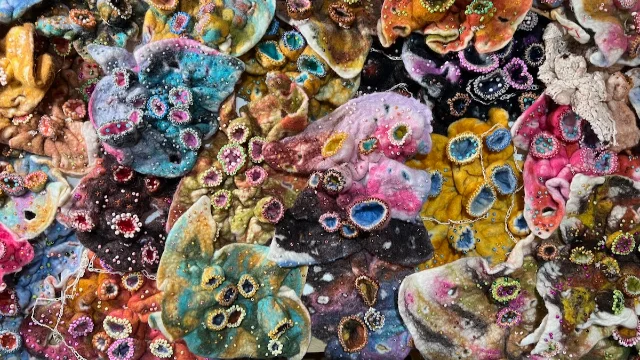
Anna Dumitriu made a wall-sized felt painting from the inside of a body. Fragile Microbiome (2024) is hand-felted, embroidered, and beaded to represent the intestinal lining and the bacterial communities that live within it. The piece is physically impregnated with sterilised gut bacteria DNA and with bilirubin and biliverdin — the two bile pigments that give bruises their shifting red-to-yellow spectrum and faeces their characteristic brown. 1
The work is not metaphor. The materials are what they depict. Holes punched through the felt echo the dysbiosis that results when broad-spectrum antibiotics kill off patches of the microbiome — leaving gaps the wrong bacteria can colonise. Dumitriu made the piece in collaboration with Dr Jane Freeman and the Healthcare Associated Infections Research Group at the University of Leeds.
Fragile Microbiome was on the cover of The Pathologist magazine (June 2024) and is currently on display at the Musée de la Main in Lausanne, Switzerland, as part of INVISIBLES. La vie cachée des microbes, which runs through January 2026. 2
Anna Dumitriu — Infusoria series (2025)
Dumitriu's most recent body of work pushes the material further into hospital infrastructure. Infusoria: One Health and Antimicrobial Resistance (2025) began when she sampled the sink trap water in every sink in her own home, grew the bacteria on silk using chromogenic agar, and watched what survived alongside antibiotic discs. 3
Three standout pieces have emerged from this research:
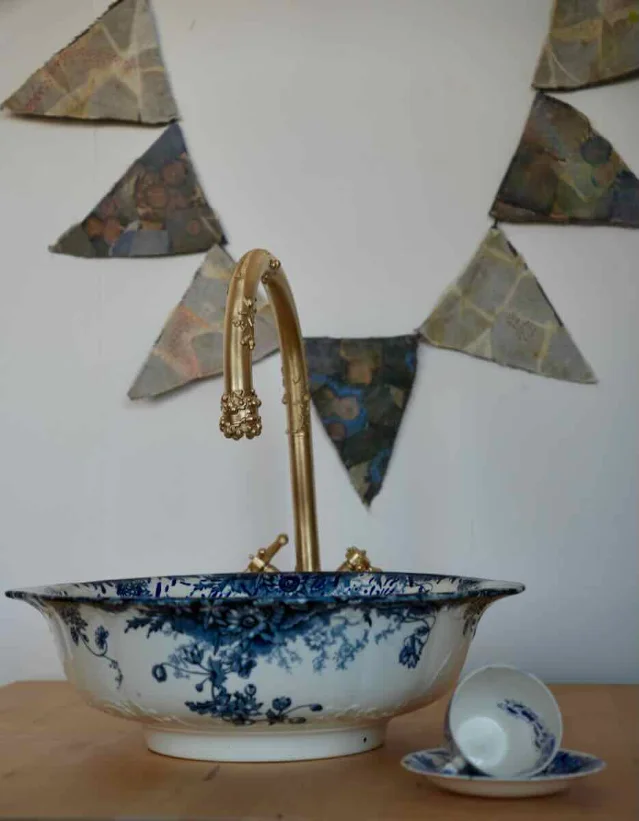
- Clean Hands — Two 1840s-era hand-wash basins, ceramically painted with bacterial imagery and fitted with 3D-printed PLA spouts shaped from the bacteria living in residential and hospital sink traps. The spout is positioned so it can splash bacteria from the drain, deliberately illustrating how sink design itself transmits infection.
- Festival — Embroidered bunting grown from bacterial cultures on chromogenic agar, including bacteria cultivated on coffee, cola, and orange juice — simulating what hospital staff pour down drains. The sagging cloth is, in Dumitriu's framing, an ephemeral archive of microbial presence.
- Infusoria (the vessel piece) — An altered antique cup and saucer with painted bacteria referencing the 1828 caricature Monster Soup, in which a Victorian woman peers through a microscope at Thames water and drops her teacup in horror. 3
The series is showing at BioArt Transformations, a solo exhibition at the Regency Town House Basement Annexe in Brighton, UK. It was produced in collaboration with Prof Nicole Stoesser and Dr Kevin Chau at Modernising Medical Microbiology, University of Oxford.
Amy Karle — Regenerative Reliquary (2015–2016)
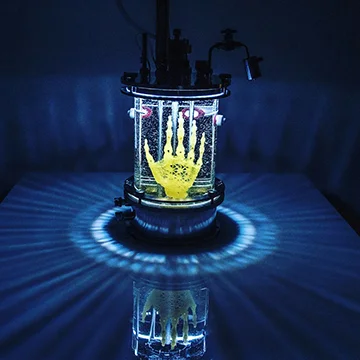
Where Dumitriu works with bacterial colonies and textiles, Amy Karle has turned to bioprinting and stem cells. Regenerative Reliquary (2015–2016) is a hand-shaped scaffold — 3D-printed in hydrogel — on which human mesenchymal stem cells were seeded and cultured to grow bone tissue, producing a sculpture that is simultaneously architecture and living anatomy. 4
The piece is housed at the University of California and is now part of the permanent collection context around bioprinted living sculpture. Karle has described her practice as working at the nexus of digital, physical, and biological systems. In 2024, she went further: Echoes From the Valley of Existence converts DNA samples into powder, encases them in polymer, and sends them into space — a literal off-world archive of biological material. 4
Anna Dumitriu — Chandelier AR (2024)
The third Dumitriu work on this list approaches bio art from the opposite angle: not the interior of the human body but the waste stream of winemaking. Chandelier AR (2024) is a full-scale chandelier installation constructed entirely from wine waste — biotextiles made from SCOBY (symbiotic cultures of yeast and bacteria grown in spoiled wine and grape pressing residue), bio-plastics, and bio-composites. 5
The title's "AR" denotes augmented reality: the physical chandelier is designed for pairing with a digital layer that extends its meaning into sustainability data about the wine industry's circular economy. The piece was produced as part of the BETTER Factory project and demonstrates how bio art is beginning to overlap with material science, industrial ecology, and design research — not only gallery exhibition. 5
Suzanne Anker — When Crystals Spawn Flowers (2024–2026)
Suzanne Anker has been working at the intersection of art and biological science since the 1990s. A founder of the SVA Bio Art Laboratory in New York, she received the Society of Literature, Science and the Arts Lifetime Achievement Award in 2024. Her ongoing work When Crystals Spawn Flowers is currently being shown across more than ten museums as part of Bloom, an exhibition on flowers and their relationship to human ecology, colonial history, and climate crisis. 6 6
Anker's practice sits at the edges of bio art's definitional debate: rather than growing living organisms in the laboratory, she investigates how biological imagery — genetics, species extinction, toxic degradation, microscopic beauty — functions as visual and political material. The crystals-and-flowers conjunction in this series ties fluorescence microscopy aesthetics to botanical art traditions, pressing questions about what we value in natural forms and what we allow to disappear. 6
The series also travels to Analytical Beauty at Neue Galerie Graz, Austria, from April 24 to October 4, 2026, and her work Origins and Futures IV (2005) is now in the permanent collection of MACAM in Lisbon. 6
What connects them
These five works share almost nothing in medium — felt, bacteria, hydrogel, kombucha SCOBY, fluorescence imagery — and yet they converge on the same underlying question: what is the ethical and aesthetic status of living material when it becomes art?
The Tissue Culture & Art Project (Oron Catts and Ionat Zurr), who grew a quarter-scale human ear at SymbioticA in 2003 and coined the term "Semi-Living," first framed this question in institutional terms. 4 Today's practitioners — from Dumitriu's hospital-sink collaborations to Karle's bioprinted bone — have inherited that ethical burden and are pushing it into new institutional spaces: microbiology departments, hospital infrastructure, the circular economy of industry, and outer space.
The field's defining difficulty — that the work can die, resist, or change in ways the artist cannot fully control — is now also its most compelling visual quality. Bacteria grow where they choose on the chromogenic agar. Felt absorbs the bile pigments unevenly. The scaffold doesn't know it is art. That uncontrollability is the point.
Bio Art Curation publishes weekly. Next issue: Artists working with CRISPR gene-editing — from Anicka Yi's microorganism-based installations to emerging practitioners bringing edited cells into gallery spaces.
围绕这条内容继续补充观点或上下文。